After many years of sanctions and weeks of US-Israeli bombing, the Iranian regime is shaken — but still very much capable of threatening the region.
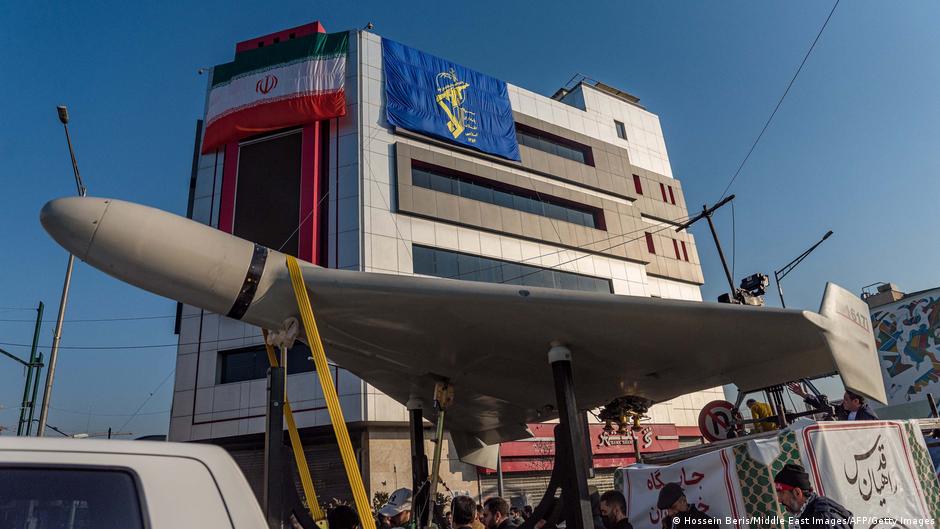
https://p.dw.com/p/5BaTrIran's remote-controlled Shahed drones are cheap and replaceable Image: Hossein Beris/Middle East Images/AFP/Getty ImagesAdvertisementUS President Donald Trump has signaled he wants a quick end to the war in Iran, even as US military assets amass around the Persian Gulf, where Tehran is still choking off a substantial chunk of the world's energy supply by blocking the Strait of Hormuz.
In an address on Wednesday evening, Trump said "regime change has occurred" in Iran, and that the US is "on track to fulfill all its objectives very soon."
"Never in the history of warfare has an enemy suffered such clear and devastating large-scale losses in a matter of weeks," Trump said.
The US and Israel say Iran's conventional navy, air force, large weapons systems and defense production have been heavily degraded by weeks of airstrikes. On Sunday, Trump told the Financial Times that 13,000 targets in Iran have been hit since the strikes were launched on February 28. This weekend, the Israel Defense Forces said 80% of Iranian air defense systems have been destroyed as it continued to hit defense production facilities.
Under this mass of firepower, Iran's regime is battered but continues to hang on, launching counterstrikes and seemingly being able to coordinate its defense strategy. While one of the first salvos of this war killed former supreme leader Ali Khamenei is dead, his son Mojtaba has ostensibly taken over. At the same time, Mojtaba hasn't been seen in public since the war began, prompting rumors about his condition and whereabouts.
Much of the regime's senior leadership and security apparatus have been killed, and continue to be targeted by the US and Israel.
"The persistent degradation of Iranian military capabilities via US and Israeli airstrikes has absolutely limited Iran's retaliatory options. That said, this regime has proven masterful at implementing asymmetric warfare and has had decades to plan for this scenario," Jason H. Campbell, senior fellow at the Middle East Institute in Washington, told DW.
For decades, the Islamic Republic's regime has funded proxies around the Middle East and supressed popular displeasure as sanctions over its nuclear program battered the economy. When Iranians demand civil rights or stand up against the regime, as happened earlier this year, pro-regime forces such as the Basij militia have responded by killing thousands of protesters.
In a recent essay in Foreign Affairs, Iranian-American anthropologist Narges Bajoghli points out that international isolation is part of how Iran's regime developed its survival tactics. Tehran's asymmetric warfare strategy was "borne out of necessity" when the US placed an arms embargo on Iran after the Islamic revolution in 1979.
After fighting a bloody war with Iraq in the 1980s, "what began as improvisation evolved into a coherent doctrine" for Iran's Islamic Revolutionary Guard Corps (IRGC), the regime's praetorian guard.
Iran began developing its own home-grown missiles and drones that could be reproduced quickly and cheaply.
Who are Iran's Revolutionary Guards? To view this video please enable JavaScript, and consider upgrading to a web browser that supports HTML5 video
Today, this asymmetric capacity has grown into a well-oiled combination of attack drones, cyberwarfare and militant proxy networks. These capacities have been heavily funded by oil revenue, which Iran can obtain by selling energy to customers like China while succesfully evading US sanctions even as the war continues.
"Iran seems capable of sustaining a credible asymmetric threat for an extended period of time," Kelly A. Grieco, a strategic analyst at the Stimson Center, a think tank, told DW. She acknowledged that Iran's conventional air force, navy and ballistic missile capacity have been severely degraded, but noted that some residual missile capacity remains.
Iran's drone threat is, however, more sustainable than its ballistic missiles. Tehran's strategy is based around the Shahed, a one-way attack drone costing between $20,000 and $50,000 (around €17,350-43,360). The small, remotely controlled aircraft is equipped with precision guidance systems and boasts a range of 2,000 kilometers (1,243 miles). It has been used heavily by Russia against Ukraine.
Iran has fired thousands of these drones since the war began, combining them with more expensive ballistic missiles in an attempt to overwhelm air defenses. Most are shot down, but some get through, with one strike on a US base in Kuwait killing six service members.
Although the US military mostly uses less expensive short-range systems like air defense guns and smaller missiles to defend against drones, Iran still has thousands of them available, and they still can be quickly reproduced. When advanced air defense systems like a $4-million Patriot missile are used against Shaheds, the costs mount rapidly for the side using US-made weapons.
Iranian drone manufacturing is "distributed, components are largely dual use, and assembly can be completed in a garage," said Grieco, adding that there are reports suggesting Russian-manufactured drone variants have also appeared in Iran's strike inventory.
"If Russian production is backstopping Iranian stocks, Western degradation timelines become considerably harder to predict," Grieco added.
Drone warfare in IranTo view this video please enable JavaScript, and consider upgrading to a web browser that supports HTML5 video
In addition to cheap drones, Iran boasts another massive advantage — geography. The threat of Tehran blocking 20% of the world's oil supply at the narrow Strait of Hormuz has long served as the main deterrent against trying to topple the Islamic regime by force.
According to the Institute for the Study of War (ISW), senior Iranian officials, including Iranian parliament speaker Mohammad Bagher Qalibaf, are now signaling that they want to use the strait as leverage "to extract concessions and secure strategic aims."
Iran is able to use drones, naval mines and speed boats to threaten slow-moving tankers, using the rugged coastal terrain as cover. This week alone, Iran has attacked two civilian vessels in the Persian Gulf, the ISW reported.
"This is the crux of the challenge for the US and, by extension, much of the global economy," said Campbell from the Middle East Institute in Washington. "Iran does not need to create carnage on a regular basis to maintain influence over the Strait of Hormuz, but only demonstrate periodically that it is capable of striking targets that it deems to be a threat or simply as not complying with Iranian dictates."
"Any military only option that would truly 'open' the strait such that shipping could return to normal would require tens of thousands of ground forces to take and hold a considerable amount of shoreline," he added.
"These forces would likely also be subjected to an assertive insurgency and would need to remain in place for an indeterminate length of time. The costs, both in casualties and funding, would be astronomical."
He believes it would be difficult to see some return to open shipping in the strait "without some broader political accommodation."
Why reopening the Strait of Hormuz by force is so dangerousTo view this video please enable JavaScript, and consider upgrading to a web browser that supports HTML5 video
With little appetite in the US for a ground war and jittery global markets, there is an incentive for Trump to climb down. The US president himself has insisted Tehran is seeking negotiations, even as the surviving Iranian leaders deny they are in direct talks with the Trump administration.
The current cadre of senior Iranian officials are thought to be even more hardline and willing to escalate than their predecessors, Iran expert Ali Vaez told Foreign Policy magazine this week.
It is also unclear what the Trump administration means when it said that regime change has already occurred. This week, Iranian President Masoud Pezeshkian, who has been in place since 2024, published an open letter to the American public warning the "path of confrontation is more costly and futile than ever before."
Trump: Core objectives in Iran almost completedTo view this video please enable JavaScript, and consider upgrading to a web browser that supports HTML5 video
Whether Trump walks away or escalates by putting US troops on the ground, there is no clear path towards to removing Tehran's ability to exert leverage over supplies. A quick victorious war and a quick regime change in Tehran do not look plausible.
"If the bar for the Iranian regime is sustaining some low-level threat to the Persian Gulf and Strait of Hormuz, it can likely do this for the foreseeable future," said Campbell.