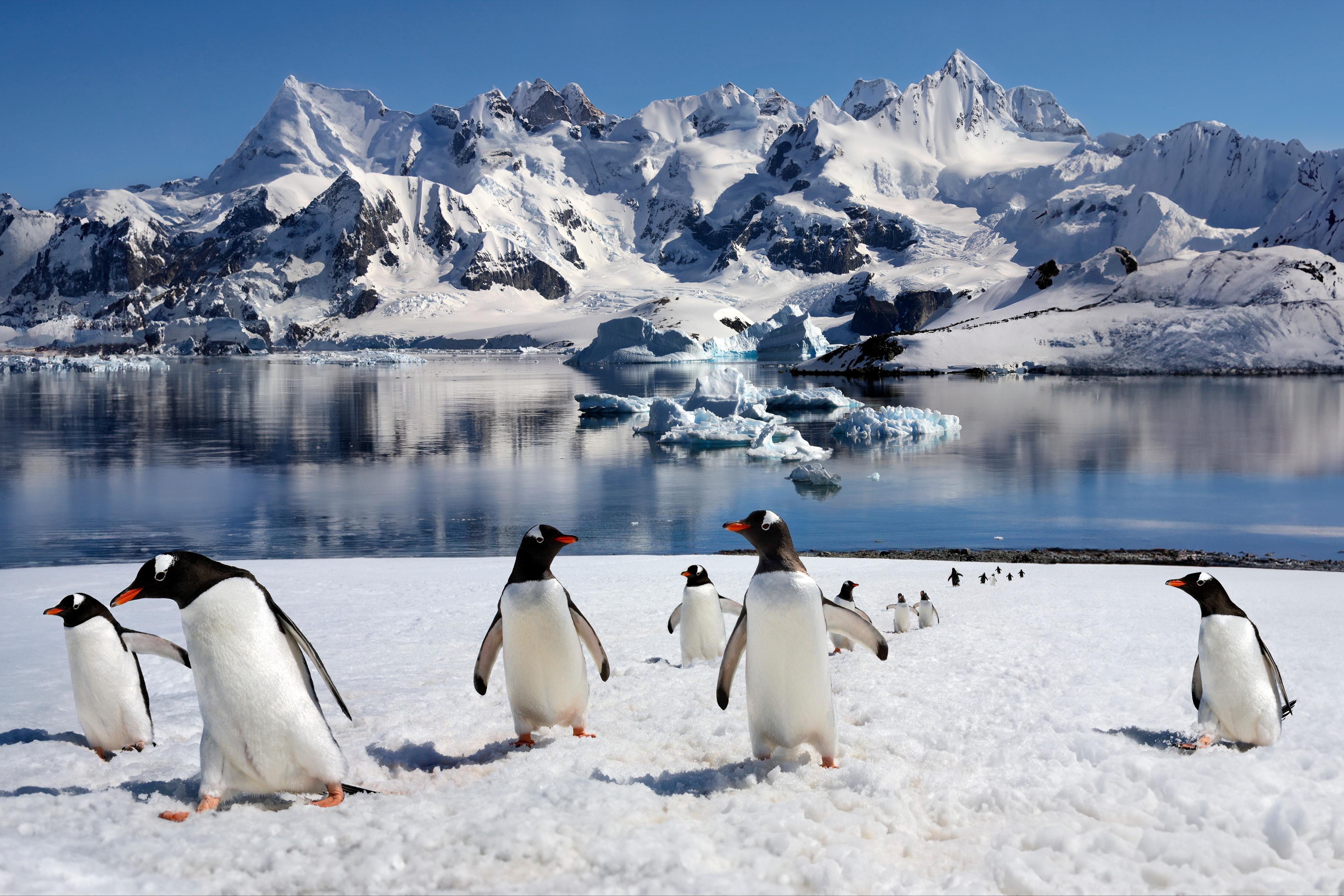
Make New York Post a Preferred Source Two dirty Gentoo penguins stand on a rock in Antarctica, Thursday, Dec. 1, 2016. Anton - stock.adobe.com Crappy feet.
While humans might be mostly to blame for Antarctica’s snow melt, scientists are pointing to another surprising source of the a-thaw-calypse — penguin poop.
Per the study in the Journal of Geophysical Research: Biogeosciences, these flightless birds’ droppings are fertilizing algae blooms across the Antarctic Peninsula.
Scientists believe that penguins’ poop-tracking habits could be accelerating Antarctic greening. evenfh – stock.adobe.com The penguins track fecal matter across the ice during their marches, prompting the spread of green snow that melts faster than its white counterpart. In turn, this bloom contributes to the rising temperatures that thaw the snow, further accelerating the greening of the frozen continent.
“The link between wildlife, nutrients, and snow algae is a critical missing component in projections of expansion of ice-free areas in Antarctica,” the study’s senior author Alia Khan, a cryosphere biogeochemist at the University of Colorado Boulder, told Phys.org. “Without accounting for these biological darkening effects, we are likely underestimating how rapidly coastal snowpacks are melting and how fast ice-free terrain will expand across Antarctica.”
This comes as the world’s largest penguin colony — a group of over 1 million chinstraps on the Zavodovski Island — saw its numbers cut in half last year as rising sea temperatures drove their food sources away.
To get to the bottom of this odiferous situation, Khan and her team focused on Antarctic snow algae, which changes color depending on conditions.
When nutrients are scarce or conditions are inhospitable, the plants stop growing and emit red pigments to shield themselves from the sun. When nutrients are plentiful, the algae load up on green pigments like chlorophyll so they can facilitate photosynthesis and bloom as much as possible during the short Antarctic summer.
Chinstrap penguins walk up a glacial ice cap on Half Moon Island, South Shetland Island, Antarctic Peninsula, Monday, Nov. 28, 2011. MC Photos – stock.adobe.com As this green snow absorbs 40% more energy, it ramps up the rate of melt.
By collecting and analyzing the algae — “stinky work” that required the researchers to work near penguins that were constantly tracking their poop everywhere, per Khan — the team found that the green algae harbored guano.
“This finding links the marine food web to snow ecology,” the researcher declared. “The penguin guano acts as a fertilizer … that fuels these dense green snow algae blooms.”
This marked the first time that someone had established a link between penguin excrement and the algae’s life cycle. With penguins waddling further South amid changing conditions, researchers fear that this greening could expand along with them.
However, more research is needed to determine exactly how much the critters’ green thumb — err … bum? — is affecting the Antarctic snowpack.
Interestingly, prior research has shown that penguin poop — which coincidentally contains high levels of “laughing gas” — could actually slow the frozen continent’s recession.
Finnish researchers found that volatiles from penguin dung help form clouds, which block out the sunlight that heats up the Antarctic.
However, the exact impacts on the climate remain unclear.