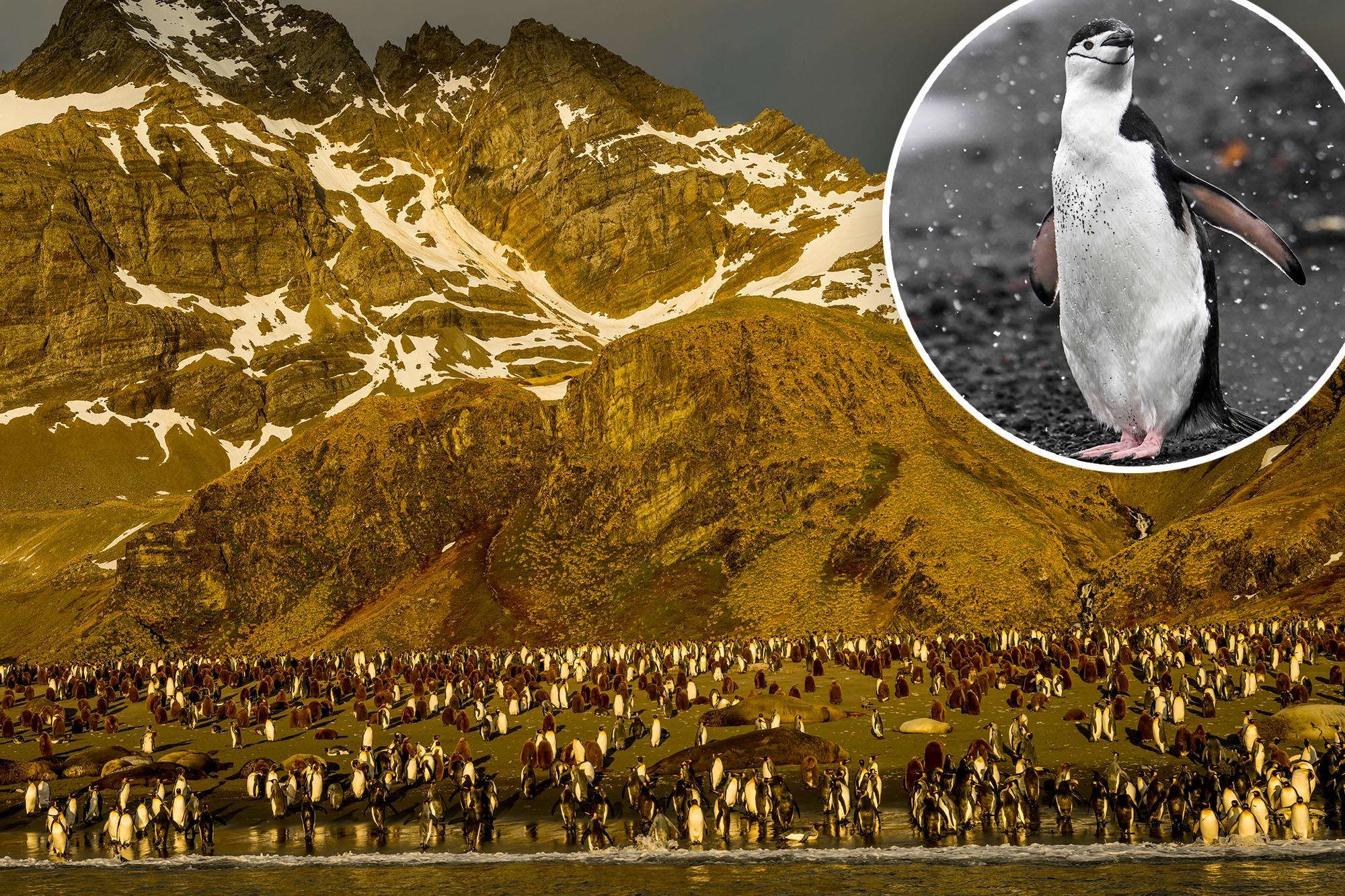
Make New York Post a Preferred Source The (former) world’s largest penguin colony on Zavodovski Island has lost its long-held title following a dramatic population collapse.
Research by the British Antarctic Survey (BAS) shows chinstrap penguins on the remote volcanic island suffered a severe decline from around 1.09 million breeding individuals in January 2011 to just 402,000 in 2025 — a drop of nearly two-thirds occurring at a sharp 7% annual rate. Lead study author Norman Ratcliffe described the decline as “very rapid.”
Because of this steep drop, Zavodovski Island has lost its distinction as Earth’s largest penguin colony – a title that now belongs to the Adélie penguin colony at Cape Adare on the opposite side of Antarctica, which was estimated to number over one million birds as of 2018.
BAS researchers attribute the collapse to human-driven climate change, noting that climate-driven changes near Antarctica have upended ocean food chains.
Winter temperatures around the Antarctic Peninsula have surged by 5°C above pre-industrial levels, marking one of the fastest warming rates on Earth. “We think that climate change operating through food webs is probably the main driver,” Ratcliffe said about the population decline in the study.
Rising ocean temperatures have pushed Antarctic krill — the tiny shrimp-like crustaceans that serve as the chinstraps’ primary food source — further south into colder waters that chinstraps do not tolerate. As a result, the birds face a life-threatening dilemma: follow their food into unsuitable habitats or remain and risk starvation.
Because chinstrap and macaroni penguins – Zavodovski’s other inhabitants – thrive in different temperature ranges, warming waters affect them differently. The local macaroni penguin population on
Zavodovski grew from roughly 338,000 in 2011 to 433,000 in 2025, now outnumbering the chinstraps. Together, the two species still total more than 835,000 birds on the island.
Summarizing these ecological changes, the BAS study concluded: “The most plausible explanation for the observed patterns of population change is that a climate-induced regime shift has occurred that has been detrimental to the maritime Antarctic chinstraps but has favored the subantarctic macaronis.”
To measure the full scale of the decline, BAS researchers sailed 15 days to reach the remote island and deployed drones over the colony. In a video released on social media, the BAS detailed how chinstraps may now qualify as an endangered species.
Zavodovski Island, dominated by Mount Curry and its volcanic ash plains, is typically blanketed by penguins, with the South Sandwich Islands hosting 38% of the global chinstrap population. However, rising ocean temperatures continue to pose a grave threat to their long-term survival.
Researchers ruled out local volcanic eruptions as the cause of the decline. Despite initial fears when Mount Curry erupted in 2016, satellite images and field measurements showed that the main ash cloud blew northeast, away from the core nesting grounds. The prevailing macaroni penguin species was further proof that the eruption was not the downfall of chinstraps.
“The decline in chinstrap colony area was in progress prior to the eruption and continued at a constant rate thereafter,” the BAS study noted. Ratcliffe added, “We don’t think the volcano is implicated or it’s not the main driver because what we see is a linear decline in the chinstrap penguins.”