Centauri Minerals Mobilizes for First Drilling Program at Rio Grande Gold-Copper Project Since 2013 Centauri Minerals Inc. Tue, October 13, 2026 at 9:39 AM EDT 10 min read CENT.V -1.55% GC=F +0.46% HG=F +0.04% Centauri Logo VANCOUVER, British Columbia, Oct. 13, 2026 (GLOBE NEWSWIRE) -- Centauri Minerals Inc. (TSX-V: CENT) ("Centauri" or the "Company") is pleased to provide an update on exploration activities at the Rio Grande gold-copper project ("Rio Grande") in Salta province of Northern Argentina.
Progress and Execution Highlights Include:
Completion of the geophysical program at the Rio Grande gold-copper project identifies new drill targets for both near surface resource expansion and potential mineralization sources at depth.
Mobilization continues with full refurbishment of historical camp at Rio Grande to support the first new drilling programs since 2013:
The Phase 1 program targets 12,000 m of diamond drilling, with two drill rigs from a local provider being mobilized to site this month.
The first rig will focus on near surface exploration to expand the understanding of known resources and for collection of new samples for future engineering/metallurgical test work.
The second rig will focus on deeper targets identified from the integration of the historical and recently acquired geophysics, which could help identify potential generative sources of the mineralized system at Rio Grande.
The Phase 1 program is expected to take approximately 6-months (into Q2 2027), at which time Centauri will evaluate findings and has funded optionality to continue towards 24,000 m with two-rigs or further ramp up activities as part of a Phase 2 program.
Recent exploration team additions are supporting ramp-up of drilling at Rio Grande as Centauri's immediate priority, however new fieldwork initiatives have commenced at the other portfolio projects; Aguas Calientes, Catua, and Frontera (subject of a future press release).
Sam Leung, Chief Executive Officer and Director of Centauri, commented:
"One month into Centauri as a public company, we are pleased with the promising target generation results that support mobilization and ramp-up to drilling at Rio Grande, which is in full swing on the ground in Northern Argentina. Our first priority is drilling at Rio Grande, but we have also begun parallel preparations for exploration across our earlier stage portfolio in the region. Our team appreciates the continuing investor support as we work hard to begin a steady pace of results driven catalysts in the weeks and months ahead."
Geophysical Program & Drill Target Generation at Rio Grande
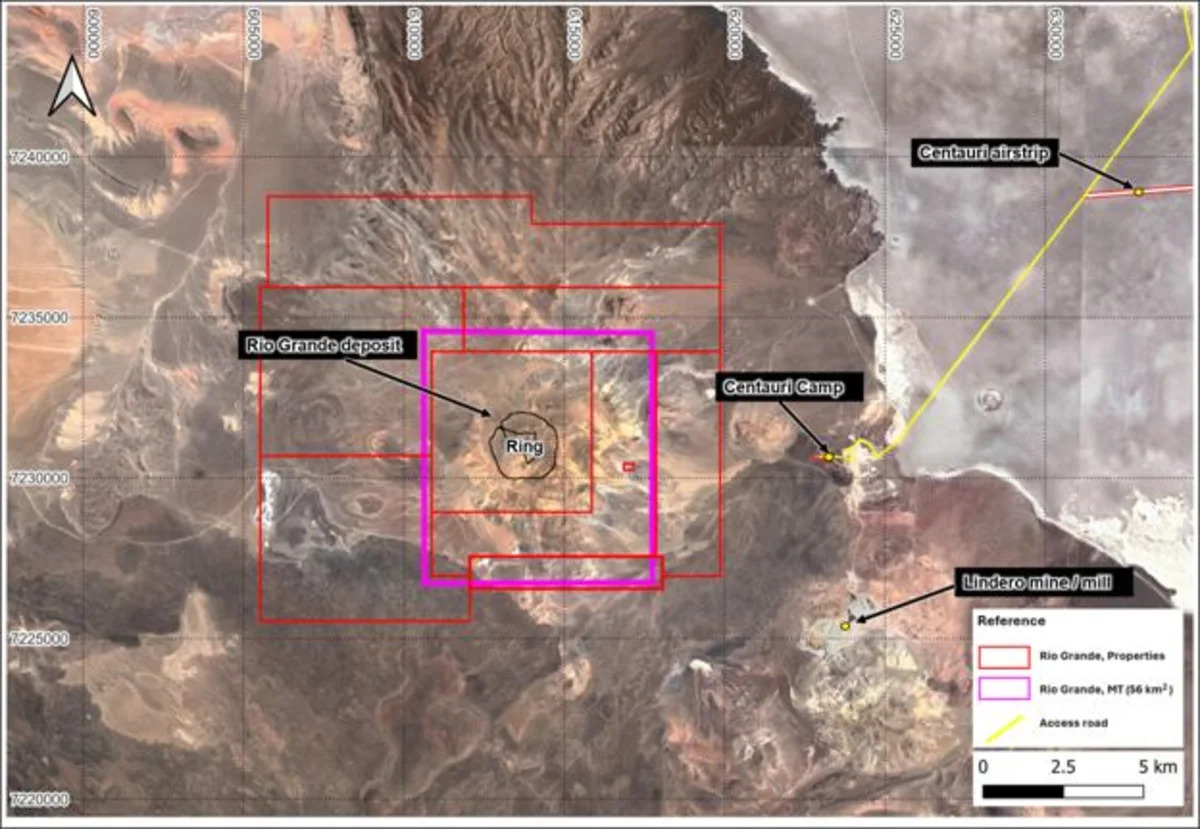
In the third quarter of 2026, Centauri completed a 3D Magneto-Telluric ("MT") survey on Rio Grande which covered an area of approximately 56 km2 (Figure 1), combined with a reprocessing review of historical geophysics, geochemistry, and geological mapping in order to define drill targets for; (a) shallow areas with near-surface resource expansion potential, and (b) high-priority porphyry targets at depth that aims to confirm the potential of a larger-scale gold-copper-silver system.
Figure 2 is a plan view map that summarizes the results of Centauri's latest interpretative model which highlights shallow zones of higher resistivity vectoring towards the southwest and northeast of the known mineral resources at Rio Grande. The shallow Phase 1 drilling program will evaluate infill areas where the geological, geochemical, and geophysical data show greater potential to expand the existing Mineral Resource Estimate (MRE), as well as to improve understanding of current estimated pit shell models and where extensions may be possible.
Figure 3 is a sectional view of these consolidated results at Rio Grande, with resistivity signals highlighted. A large low-resistivity (i.e., high-conductivity) target area measuring over 1.3 by 2.0 km appears to be located beneath the currently known ring-shaped mineralization that defines the Rio Grande deposit.
This distribution of low resistivity (i.e., high-conductivity) may relate to a predominantly intrusive setting in the central area which transitions outward to higher resistivity that could be volcano-sedimentary dominated rocks toward the peripheries and/or to alteration zoned concentrically outwards. The 3D inversion modelling presents a central domain of moderate-high resistivity (nominally >100 Ωm) open to the east, partially ringed by moderate-low resistivity (nominally