On the eve of Hungary's elections, Prime Minister Viktor Orban's government has been rocked by an espionage scandal. The intelligence services are said to have tried to infiltrate the opposition Tisza Party.
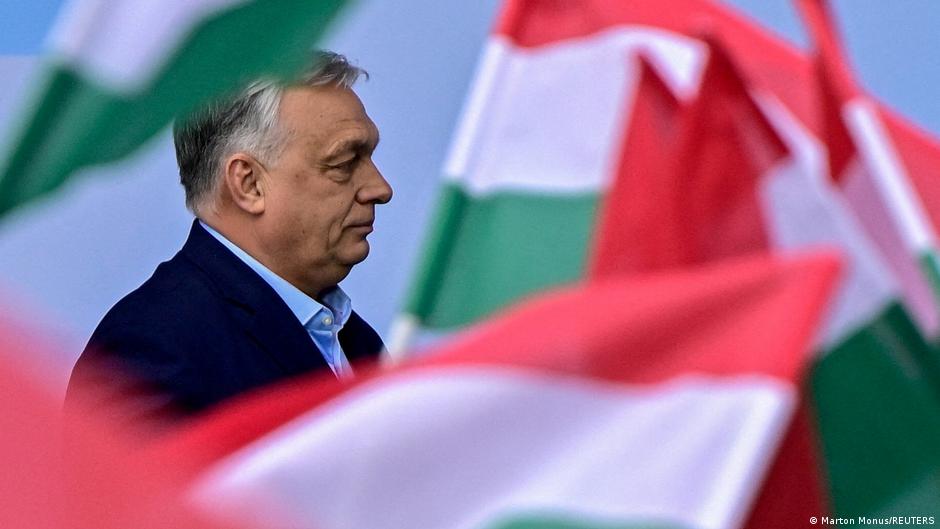
https://p.dw.com/p/5BXCbThe latest revelations have put mounting pressure on Hungarian Prime Minister Viktor OrbanImage: Marton Monus/REUTERSAdvertisementThe Hungarian election campaign has been in a frenzy for weeks, but this latest scandal has shocked even the most cool-headed observers. Many have described it as a "return to dictatorship and Communist times."
Last week, it emerged that Hungary's Constitution Protection Office (Alkotmanyvedelmi Hivatal), one of the country's five intelligence services, is believed to have tried to infiltrate the opposition Tisza Party with the aim of obstructing its participation in the elections, or at least minimizing its chances of success. The intelligence service is said to have tried to recruit technicians in charge of maintaining the party's IT system, in order to access internal party information and use it to rig the election.
The operation is said to have started in July 2025. It was already apparent by then that the Tisza Party was a real threat to Prime Minister Viktor Orban. Tisza is currently well ahead of Orban's Fidesz party in the polls, and is predicted to win the parliamentary election on April 12.
There is no evidence that the Hungarian leader ordered the operation himself. However, the Constitution Protection Office reports directly to the prime minister's office. And the Hungarian government has not denied the revelations; instead, it has described the intelligence services' actions as a response to an alleged Ukrainian espionage attempt, though it does not say what exactly this was.
The story was broken by the Hungarian investigative portal Direkt36, in an article published on March 24. This reported on the alleged operation by the Constitution Protection Office. The following day the same journalists' collective, which is renowned in Hungary for the high standard of its investigations, published a video on YouTube: a 90-minute interview with Bence Szabo, a former police captain with the National Bureau of Investigation (NNI), who goes into all the details of the case.
Szabo was a senior investigator in the NNI's cybercrime division specialising in online child pornography. Shortly before the video was published he handed in his resignation, and he has since been fired.
Szabo says that in July 2025 the Constitution Protection Office, which is not authorized to conduct its own investigations, put pressure on his department to investigate an alleged case of child pornography and seize computer hardware from the two suspects. It soon became apparent that neither suspect had anything to do with child pornography. Instead, they were responsible for maintaining the Tisza Party's IT system.
The background to this operation appears to be that the Constitution Protection Office had previously tried and failed to recruit the two men to spy on Tisza, and was afraid they would expose what it had done. It was also apparently still determined to access Tisza Party data. And after the two individuals' hardware was seized, the intelligence services did indeed have data from it copied — without authorization.
Last autumn, the Tisza Party app made headlines when the personal data of around 200,000 supporters was leaked and made public. Orban's government and his Fidesz party accused Ukraine of being responsible for the breach, because the app had been developed by Ukrainian IT experts. According to Bence Szabo's testimony, it now appears that the breach was in fact orchestrated by Orban's apparatus of power.
In the video, Szabo goes into great detail about the operation, which was conducted over several months. He explains what motivated him to become a whistleblower, saying that he had informed his superiors that it was a politically motivated operation, but all his warnings were dismissed or not acted upon. At one point, he says, he even defied an order to "find" incriminating material on the two supposed suspects.
Szabo says he ultimately took the information to the media because he couldn't find anyone in the state apparatus who would listen to him. "I swore an oath," he says in the video. "I want to serve my country, not a specific group of people, like a party."
So far, the video has been watched by 2.5 million people. And no wonder: It describes an exceptionally serious case of abuse of power. The investigative journalist Andras Petho, co-founder of Direkt36, also helped to research the report. He told DW it has raised "serious questions about the independent, politically neutral work of the Hungarian government agencies and intelligence services."
The political scientist Miklos Sukosd compares the current situation with the end of the dictatorship in 1989–90. He concludes: "In 1989, the former state party did not resort to every means possible to cling to power, and did not make use of an intelligence service to bring down an opposition party. In the spring of 2026, the situation is different. Fidesz is not willing to hand over power, and it is not abiding by the rules of democracy."
Several government politicians have portrayed the case, dubbed "Hungary's Watergate," as anti-espionage measures taken against Ukraine. One of the accused is described, without evidence, as a Ukrainian spy. At the weekend, the Orban government took the unprecedented step of publishing a video on its Facebook page of the 19-year-old's interrogation by the Constitution Protection Office. Meanwhile, Bence Szabo has been charged with misconduct in public office.
As if that were not enough, the government has also filed espionage charges against another journalist, the investigative journalist Szabolcs Panyi, whom they also describe as a "Ukrainian spy." In recent weeks, Panyi had published a number of reports detailing secret ties between Russia and the Hungarian government. He described the espionage accusations as "absurd."
Szabo is being enthusiastically celebrated by the anti-government segment of the Hungarian public. Peter Magyar, the Tisza Party leader and head of the opposition, even threatened the Orban regime: "If you touch a single hair of his head, you will have the people against you."
In a further interview, Szabo commented that he didn't consider himself a hero. He gives the impression of being an unassuming official whose oath of office was an article of faith, and who is deeply troubled that he was instructed to act in contravention of it.
So far, Orban has not commented on the case directly. In a video, he called on the Ukrainian president, Volodymyr Zelenskyy, to "summon his agents back home," but did not specify who was meant.
But at an election campaign event on March 29, Orban made an enigmatic threat in the military language he tends to favor. "I still have a few left bullets in the magazine that I can use," he said.
This article was originally published in German.