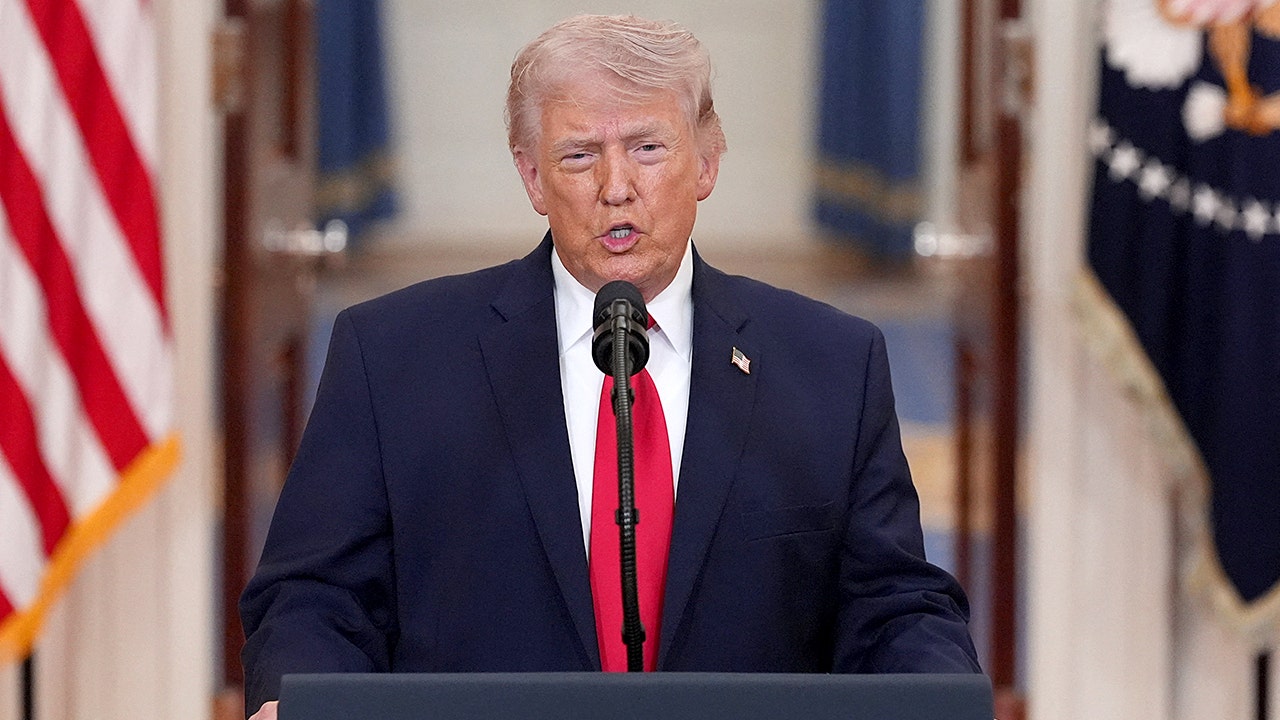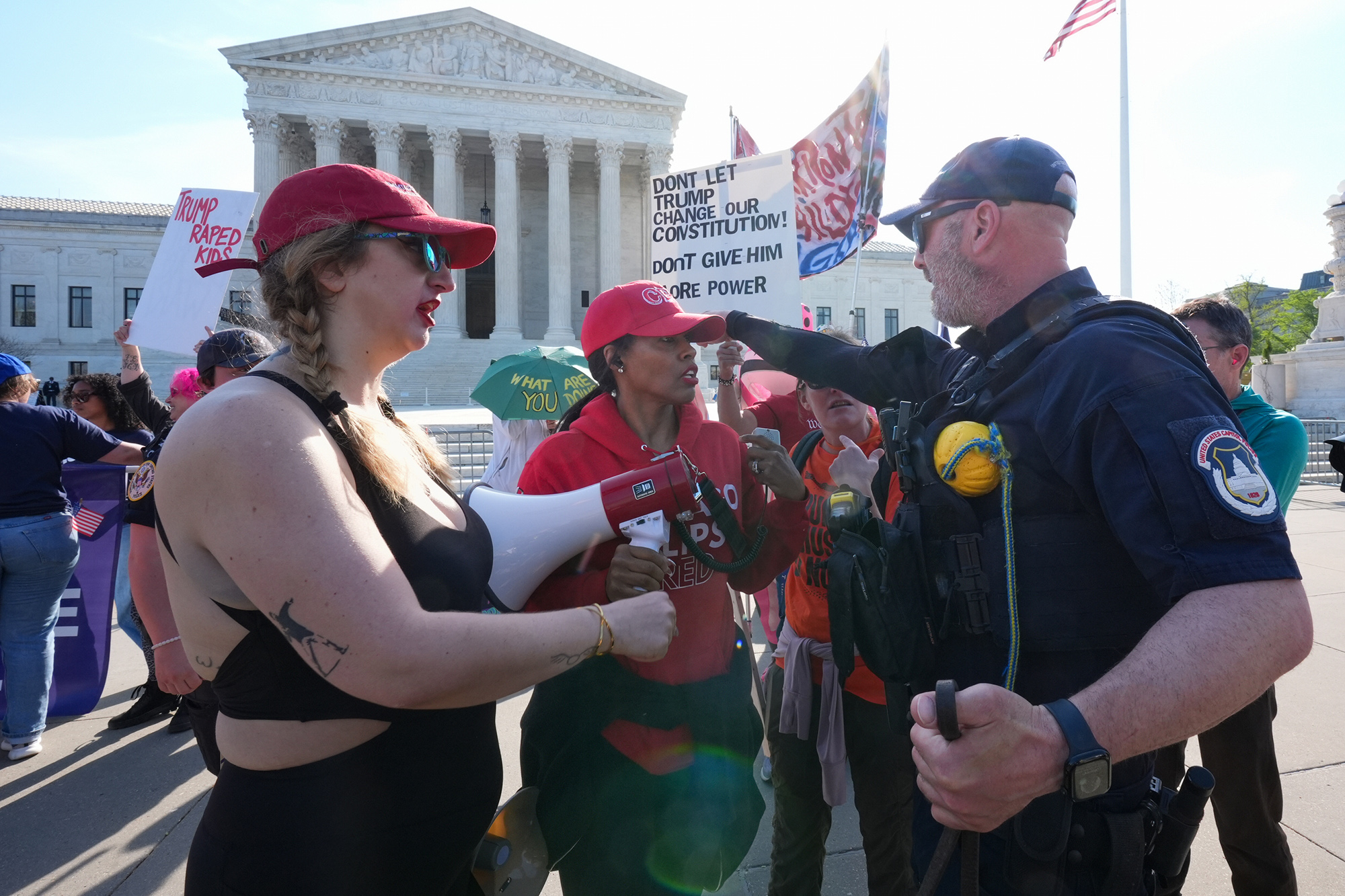
A U.S. Capitol Police officer steps in to calm tensions between a supporter of birthright citizenship and a pro-Trump demonstrator outside of the Supreme Court building. AP When President Trump left the courtroom midway through the argument in the case challenging his birthright-citizenship executive order, he was signaling what all of us following the argument were feeling: the administration was going to lose.
Of course, that was the conventional wisdom going in, which is probably why Trump has been so negative on the court, culminating in a Tuesday press conference where he announced that he’d come to the argument.
Trump’s presence was a big deal — the first time a sitting president has ever attended a Supreme Court argument — but it didn’t affect the argument.
It showed how important this case is to the president’s agenda, but his policy arguments in response to historic levels of illegal immigration and birth tourism, popular as they are, didn’t seem to change any justice’s vote.
Which isn’t to say that there were no surprises.
The smart bet going into the argument was that the court would take an “off-ramp” that would allow it to avoid deciding whether the 14th Amendment requires birthright citizenship for children of illegal aliens and temporary visitors.
The relevant provision states, “All persons born or naturalized in the United States, and subject to the jurisdiction thereof, are citizens of the United States” (emphasis added).
But it’s unclear what “jurisdiction” means, particularly given that neither illegal immigration nor birth tourism existed at the time of the 14th Amendment’s ratification in 1868.
There was thus much discussion of “allegiance” or “domicile” both technical legal terms that could shift depending on a person’s state of mind or intent to remain in the country (or not).
Those who claim that the administration’s legal arguments are frivolous or borne of xenophobic malice are simply wrong: These are hard questions and live disputes.
But regardless, it very much looks like the justices will bite the bullet and rule squarely on the constitutional issue.
For example, late in the ACLU’s argument for the challengers, Justice Brett Kavanaugh asked about a potential resolution on statutory grounds — that Trump’s executive order goes against existing law, implying Congress could change birthright citizenship rules — but there seemed to be little appetite for that kind of compromise.
Other key justices expressed significant skepticism of the administration’s position.
Chief Justice Roberts called Solicitor General John Sauer’s examples of historic exceptions to birthright citizenship “quirky.”
Justice Neil Gorsuch characterized Sauer’s supporting authorities as “Roman law,” while stumping Sauer — who otherwise performed better than the ACLU lawyer representing the challengers — with a question about whether Native Americans (who were made citizens by the Indian Citizenship Act of 1924) would still be citizens under his approach.
Justice Amy Coney Barrett said reinterpreting existing law and practice would be “messy in some applications.”
With only two justices, Clarence Thomas and Samuel Alito, showing themselves to be in the administration’s camp, there doesn’t seem to be a way that the executive order can survive.
But we could end up with a splintered decision, with plenty of concurrences on the finer points of ratification debates, precedent — especially Wong Kim Ark, the 1898 case granting citizenship to the children of noncitizen permanent residents — and statutory interpretation.
President Trump won’t like that at all, but it could be a winning issue for Republicans in the midterms, energizing not just the base but those many independents for whom immigration is a decisive issue.
Ilya Shapiro, director of constitutional studies at the Manhattan Institute, writes the Shapiro’s Gavel newsletter.