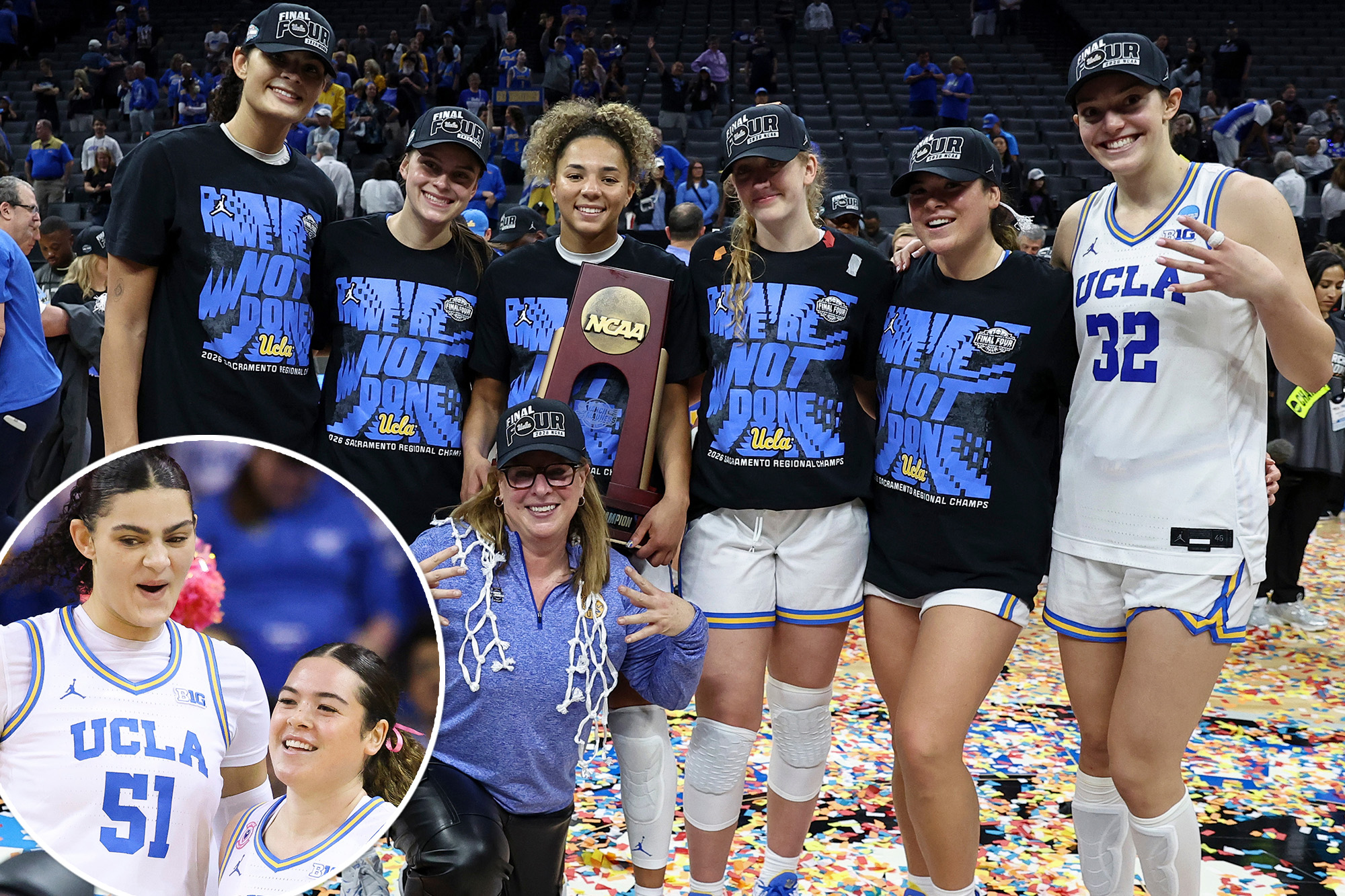
Each UCLA women’s basketball starter bolts from her seat on the bench during player introductions, racing toward teammate Timea Gardiner to commence a personalized routine.
Point guard Kiki Rice spreads her arms for a pat down because she has so many tools in her arsenal. Center Lauren Betts makes the Kobe Bryant clear-out hand gesture. Point guard Charlisse Leger-Walker balls her fingers into circles, a nod to her court vision.
There’s more delight to come after games, so much to celebrate for a team that’s sustained only one loss on the way to a second consecutive Final Four.
Players dance on the court, in the locker room – and even at halftime of a Bruins men’s basketball game. Coach Cori Close once stopped a practice so that Betts and sister Sienna could show everyone a routine they remembered from childhood.
Close sometimes busts out her own moves, getting down to commemorate reserve guard Megan Grant’s first basket.
“It was like kind of shocking just to see her dance like that,” Lauren Betts said with a laugh. “I was like, ‘OK, coach Cori.’ ”
What’s seemed like one Big Dance marathon has also included more subtle, serious moves.
In perhaps her greatest coaching feat, Close has nimbly balanced joy and tension in getting her team back to college basketball’s biggest stage. She’s done it so well that the stressful part often gets lost amid all the revelry.
“I just think this has got to be an incredibly fun experience while we’re pursuing our craft at the highest levels,” said Close, whose Bruins (35-1) will face fellow top seed Texas (35-3) in a national semifinal Friday evening at the Mortgage Matchup Center.
“I don’t think at any level, whether you’re in the WNBA Finals or you’re in the Final Four competing for a national championship, I think there’s still room for both. And I hope we don’t ever lose sight that this is supposed to be a really fun, life-changing experience.”
Contrary to appearances, there have been times when the veteran coach isn’t all about having fun. Just ask Lauren Betts, the superstar who doesn’t get to do whatever she wants just because of her superior talent.
“She’s hard on me every single day and annoys me at times,” Betts said of her coach, “but I know it’s because she loves me.”
Among other things, Close demands growth. She makes everyone commit to difficult habits, forming a culture of relentless improvement that is reflected in players voluntarily staying before and after practice for extra work.
And she can be a pain to deal with during the portion of practice when she’s teaching how to handle special situations like end-of-game shots.
“I’m an absolute jerk in those,” Close said, “because it’s hard to create the feeling that they’re going to have, you know, just the state change that happens internally. So I just try to make it as uncomfortable for them as they possibly can be in practice.”
Close strives to maximize each player’s strengths based on their personality while upholding the same standard. For some players, that means a more lighthearted approach. For others, it means turning up what Close called their “warrior dial.”
It’s an art form that Close learned in large part from Michaela Onyenwere, the UCLA assistant coach known for having a goofy disposition when she played for the Bruins.
“When she was a freshman,” Close said, “I was like, she is just not locked in. And … she was one of the most intense players when that tip came up, but she was at her best when she had that kind of lightness and joy. And I think I realized that I needed to adjust, in that you have to develop genuine relationships and really get to know your players.”
Close fosters a growth mindset, having players write in journals about what they learned from each experience and how it might help them in the future. She tells players to focus on the response rather than the event, knowing that what happens is often out of their control.
“It could be a bad shot,” Close said. “It could be a lack of rhythm. It could be your nerves. Instead of focusing on the events, focus on the response. We want to strengthen our ‘R’ to be stronger than any ‘E’ we’re going to have to face.”
One of Close’s mantras is talking to yourself rather than listening to yourself, the point being that one’s internal dialogue can skew toward the negative. It’s an approach that the coach used at halftime last weekend with her team trailing Duke by eight points in the Elite Eight.
“Stuff comes in, doubts come in, all these things,” Close said. “And literally I was going into the locker room talking to myself going, they’ve got this, be solid, stay really steady for them. I was literally just talking to myself, like, hey, we just gotta regroup here.”
That’s exactly the way it played out. The Bruins went on to outscore the Blue Devils by 16 points in the second half of a runaway victory.
Rice said she appreciated having a coach who tilted toward upbeat even while demanding excellence.
“I think she’s made a big effort this year to be hard on us, to hold the standard every single day, to hold it high, to keep on us if we’re not living up to the standard,” Rice said, “but also to celebrate things when they need to be celebrated and pick us up and have joy when that’s needed.”
That emotion could be felt in a TikTok dance that Leger-Walker performed last weekend in the locker room alongside Gabriela Jaquez, their elation spreading to teammates and a legion of social media followers.
“It’s just kind of easy,” Leger-Walker said, “when you’re surrounded by people who also love to do that.”