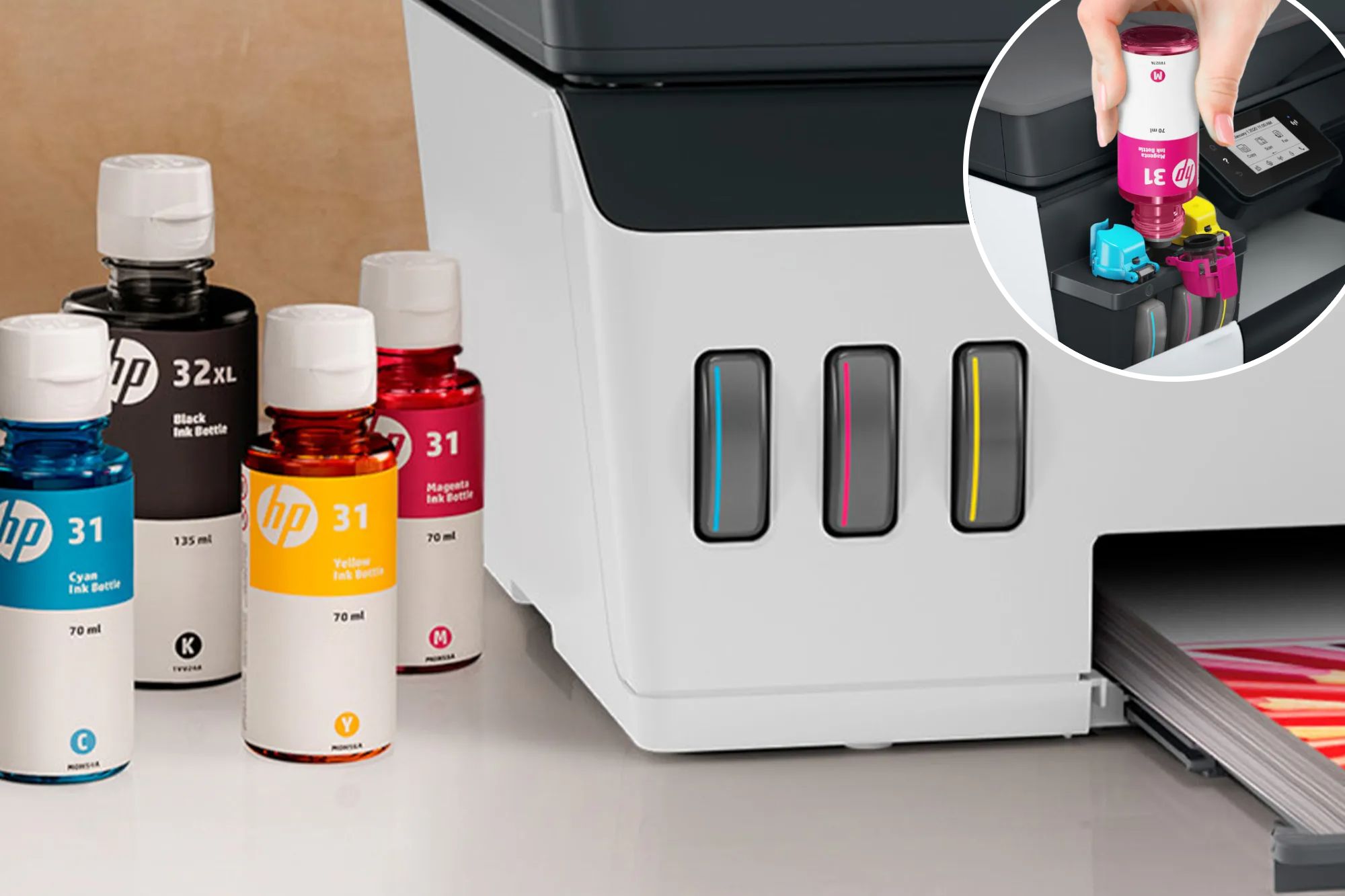
New York Post photo composite If you own a standard inkjet printer, you’ve participated in one of the most successful, albeit frustrating, business models in modern history: the “razor and blade” strategy.
You buy the handle, or in this case, the printer, for next to nothing, and you spend the rest of your life paying a premium for the blades – the ink.
We’ve all been there, standing in a brightly lit office supply aisle, staring at a plastic cartridge the size of a matchbox that costs $40, wondering if the ink inside is actually worth the price.
Refillable ink tank printers were born out of a breaking point in consumer patience. They aren’t just a new printer model; they represent a fundamental shift in the economics of home and home office printing.
Instead of buying ink by the milliliter in expensive proprietary shells, you buy it by the bottle and pour it into the machine yourself.
But is the printer with refillable ink tanks the revolution we’ve all been waiting for? While the marketing promises “thousands of pages for pennies on the dollar,” the reality of owning one involves a different set of chores and a higher upfront investment.
Here is the unfiltered truth about how these machines work, the math behind the savings and the maintenance tax you won’t see on those banner ads.
To understand whether you should drop $300 on a refill-ink-tank printer today, you need to see the ledger.
Most guides gloss over the downsides, but for some users, a tank printer might actually be a worse choice than a less expensive cartridge model. Allow us to explain.
D.APIWAT – stock.adobe.com The Evolution of the “Ink Scam” To appreciate why tank printers are a big deal, we have to look at why printers became so hated in the first place. In the early 2000s, manufacturers realized they could practically give printers away if they chipped in the cartridges. These microchips did two things: they ensured you couldn’t use third-party ink, and they often triggered an “empty” signal based on a page count rather than the actual liquid level.
Refillable tank printers were a response to a growing “Right to Repair” sentiment and a massive loss of market share to laser printers. By moving the profit center from the ink to the hardware, manufacturers finally gave high-volume users a reason to stay with inkjet technology.
Internally, the engine of a tank printer isn’t that different from a standard inkjet. The difference is the plumbing.
In a cartridge system, the ink sits directly on top of the print head. In a tank system, the ink is stored in a reservoir and pulled through flexible silicone tubing to the print head. This “continuous ink supply system” (CISS) is what allows for the high capacity, but it’s also the system’s Achilles’ heel.
If air bubbles get into those tubes – typically as a result of letting the tank run completely dry – the printer can lose its “prime,” and you’ll be stuck running “Power Cleaning” cycles that waste significant amounts of ink just to get the lines flowing again.
OK, it’s time to nerd out with the numbers a bit. If you buy a $300 Tank Printer versus a $100 Cartridge Printer, you are starting $200 in the hole.
Ascannio – stock.adobe.com Maintenance: The Part Nobody Talks About If you buy a tank printer and treat it like a “set it and forget it” appliance, you may be investing in the wrong printer.
Depending on the model, the ink may be exposed to air (via tank vents), making it susceptible to evaporation and viscosity changes. However, as the technology progresses, the likelihood of this happening to you lessens, but it’s always something to consider when choosing your printing needs.
The Golden Rule: Print something once a week. It doesn’t have to be a masterpiece. A simple nozzle check or a single paragraph of text in color will keep the ink moving.
Think of a tank printer as you would a cast-iron skillet. It’s a superior tool that can last for years, but it requires a specific kind of “seasoning” through regular use. You can’t just ignore it and expect it to perform at its peak (or maybe at all). If you don’t cook once a week or so, the surfaces degrade, and you’re left with a high-maintenance headache instead of your reliable investment.
Some tank printers have what are called “waste ink pads,” internal sponges that catch the ink used during cleaning cycles. Once these pads are full, some printers can lock down and stop printing until they are serviced; however, this is not a common issue.
The market is currently split between four major players, each with a slightly different philosophy:
The refillable tank printer is a tool for the active user.
If you are a parent with three kids in school who are constantly printing posters, essays and coloring pages, this might just be the best tech purchase you make this decade. You will save hundreds, if not thousands, of dollars over the life of the machine.
However, if you are a “digital-first” person who only needs a printer for the occasional tax form or return label, this may be more than you need. The high upfront cost and the maintenance requirements mean you’ll likely end up with a $300 paperweight. For you, a basic, low-cost printer is the far superior choice.
If you are a small business owner, looking to fill volume needs in record time, you’re going to want to invest in an affordable, top-of-the-line laser printer, which you can read all about here.
The tank printer is a commitment. If you’re willing to feed it and use it, it will reward you with the cheapest, most liberated printing experience available today. Just remember to buy a ream of paper; you’re going to be using it a lot more than you used to.