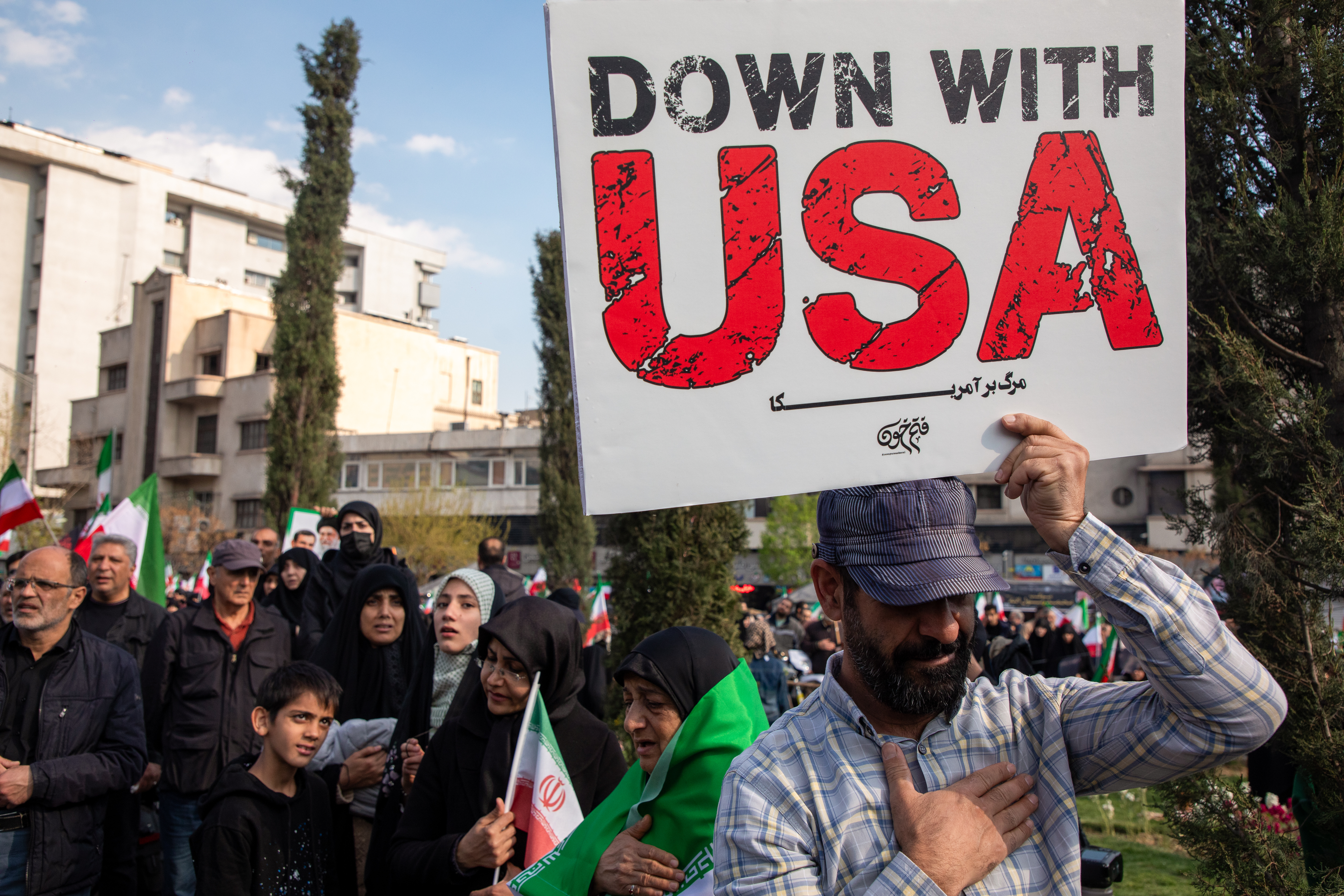
An anti-American protester holding a "Down with USA" sign at a funeral in Tehran for IRGC Navy Chief Alireza Tangsiri and other Iranian military leaders killed in Operation Epic Fury on April 1, 2026. Getty Images In the face of economic calamity, President Franklin Roosevelt said boldly, “we have nothing to fear, but fear itself,” highlighting how panicked markets feed on themselves.
Today, he would likely revise it to: “we have nothing to fear but fear of higher oil prices.”
These cost increases are Iran’s primary strategy to preserve itself. It tried and failed so far to get nuclear weapons, and is seeing its missiles, air force, navy and proxy militias all in tatters.
The best way for it to survive is to convince the world it holds the key to our economic future and so it cannot be overthrown, ever.
America consumes about 20 million barrels of oil a day.
We produce internally for our own use about 12 million barrels and import about 8 million, while exporting another 11 million because our refineries are set up to process certain kinds of oil but not others.
So America is a net exporter of oil, and so its overall economy actually gains, not loses from the spike in prices.
Continuing the equation, an increase in prices from $60 to $110 a barrel results increased energy costs for the US of about $1 billion a day.
A 90-day war would add $90 billion of higher oil costs, far less impactful than President Trump’s tariffs or the inflation President Joe Biden caused with runaway spending.
And the money shifts from one part of our economy to another.
Of course, the increase in prices is real, and impacts consumers, especially in states who have raised prices as a deliberate strategy to discourage oil use as part of their green strategies. There are a lot of tax relief and other strategies Trump could use to return these temporary increases to consumers.
But America had oil prices over $100 a barrel for 3.5 years while Barack Obama was president and the press yawned. And even for four months during 2022 when Russia invaded the Ukraine, oil was at similar levels, reaching a peak of $128 without the Armageddon-like headlines.
And many of those politicians suddenly complaining about these price increases have for years been behind policies deliberately engineered to raise and tax them.
At the same time, preventing Iran from continuing to build up its military and nuclear arsenal could save trillions of dollars of future costs.
The costs of the 9/11 attack by 24 terrorists has been estimated at between $3.3 trillion and $8 trillion. Heading off Iran’s capabilities now rather than waiting until it is too late could have savings of similar if not greater magnitude.
For 47 years, this regime has preached death to America and death to Israel. It has been using its energy resources not for its people but to build up a machine dedicated to regional and even world domination.
This is a regime that gunned down tens of thousands of its own unarmed citizens just for attending a protest; imagine what they would do with more power and with those intercontinental ballistic missiles they lied about.
In short — the price of the Iran war is much, much less than the benefits it provides. A temporary increase in oil prices has been overblown and in the end will be worth it compared to crippling one of the worst regimes in history.
Mark Penn is CEO of Stagwell Inc. and chairman of the Harris Poll. He served as a key adviser and pollster to both Bill and Hillary Clinton from 1995 to 2008.