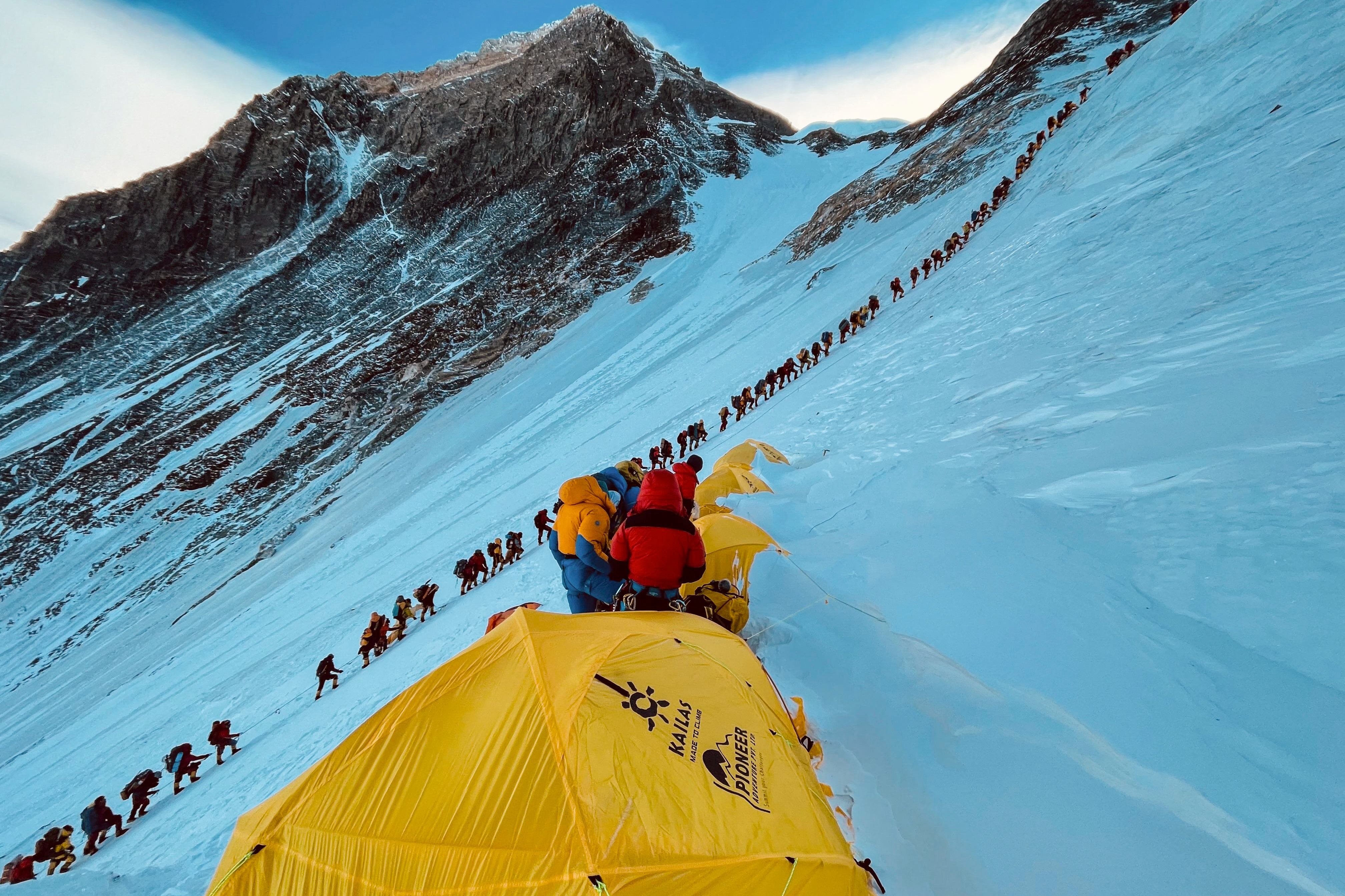
Mount Everest guides have allegedly been secretly lacing tourists’ food to trigger costly helicopter rescues as part of a $20 million insurance scam, according to a new investigation.
Police in Nepal have charged 32 individuals with organized crime and fraud charges related to the plot, which involves trekking company owners, helicopter operators, and hospital executives, the Kathmandu Post reported.
Guides with the trekking agencies allegedly poisoned tourists by putting baking soda in their food to trigger severe gastrointestinal distress that mimicked altitude sickness or food poisoning, investigators said.
Once ill, the visitors were allegedly pressured into agreeing to costly emergency helicopter evacuations, with operators using forged medical and flight documents to bill international travel insurers for the cost, according to authorities in the Himalayan country.
Mount Everest guides allegedly poisoned climbers as part of a $20 million insurance scam. AFP via Getty Images Those ill-gotten gains were then allegedly split among the guides, helicopter companies, trekking agencies, and the hospitals where the tourists were taken for fake treatments.
The investigation began in January when six executives from three prominent mountain rescue firms were arrested.
The groups allegedly fraudulently obtained at least $19.69 million in insurance payouts, according to police.
The scammers allegedly used baking soda to lace the climbers’ food, mimicking the symptoms of altitude sickness or food poisoning. AFP via Getty Images One company is accused of faking 171 of its 1,248 claimed rescues, leading to more than $10 million in illegitimate payouts.
A second company allegedly fabricated 75 of its 471 claimed rescues, fraudulently claiming $8 million, while a third is accused of making 71 false claims worth more than $1 million.
Prosecutors are seeking total fines of $11.3 million.
“The court is … giving high priority to this high-profile corruption case,” a court spokesperson said.
This is not the first tourism scandal of its kind to hit Nepal’s tourism industry, which supports over 1 million jobs, directly or indirectly, in the country.
In recent years, several major international insurers have halted coverage for trekking tourists in Nepal due to escalating fraud incidents.
In 2018, the Nepalese government claimed to have eliminated all “intermediaries” involved in arranging emergency evacuation for tourists, making operators legally responsible for their clients throughout the trip.
This move was supposed to make tour companies more accountable by requiring them to submit details of any rescue flights or medical treatment to Nepal’s Department of Tourism.
“The scam continued due to lax punitive action,” said Manoj Kumar KC, chief of the Nepalese police’s specialized organized crime unit.
“When there is no action against crime, it flourishes. The insurance scam too flourished as a result,” he added.