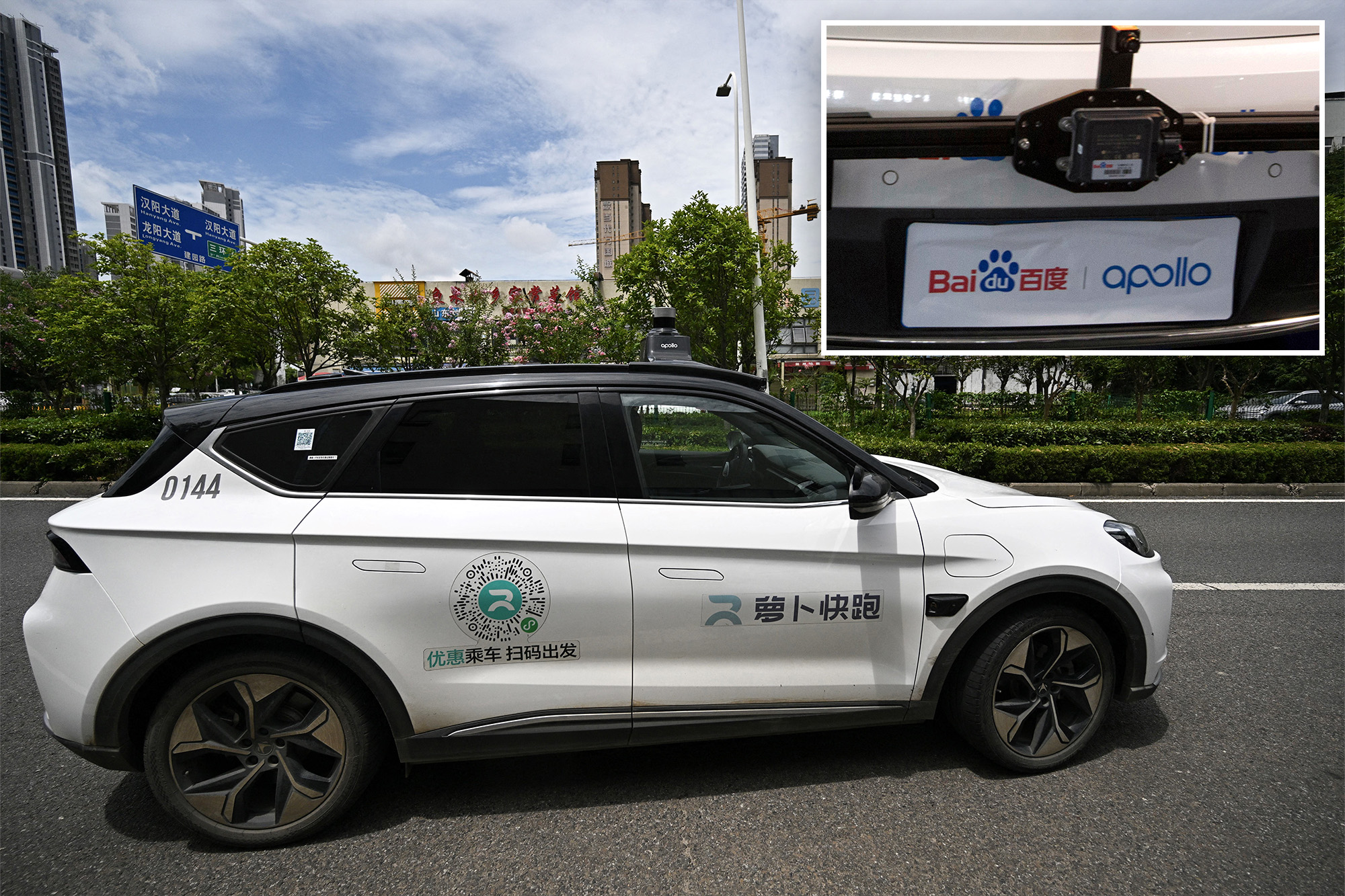
A glitch caused a fleet of Chinese robo-taxis to come to an unscheduled stop in Wuhan, China, leaving passengers trapped and stranded in traffic.
A preliminary investigation by Wuhan police revealed that over 100 of the AI-powered Apollo Go robo-taxis, operated by Chinese tech giant Baidu, ground to a screeching halt on a busy highway Tuesday night following a “system malfunction,” ABC News reported. At least one collision also occurred, according to CNBC.
One customer told local media that their automated cab stalled while rounding a corner — a backfire that was announced on the robo-ride’s screen.
“Driving system malfunction,” it read. “Staff are expected to arrive in 5 minutes.”
Unfortunately, when help didn’t come, the stranded passenger was compelled to open the door and vacate the vehicle.
While some riders exited on their own, others were concerned about departing, as they were in the middle of an active ring road — overpasses without traffic lights to help facilitate traffic flow — with cars moving at high speeds on either side of them.
Thankfully, no injuries were reported during the freak incident, which saw multiple people rescued, local media reported.
This marked the first time robo-taxis have shut down en masse in the Middle Kingdom.
Baidu hasn’t released an official statement identifying the cause of the outage, although the techsperts at The Tech Buzz theorized it could have been due to a variety of factors, ranging from Cloud connectivity issues to software bugs. As auto-rides require constant communication with servers for navigation, route optimization and other functions, one small hiccup can crash the entire system, causing them to freeze in place.
The fiasco couldn’t have come at a more inconvenient time. Baidu has increasingly cornered the market on self-driving cabs, operating more than 1,000 models operating in cities across China.
They also rolled out vehicles in Abu Dhabi and Dubai this year and are planning to plant their flag in Britain and Switzerland as well.
While the country has been more lax about driverless taxis than their US counterparts, they could clamp down in light of this latest calamity, Tech Buzz predicted.
This isn’t the first time the robo-taxi movement has hit a speed bump in China, although this mishap might be the most widespread.
In August, an Apollo Go model transporting a passenger toppled into a construction pit in Chongqing, while in May, one of the rides operated by Pony.ai burst into flames in Beijing, Reuters reported.
The mishaps aren’t limited to overseas, either. In December, self-driving cars owned by Alphabet’s autonomous tech arm Waymo came to a stop in San Francisco following a mass blackout that plunged the entire city into darkness.
Last year, the National Highway Traffic Safety Administration announced that it was probing thousands of the company’s driverless rides following reports that the models neglected to adhere to traffic safety laws around school buses.
Over the summer, Waymo conducted tests in NYC with humans still in the driver’s seat, but they were marred by criticisms from residents and officials alike, who claimed that the city was too busy and riddled with obstacles to harbor driverless vehicles.
Last month, New York Governor Kathy Hochul hit the brakes on efforts to expand upstate following an outcry from professional drivers and unions.
“Based on conversations with stakeholders, including in the legislature, it was clear that the support was not there to advance this proposal,” Hochul spokesperson Sean Butler wrote in a statement.