The US-Israeli strikes on Iran's two biggest steel mills will likely harm Tehran's ability to wage war, but could also cripple Iran's economy in irreversible ways.
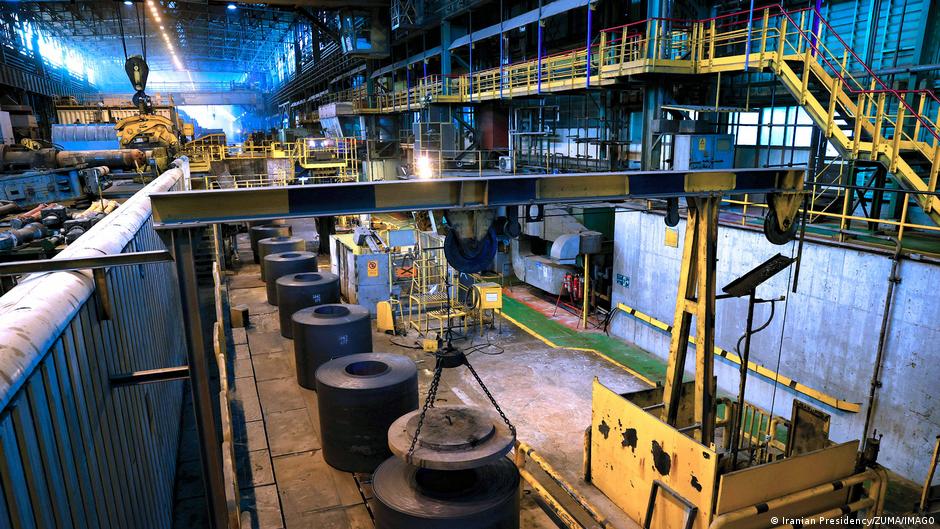
https://p.dw.com/p/5BUjfIran's Mobarakeh Steel company is considered the largest steel producer in the Middle EastImage: Iranian Presidency/ZUMA/IMAGOAdvertisementThe bombing of two Iran's largest steel producers, Mobarakeh Steel in Isfahan and Khuzestan Steel in Ahvaz, triggered a strong reaction inside Iran — with most of the conversation focusing on whether the two plants were legitimate military targets.
Some have argued that the sites were linked, directly or indirectly, to the economic networks that sustain the state and the Islamic Revolutionary Guard Corps (IRCG). Others saw the strikes as an attack on civilian industrial infrastructure in a country already under severe pressure due to the US-Israeli bombing.
Fewer people, however, seem to be concerned with the long-term effects of crippling Iran's steel production, which is one of the most important industrial sectors in the country.
While Iran's economy heavily relies on oil, the country was also among the top then crude steel producers in 2025. The World Steel Association put Iran's annual output to about 31.8 million tons. Mobarakeh Steel alone had generated $860 million (€741 million) in export revenue between March 2025 and January 2026, according to company linked-reporting.
An airstrike on a plant of this size impacts more than Iran's military forces. It is also a blow to supply chains, industrial employment, exports and one of the few sectors of the Iranian economy that still carries real weight under sanctions.
The full extent of the damage is still not independently clear, and much of the detail has come from Iranian reporting and specialist commodity coverage. But the broad picture is consistent.
Argus Media, an organization focusing on global energy and commodity markets, reported that the strikes damaged storage facilities and power infrastructure at both Khuzestan Steel and Mobarakeh, and said the attacks were expected to reduce Iran's production and its export capacity.
The Wall Street Journal reported that Khuzestan Steel had halted operations, while Mobarakeh remained operational despite damage.
Trump issues new threat to Iran's energy sitesTo view this video please enable JavaScript, and consider upgrading to a web browser that supports HTML5 video
Steel production is also heavily dependent on a continuous supply of electricity. If substations, captive power plants or production lines are hit, the effects often spread well beyond the immediately damaged units.
The longer the war continues, the more capital and state resources will be diverted toward conflict and away from managing Iran's already crisis-hit economy, an Iran-based economist told DW.
The economist, who asked not to be named, also said the deeper effects may become clearer only after the war.
But even now, Iran is dealing with war damage on top of sanctions, inflation and long-term economic mismanagement. If the fighting ends without political change and with sanctions still in place, many skilled workers may choose to leave the country and make Iran's economic recovery even harder, the source warned.
Reports on the strikes indicate that power generation units, parts of the iron and steel workshops and alloy-steel production lines were hit, economist Hassan Mansour told DW.
He said the direct losses may be in the range of $5 billion to $6 billion, but argued that the wider damage to the national economy could be far greater, with the disruption spreading into construction, manufacturing and a wide range of downstream sectors.
That assessment fits with the broader strategic importance of the metallurgy sector for Tehran. The US Treasury has long treated Iranian steel as a major source of state revenue. In 2020, it sanctioned entities linked to Mobarakeh Steel and pointed out that Iran's metals industry generated billions of dollars in export revenues.
Alireza Salavati, an economic activist, believed that some damaged units might technically be repaired within a few months if the destruction is not too extensive. But he said the more serious problem lies elsewhere.
According to Salavati, parts of the steel industry operate on narrow margins. If those sections are badly damaged, rebuilding them may no longer make economic sense. In such cases, he said, it could become cheaper to import steel than to restore some damaged units.
Will the Iran war really be over within weeks?To view this video please enable JavaScript, and consider upgrading to a web browser that supports HTML5 video
This is where the longer-term danger becomes clearer. The visible damage from airstrikes is only one part of the story. The more lasting effect may come later, if damaged sections are never fully rebuilt, output remains lower, and supply chains begin to weaken.
The social consequences may also be substantial. The Wall Street Journal reported that Khuzestan Steel employs around 10,000 workers, many of them contractors with little job security. A prolonged suspension of production would affect not only plant workers but also subcontractors and dependent industries.
For years, Iran has relied on steel and other metals as one of its most important non-oil sources of foreign currency. That is one reason the sector has repeatedly come under sanctions pressure. It is also why the strikes matter beyond immediate wartime calculations: they hit a sector that sits at the intersection of industrial production, exports, employment and state revenue.
For many Iranians, this is the real significance of the attacks. The strikes were not just against steel plants. They were against a sector that helps hold together a large part of the country's industrial economy.
And if that sector weakens further, the consequences are unlikely to stay inside the factory gates.