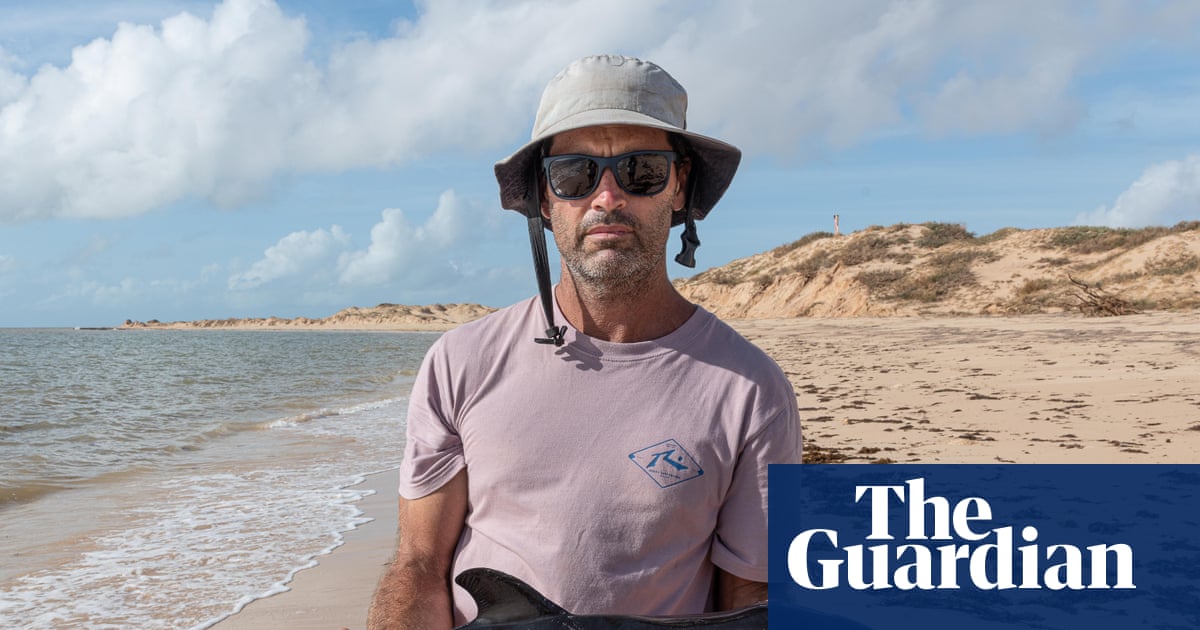
Cyclone Narelle left Graveyards beach near Exmouth strewn with dead turtles, fish, dolphins and seabirds. Photograph: Brooke Pyke PhotographyView image in fullscreenCyclone Narelle left Graveyards beach near Exmouth strewn with dead turtles, fish, dolphins and seabirds. Photograph: Brooke Pyke Photography‘Harrowing’: Cyclone Narelle leaves graveyard of turtles, dolphins and seabirds in Western AustraliaExmouth local says devastating impact on wildlife along the coastline is ‘hard to put into words’
Follow our Australia news live blog for latest updates
As the flooding from Tropical Cyclone Narelle’s violent visit to Exmouth subsided and the winds dropped, Brinkley Davies headed to Graveyards beach.
The beach, at least according to some Exmouth locals, got its name because of the tendency for turtles to get stuck on the dunes.
But on Sunday morning, this stretch of sand in remote Western Australia had turned into a literal graveyard, strewn with thousands of baby turtles and turtle eggs alongside dead fish, sea snakes, dolphins and seabirds.
“The sheer amount of animals was just disturbing. I’m a pretty positive person, but it was so bad. I just rescued whatever I could,” Davies said.
The state government said there had been similar scenes across hundreds of kilometres of beaches along the world heritage-listed Ningaloo coastline since Narelle passed over.
Brooke Pyke, a photographer based in Exmouth, also went to Graveyards and struggled to hold back her emotions at recounting the scene.
View image in fullscreenPhotographer Brooke Pyke went to Graveyards beach after the cyclone … ‘It was pretty devastating.’ Photograph: Brooke Pyke PhotographyView image in fullscreen‘My theory is that everything that needs to come to the surface to breathe would have faced pretty intense and exhausting conditions.’ Photograph: Brooke Pyke Photography“It’s hard to put into words actually,” she said. “It was pretty devastating. Harrowing.
“My theory is that everything that needs to come to the surface to breathe would have faced pretty intense and exhausting conditions. We didn’t find any sharks or rays – maybe they could get a bit deeper.”
Read moreDavies – who makes a living as a free diver, occasional stunt double, tour guide and photographer – is the founder of the Balu Blue Foundation conservation charity that cares for injured wildlife.
But with no permanent building, Davies took in more than 70 seabirds and other animals into her home and driveway in the days after the cyclone.
Sign up to get climate and environment editor Adam Morton’s Clear Air column as a free newsletter
Many of the birds were “too far gone”, she said, but alongside other volunteers more than 20 have been nursed back to health and released.
“I hope out of this, at least it shows we need a sustainable facility here [to care for wildlife]. It’s insane what we just went through,” Davies said.
“A lot of people have been saying this is just nature. But I think we’ve affected the climate so much that I don’t think this is just nature.”
Cyclone Narelle was the first storm to make landfall as a severe system in three different states and territories since Tropical Cyclone Ingrid in 2005.
Climate experts said global heating had likely helped the storm to intensify before it made its first landfall.
After travelling for thousands of kilometres over Australia’s north, the storm was a severe category four system as it passed Exmouth, delivering wind gusts of about 250km/h.
Riley Carter, a wildlife officer at the WA Department of Biodiversity, Conservation and Attractions, said hundreds of shorebirds had been found dead on beaches around Exmouth and the Ningaloo coast and about 30 dead cetaceans had been recorded.
“We have had reports of dead turtles, dolphins, snakes and other wildlife across hundreds of kilometres of coastline,” he said.
There had been “immediate and significant animal welfare impacts” and helicopters were being used to assess the situation, with vets available to euthanise animals if needed, Carter said.
There were some positive signs, he said, including 19 fresh turtle tracks observed since the cyclone passed through.
Narelle’s track took the storm directly over northern parts of the Ningaloo coastline and its coral reefs.
Last year, two out of three corals on Ningaloo died after an unprecedented marine heatwave caused the worst recorded mass coral bleaching event over more than 1,000km of the WA coastline.
Dr James Gilmour, a senior research scientist at the Australian Institute of Marine Science, said cyclones can smother corals in sediment, making them more susceptible to disease.
View image in fullscreenBrinkley Davies took in more than 70 seabirds and other animals in the days after the cyclone. Photograph: Brinkley DaviesView image in fullscreenOne of the birds Davies is caring for. Photograph: Brinkley DaviesThe large-scale death of plants and animals in the water also increased the risk of algal blooms that can harm corals.
“Entire sections of reef can be lifted and corals can be scarred and literally sandblasted or buried under rubble. There’s a lot of direct and indirect pressures they’ve faced,” he said.
The timing of Narelle’s arrival over Ningaloo came as corals were in the middle of their spawning season.
“Corals invest a considerable amount of energy in the production of their spawn and that happens over several months.
“The corals will be very low on energy and so having the energy for the polyps to remove the sediment is much lower,” he said.
View image in fullscreenThe large-scale death of plants and animals increases the risk of algal blooms that can harm corals. Photograph: Brooke Pyke PhotographyGilmour said any Ningaloo corals that did not die in the mass bleaching last year had been weakened by that event. There was a chance some surviving corals could have perished after the cyclone.
“[Narelle] is another mortality event and that of course makes us worry,” he said.
“We are becoming concerned about the windows of recovery. You need five or 10 years and we worry greatly how many of these windows will remain.”