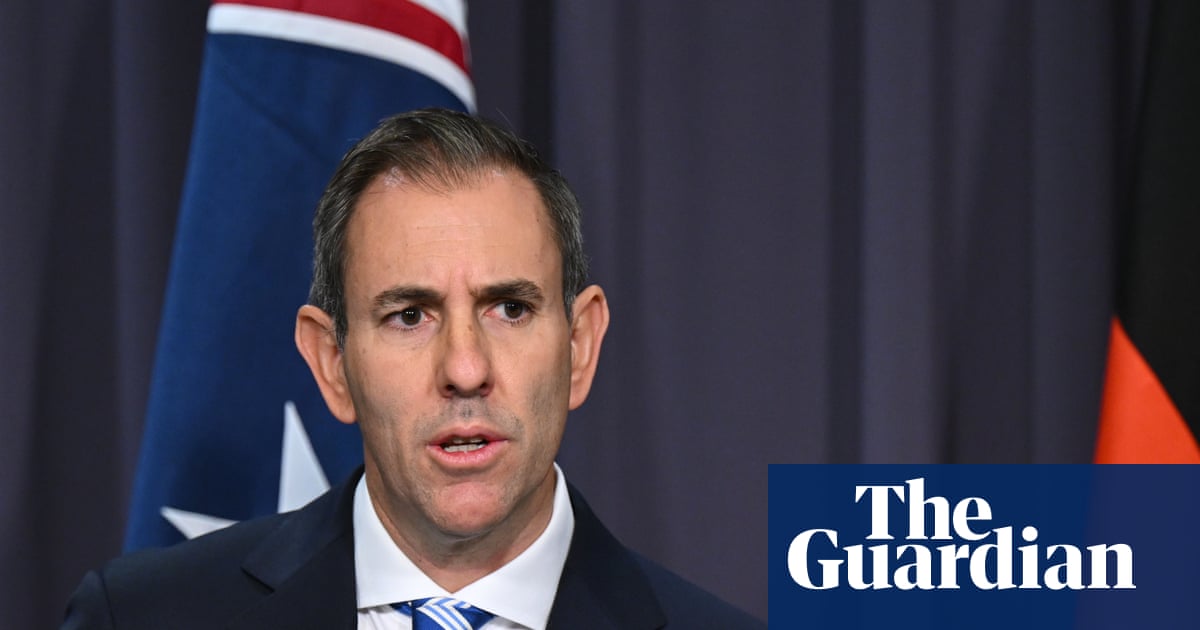
Jim Chalmers has announced a series of measures to support small businesses, including more generous ATO payment plans, amid the fuel crisis and the war in Iran. Photograph: Lukas Coch/AAPView image in fullscreenJim Chalmers has announced a series of measures to support small businesses, including more generous ATO payment plans, amid the fuel crisis and the war in Iran. Photograph: Lukas Coch/AAPChalmers says small business ‘paying the price’ for Middle East conflict as he unveils support measuresTreasurer says Iran war having ‘extreme impact on global economy’ as Albanese to address nation about fuel crisis
Follow our Australia news live blog for latest updates
Get our breaking news email, free app or daily news podcast
Jim Chalmers has unveiled a suite of Covid-era support measures for businesses struggling with soaring fuel prices and the prime minister is set to address the nation in the latest sign the government is preparing for a more severe economic downturn from the US-Israel war on Iran.
“The war in the Middle East is having an extreme impact on the global economy. Australians and Australian small businesses are paying the price for that,” the treasurer told reporters on Wednesday.
The support package will include more generous Australian Taxation Office payment plans, doing away with penalties and interest on unpaid tax debts and support to defer PAYG payments where the business has suffered a hit to their revenue “due to fuel supply issues”.
The ATO will also hold off chasing unpaid tax debts.
Anthony Albanese will deliver an address to the nation on Wednesday night at 7pm, where he’s expected to encourage Australians to play their part in the fuel crisis, including helping to save fuel for areas that need it. The prime minister’s office said it would be broadcast live across all television and radio networks simultaneously. Albanese is expected to detail the government’s plans on the fuel issue and how they are responding.
In further echoes of the pandemic’s “Team Australia” moment, the banks on Wednesday morning also announced they had put in place specialist teams to assist customers wrestling with the fuel crisis.
Chalmers said “these are common-sense steps that recognise and respond to the extraordinary circumstances we find ourselves in”.
“We know that the fallout [from the Iran war] is affecting everyone, but we believe that by working together, if everybody does their bit, we can get through this difficult period.
“From an economic point of view, this war can’t end soon enough, but the consequences will linger for longer, and that’s why, in the interim, we’re working very closely together to try and shield Australians from the worst the world can throw at us.”
Ahead of the 12 May budget, the treasurer flagged officials were now considering a wider range of economic scenarios, potentially including a long-lasting global oil shock that triggers a recession.
“The longer the shock drags out, obviously, the harsher the consequences for our economy, whether that’s measured by inflation or by growth or by impacts on the labour market,” he said.
“I would remind people that we go into this quite severe global economic shock from a position of genuine relative economic strength.”
The new support package comes two days after Anthony Albanese announced a three-month halving of the fuel excise tax that will lower the price of fuel by about 26c per litre at a cost of $1.5bn.
There was also the temporary removal of road user charges for heavy vehicles, at an additional cost of $1.05bn.
Economists believe the spike in fuel prices will push inflation and unemployment towards 5% over coming months and have pointed towards a painful stagflationary period that will heap pressure on households already struggling with high cost of living before the start of the Middle East conflict.
The government will have the fiscal firepower to deliver more relief measures in the 12 May budget, according to analysis by Westpac, which estimated soaring commodity prices linked to global volatility will deliver a $60bn tax windfall over the five-year forward estimates period.
“Around $20bn of this uplift reflects the impact of the Middle East conflict, particularly via higher coal and LNG export prices,” Westpac senior economist Pat Bustamante said, with high gold prices also contributing.
This more than offset the $2.55bn cost of the fuel and road user charge support, Bustamante noted.
“The federal treasurer has warned that the economic fallout from the Middle East conflict could be ‘just as serious’ as the GFC, the COVID‑19 pandemic and Russia’s invasion of Ukraine,” he said.
“But there is a countervailing force: higher commodity prices and elevated inflation are lifting treasury tax collections.
“Tax receipts can continue to rise even as real economic activity slows over the coming years, as we expect.”