Jeff Bezos Says We Went To The Moon In 1969, But If It Was So Easy Then Why Is It So Hard Now? ‘We Spent 3% of GDP…It Was Very Expensive’ Jeannine Mancini Mon, October 12, 2026 at 9:52 AM EDT 7 min read AMZN -0.37% Trade AMZN on Coinbase Trading disclosure Trading disclosure The above button links to Coinbase. Yahoo Finance is not a broker-dealer or investment adviser and does not offer securities or cryptocurrencies for sale or facilitate trading. Coinbase pays us for certain activity generated through this link. Prices displayed are informational.
Benzinga and Yahoo Finance LLC may earn commission or revenue on some items through the links below.
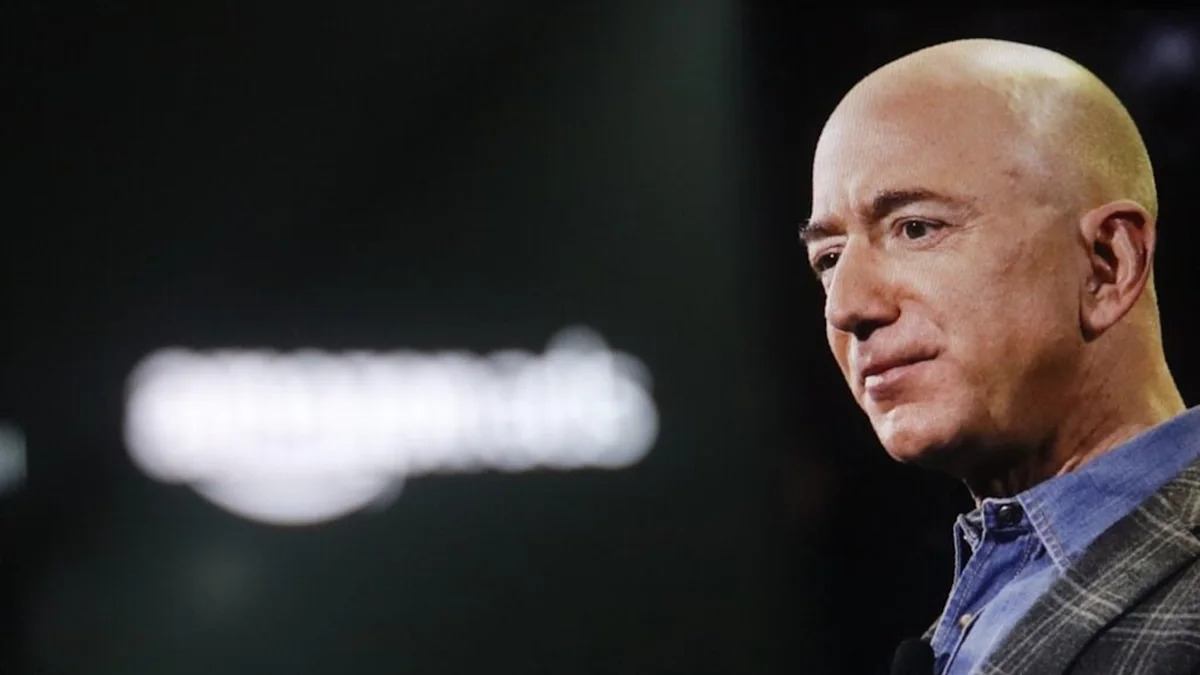
Getting to the moon took a Cold War rivalry, a national commitment and a mountain of money. Now, Amazon and Blue Origin founder Jeff Bezos wants to make lunar exploration a permanent human endeavor, and he says the cost of the original mission helps explain why returning hasn't been easy.
Bezos discussed the issue on Fox News in October, after host Bret Baier raised the moon-landing conspiracy theories that continue to circulate, including claims that the U.S. never actually put astronauts on the lunar surface.
He Thought He Needed $88K To Invest In Real Estate. Then He Found A Way To Start With $100.
A $90 Trillion Global Market Is Opening Up To U.S. Traders. Here's How Perpetual Futures Work And What Makes Them Different.
"We have been there in 1969," Bezos said. "People ask, 'Why is it so hard for us to do it if we did it in 1969?' What you have to know is we spent 3% of GDP when we did it in 1969. Almost 3% of GDP. It was very expensive."
Rather than simply landing astronauts and bringing them home, Bezos wants the next chapter of lunar exploration to establish a lasting presence.
"Today we're going to do it at a lower cost and going to the moon to stay," Bezos said. "It won't just be a mission and leave. It will be a real sustainable lunar base. That's how we'll explore the moon and find interesting things."
The Fox News interview also touched on why the moon could serve as a steppingstone for deeper space exploration. Bezos described it as a gift because it's only about a three-day journey from Earth and offers resources that could be used to produce solar cells and rocket propellant.
Trending: Do You Know What Your Adviser Costs You In Dollars—Not Just Percentages? Find Out In Minutes.
The idea is to build infrastructure that supports continued exploration, rather than treating each lunar landing as an isolated mission. Bezos has argued that establishing a presence on the moon should come before sending humans to Mars.
The ambition comes with a considerable price tag. Bezos said he has personally invested $28 billion in Blue Origin since founding the space company in 2000. The company recently raised $10 billion from outside investors for the first time.
Asked about a potential initial public offering, Bezos said he expects Blue Origin to eventually become a publicly traded company, although investors may have to wait several years.
"I think Blue Origin will have an IPO one day," he told Fox News. "I don't know exactly when that will happen. It will be a few years later, but it seems reasonable for Blue Origin to become a public company at some point."
See Also: Marvel. Star Wars. Pokémon. See Why Investors Are Paying Attention To The Next Big IP Company.
The prospect comes as investors look for opportunities in ambitious companies pursuing major technological advances. SpaceX completed its IPO in June, giving public-market investors access to a business that had spent years operating outside the stock market. Early access to a fast-growing company can be appealing, although even high-profile businesses carry investment risks.
The startup story extends well beyond space. Amazon began as an online bookstore, while SpaceX grew from a startup into a major player in the space industry. Today, companies are chasing big opportunities in fields ranging from AI to robotics and energy infrastructure. American PowerGen, for example, is developing power plants designed to meet the growing electricity needs of AI and data centers. The industries differ, but the common thread is the effort to build something that could become far more valuable as demand grows.
For Bezos, the immediate focus remains on making lunar exploration sustainable. A permanent base could turn the Moon from a destination for brief visits into a place where humans can work, develop resources and prepare for journeys farther into space.
Read Next: Think Your IRA Can Only Hold Stocks And Funds? Think Again. Here's What A Self-Directed IRA Can Actually Invest In.
Building a resilient portfolio means thinking beyond a single asset or market trend. Economic cycles shift, sectors rise and fall, and no one investment performs well in every environment. That's why many investors look to diversify with platforms that provide access to real estate, fixed-income opportunities, precious metals, and even self-directed retirement accounts. By spreading exposure across multiple asset classes, it becomes easier to manage risk, capture steady returns, and create long-term wealth that isn't tied to the fortunes of just one company or industry.
For accredited investors looking beyond stocks and bonds, EquityMultiple provides access to vetted commercial real estate deals starting at $5,000, with only ~5% of opportunities passing their due diligence process.
Backed by Jeff Bezos, Arrived Homes makes real estate investing accessible with a low barrier to entry. Investors can buy fractional shares of single-family rentals and vacation homes starting with as little as $100. This allows everyday investors to diversify into real estate, collect rental income, and build long-term wealth without needing to manage properties directly.
For accredited investors looking beyond traditional stocks and bonds, Realberry provides access to institutional-quality real estate investments, including a preferred equity opportunity in the 297-room Hyatt Place Boston Seaport. The firm has invested across multiple property types and markets, with 13 million square feet of real estate across seven U.S. states and $481 million in cumulative distributions paid to investors as of Q4 2025.
Entertainment franchises can become valuable long-term assets when they successfully expand across multiple platforms. Skybound Entertainment, the company behind The Walking Dead and Invincible, develops original intellectual property that spans comics, television, film, video games, merchandise, and licensing. With more than 250 IPs in its portfolio and a strategy focused on retaining franchise rights while scaling successful stories across media, Skybound offers investors exposure to the growing entertainment and creator economy through a private company rather than traditional public market investments.
As artificial intelligence drives a surge in electricity demand, reliable power generation is becoming a critical part of the technology ecosystem. American PowerGen is developing natural gas-fired power plants in Texas, a fast-growing market fueled by AI data centers, manufacturing expansion, and population growth. By advancing projects through permitting, fuel supply, and grid interconnection, the company is positioning itself to help meet rising energy needs while offering investors exposure to the infrastructure supporting the next wave of AI and industrial growth.
As AI coding tools take on more of the work traditionally done by developers, companies are facing new challenges around code quality, context and the rising cost of AI-powered development. Bito is building software designed to help AI coding agents better understand complex codebases while helping companies control AI development costs. Founded by former PubMatic executives, Bito has raised more than $10 million from institutional and individual investors and is now raising additional capital through a Wefunder offering, giving investors an opportunity to invest in a company targeting an emerging need within the rapidly expanding AI software market.
For accredited investors looking beyond stocks and traditional real estate opportunities, DLP Capital provides access to private real estate strategies focused on workforce housing — homes for essential workers such as teachers, nurses, firefighters, and police officers. With more than $5.5 billion in assets under management and a community of 4,000+ accredited investors, DLP Capital gives investors access to real estate strategies designed around the growing need for housing that working Americans can actually afford.
Farmland has historically held its value through market volatility and delivered returns uncorrelated to stocks and bonds. For accredited investors, FarmTogether offers direct access to high-quality U.S. farmland starting at $15,000 — fully managed, with no landlord headaches.
Private real estate and private credit can add income and stability to a stock-heavy portfolio. Fundrise offers access to diversified private real estate and credit strategies through an easy-to-use platform, with professionally managed portfolios designed to generate passive income and long-term growth.
This article Jeff Bezos Says We Went To The Moon In 1969, But If It Was So Easy Then Why Is It So Hard Now? 'We Spent 3% of GDP…It Was Very Expensive' originally appeared on Benzinga.com
© 2026 Benzinga.com. Benzinga does not provide investment advice. All rights reserved.