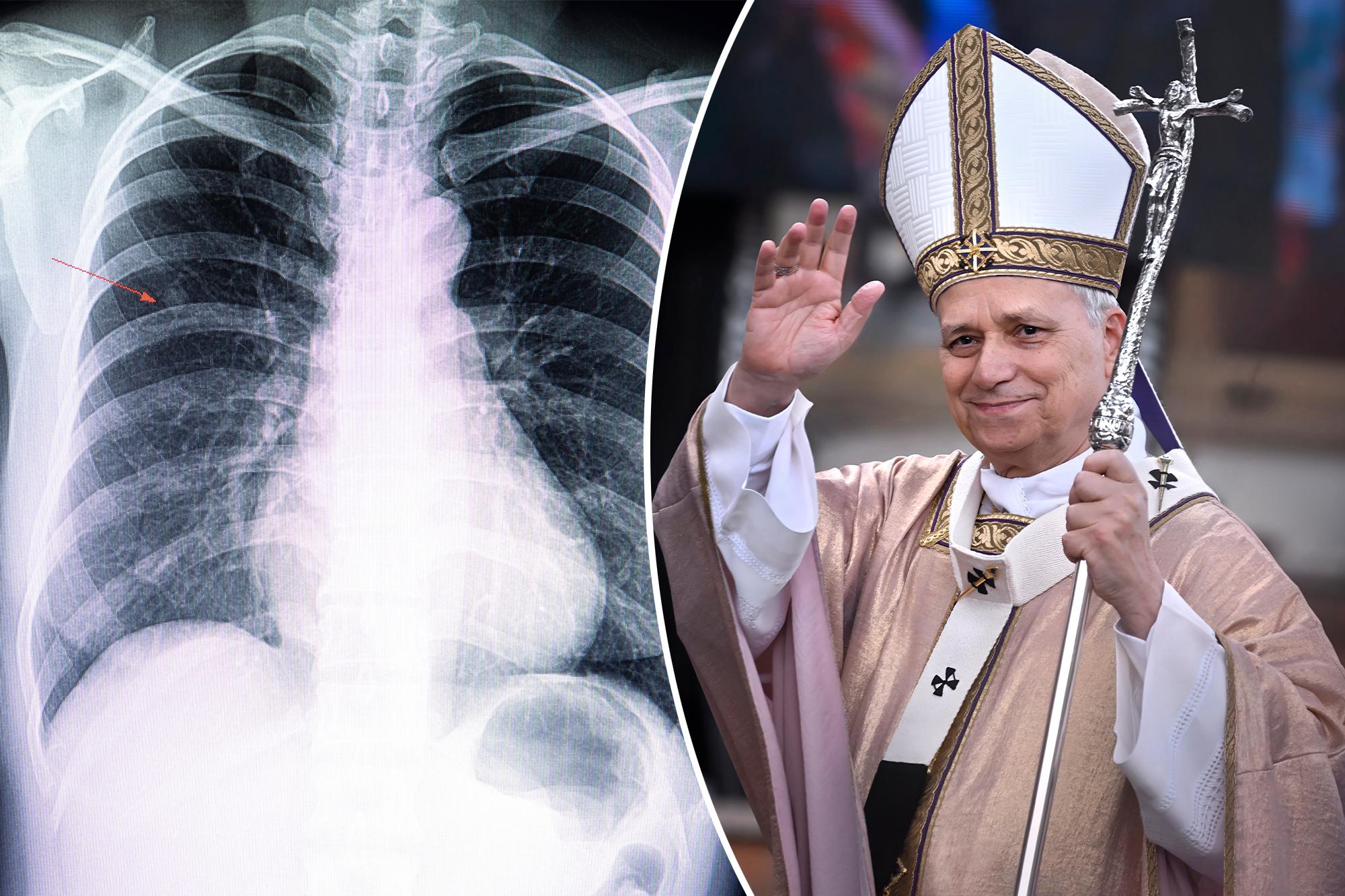
The Vatican announced Sunday that Pope Leo XIV will undergo surgery to remove a growth found on his lung.
The South Side Chicago native revealed the first health scare of his 17-month tenure during his noon prayer at St. Peter’s Square, saying a nodular lesion was discovered during medical checks.
“Doctors found a small, localized nodule in my lung,” the 71-year-old American pontiff said. “It was detected at a very early stage and is circumscribed.”
Pope Leo XIV recently revealed he’ll be undergoing surgery to remove a nodular lesion discovered in his lungs. ZUMAPRESS.com After finishing his traditional Angelus prayer, Leo told the crowd he would follow his doctors’ advice, who “believe it’s best to take action,” although the Vatican didn’t say when the procedure would take place.
While the Pope may miss his main planned event of the week — Wednesday’s closing of a weeklong conference on family ministry — he still plans to go on his scheduled trip to Uruguay, Argentina and Peru early next month.
Lung nodules are sometimes indicative of cancer, but most are benign and finding one doesn’t always mean a diagnosis of a disease.
Here’s everything you need to know about lung nodules, from who’s most at risk to diagnosis and treatment options.
Pulmonary nodules — also known as lung nodules — are small, abnormal spots on the lungs that often measure less than 10 millimeters across.
These look like a round white mass during a chest X-ray or CT scan, according to Northwestern Medicine.
Some doctors might refer to how solid a nodule looks, describing it as having either “ground glass opacity,” meaning the area is hazy and structures can be seen underneath, or as solid, meaning it blocks the view of structures underneath.
Nodules are found in up to half of adults who get an X-ray or CT scan.
Lung nodules are small, abnormal spots that are often benign, with less than 5% being cancerous. SOPONE – stock.adobe.com How serious are lung nodules? Small nodules don’t typically cause symptoms.
However, larger ones that press against the airway or are cancerous may come with shortness of breath, chest pain, chronic cough, fatigue or recurring respiratory infections.
While 95% of nodules are benign or noncancerous, most lung cancers start as nodules. Nodules that don’t grow over a two-year period are considered noncancerous.
Those who smoke, are of older age, have had previous or chronic respiratory infections or are exposed to and continuously inhaling toxic chemicals are most at risk for developing nodules.
Lung nodules can be caused by several factors, including clusters of immune cells called granulomas, benign or cancerous tumors and scarring from smoking or breathing in lung irritants and chemicals.
Lung nodules are often found via a chest X-ray or CT scan being completed for an unrelated reason.
Nodules are evaluated by size, shape, borders and composition to determine if additional imaging scans, blood tests or a biopsy is necessary to see if the nodule is cancerous.
A biopsy may be performed if the nodule is bigger than 9 millimeters, if you currently smoke or used to smoke, or if you are over 65, have a family or personal history of cancer or have been exposed to asbestos or secondhand smoke.
If the nodule is caused by an infection, antibiotics or antifungal medications may be prescribed to treat the underlying infection.
A doctor may suggest routine CT scans to monitor the growth of benign lung nodules as a precaution, or recommend surgery to remove it.
Cancerous nodules may also require chemotherapy or radiation therapy if the cancer has spread.