@rockmarooned Published March 31, 2026, 8:00 a.m. ET Photos: Everett collection, Warner Bros. ; Illustration: Dillen Phelps Where to Stream: Batman V Superman: Dawn Of Justice Powered by Reelgood More On: Ben Affleck Will There Be a ‘The Rip 2’ Movie on Netflix? ‘The Rip’ Ending Explained: What Happens in the Matt Damon and Ben Affleck Netflix Movie? Is ‘The Rip’ Based On A True Story? And Who Is Jake William Casiano? Stream It Or Skip It: ‘The Rip’ on Netflix, a Generic Bummer of a Ben Affleck-Matt Damon Action-Flick Pairing It didn’t take long into the 21st century comics-cinema craze for the reluctant superhero to become an overfamiliar type. As early as X-Men, way back in the year 2000, Hugh Jackman was making Wolverine’s resistance to joining a super-team relatable and understandable. In the modern comics and on film, being Batman isn’t depicted as especially fun, something Christian Bale expanded upon in the Dark Knight trilogy. Even the more youthful adventures of Peter Parker were mitigated by a sense of obligation, conflicting with a suspicion that his life might be better if he opted not to embrace his Spider-Man identity, particularly in the superior sequel Spider-Man 2.
After some 16 years of superhero adventures, then, some degree of ante-upping was necessary, and ten years ago, Ben Affleck became the man for the job. He would show them what a truly reluctant hero looked like, presumably by using sense memory of his own misery in the role. He would be the world’s unhappiest Batman. He would show them all.
True to form, Batman was called into action for a rescue involving a great deal of potential property damage. DC had attempted to jump-start its own Marvel-competing cinematic universe with Man of Steel in 2013, a movie that made money about in par with the Marvel average at the time, but failed to match DC’s own sky-high expectations based on its recently concluded Dark Knight trilogy. Being ace problem-solvers, executives quickly happened upon a creative solution: Maybe more Batman? Like a lot more?
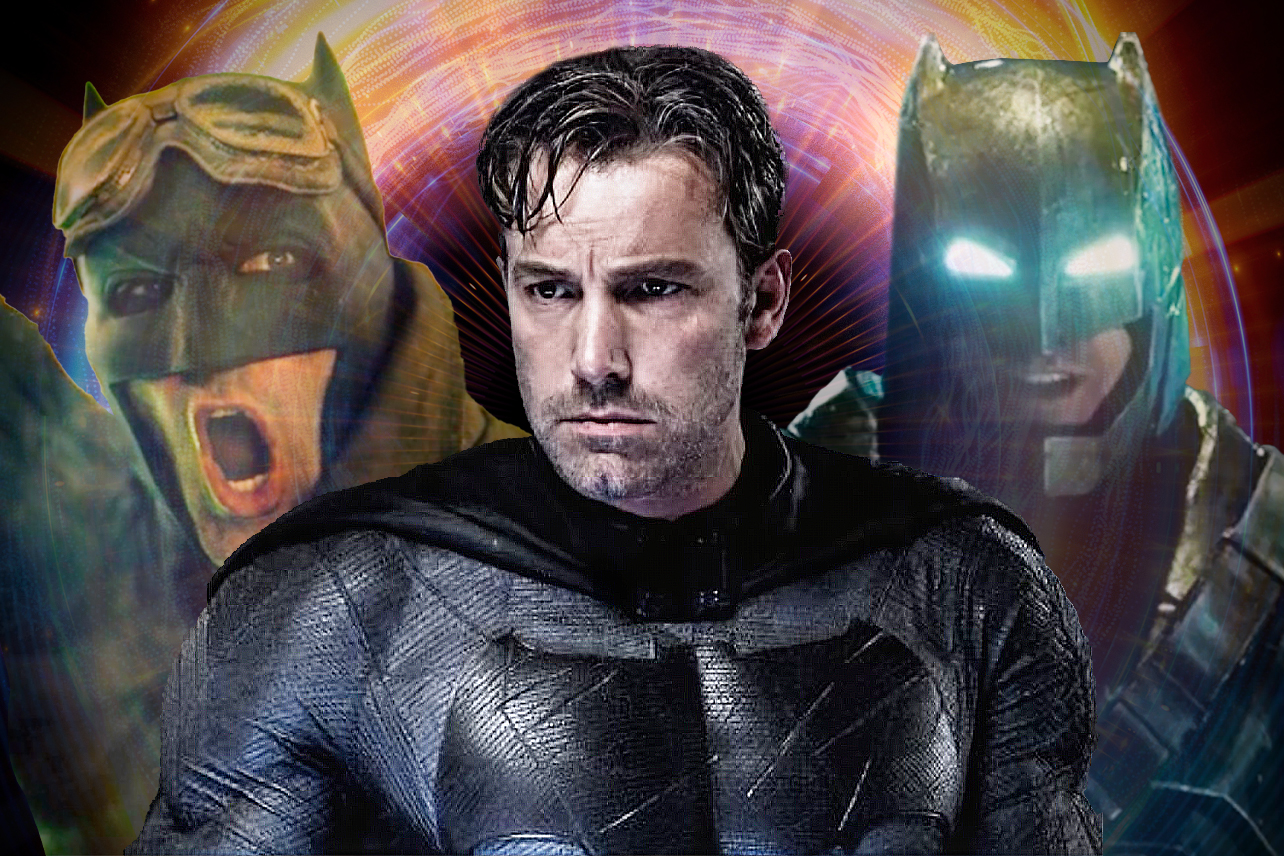
And so, a sequel to Man of Steel was hastily reworked into a franchise accelerant: Batman v. Superman: Dawn of Justice, a movie that would definitely introduce Batman and also plant seeds for an upcoming Justice League movie. Affleck, ever the trouper, announced his reluctance almost immediately, mere weeks after shooting began in fall 2013 (though, granted, he was describing his initial hesitation to take the role and how he ultimately overcame it). Perhaps he was just getting into character: This version of the character, as designed by director Zack Snyder and screenwriter Chris Terrio, is an older Batman who has been fighting crime for some years as Batman v. Superman opens, with plenty of attendant weariness. One of the most intriguing aspects of the film is how it begins in earnest by revisiting a scene from Man of Steel from Bruce Wayne’s perspective. In this telling, Gotham City is nonsensically located a short bridge’s drive from Metropolis, and Wayne races into the city during the apocalyptic fight between Superman and Zod, hoping to save some of his employees in the other city.
Now, why doesn’t Wayne hop into the Batmobile and show up on the scene as Batman? Unclear! Though this is supposed to be an older, more experienced Batman, the actual movie is a bit murky about how long he’s been at it; the press coverage of Batman’s antics in-movie seem to regard him as somewhat mysterious, while his dialogue with Alfred (Jeremy Irons) makes a lot of references to him growing old, and there’s some kind of memorialized Robin suit on display in the Batcave (a nod to Jason Todd, the second Robin in the comics). It’s also possible Wayne goes to Metropolis as himself because hates being Batman as much as Affleck does. But who he hates even more than himself is Superman, who, as he sees it, has rained destruction upon the Earth with no accountability, and must be put in check.
There have been countless interpretations of Batman’s whole deal over the years, and I’m not saying anything is inherently off limits. That said, “settles into a murderous fugue state when he lays eyes on Superman” is pretty far afield from what the character means to a heck of a lot of people – fans, creators, and past interpreters alike. To cast a star as notable as Affleck, who can be convincing as both a suited-up rich guy and a scrappy fighter, and hand him this version of Batman that merges both of those elements into a single twisted malcontent, is an act of classic Snyder perversity, indicative of his instinct to “deconstruct” things that have not yet been properly constructed.
In other words, this idea of Batman might have worked a few movies in, if they really wanted to play the cinematic-universe long game. But Warner Bros. was in a rush, and while Affleck may not be a huge comics geek, he’s certainly spent enough time with Kevin Smith to sense when something might be amiss with this characterization. Affleck had also played a superhero before, and while his Daredevil in the 2003 film of the same name is tortured in some respects (not least by starring in an overwrought and underwritten film), he also manages to look like he’s having some fun in the process, if more often in his real-world guise of attorney Matt Murdock, where he’s able to defy the world’s expectations of what a blind man can do. Here, even the millionaire-playboy aspect of Wayne, which Bale played so enthusiastically as a fatuous front, is a source of depression: We see Bruce wake up next to a faceless woman, pound a glass of wine for breakfast, and take shit from Alfred for not siring any de facto grandchildren. (OK, that’s pretty well in-character.)
In a display of faux-patience, we don’t actually see the Batsuit for almost 40 minutes into the movie, and Batman doesn’t actually put it on until the hour mark. (There’s a ridiculous dream sequence where Batman wears an adorable trenchcoat over his suit; this doesn’t count because it’s mostly an extended teaser for a Justice League sequel Snyder never made, based on a horrible-sounding edgelord video game.) And in fairness, Batman v. Superman does feel most alive when Bruce Wayne, Clark Kent (Henry Cavill), and Diana Prince (Gal Gadot) are warily circling each other out of costume, especially when Jesse Eisenberg’s insouciant Lex Luthor is tossed into the mix. That’s why you hire a star like Affleck: To make it somewhat less laughable when Bruce Wayne is obviously thirsty for Wonder Woman. As with George Clooney on the complete opposite end of the Batman spectrum, you can see the outlines of how Affleck would have been a good fit for this role. He’s got the ingredients, but the movie doesn’t, and Affleck never stops looking disappointed by this. (Based on subsequent press, it sounds like he took a page out of the Clooney book and blamed himself.)
Unlike the dopey wisecracks provided for Clooney, Affleck’s long-suffering Batman is nonetheless kind of funny, not least because he projects “long-suffering” within about eight minutes of screentime. He has a little more pep in his step, ironically, as the remorseful Batman of the maligned 2017 adventure Justice League, who has essentially helped to kill Superman and now gets gung-ho about bringing him back from the dead, all while continuing to flirt with Wonder Woman. It’s a breezier movie, again by executive design, and Affleck does a little better in it? Maybe? But weirdly, the Batfleck that feels most comfortable is the one who appears briefly in The Flash. (In a nice bit of spiritual kinship, he’s replaced by Clooney in a movie-ending gag.) Amazingly, this iteration of the DC movies lasted a full decade without ever producing a solo Batman movie; he appears briefly in the first Suicide Squad and helps wrap things up with The Flash, but while Warners dangled the idea of Affleck writing and directing his own version of The Batman, he stayed true to his reluctance and ultimately preferred not to. As a result, the Robert Pattinson version, separate from any other DC movies’ continuity, went along in its place, and did quite well.
And just as the existence of Batman Begins made Batman & Robin a lot easier to take, the Battinson take (and a decade’s worth of superhero glut) has made it all the easier to celebrate the ludicrousness of Batfleck: Asking Superman if he bleeds and then muttering “you will” after he flies away in disgust; screaming in agony as he puts himself through hell-week training to prove it; endlessly emailing Wonder Woman. In a way, Affleck was way ahead of his time. During a period when seemingly every actor in Hollywood was signing up for superhero duty (Batman v. Superman also has Amy Adams, Holly Hunter, and Scoot McNairy!), Affleck looked visibly uncomfortable. A decade later, that discomfort is starting to spread, and superhero movies no longer look like the only blockbusters in town. Batfleck was there grimacing on the ground floor, trying to warn us.
Jesse Hassenger (@rockmarooned) is a writer living in Brooklyn podcasting at www.sportsalcohol.com. He’s a regular contributor to The A.V. Club, Polygon, and The Guardian, among others.
Stream Batman v. Superman: Dawn of Justice on HBO Max