I have spent months reading the AI governance literature — the academic papers, the policy proposals, the regulatory frameworks, the industry commitments. I have found sophisticated analysis of the risks. I have found detailed technical proposals for alignment. I have found extensive discussion of regulatory structures, liability frameworks, and international coordination mechanisms.
What I have not found, anywhere, at the level of seriousness the problem requires, is a proposal for the human identity infrastructure that any of these governance frameworks ultimately depend on.
Let me explain what I mean.
Governance requires accountability. Accountability requires identity.
Any governance framework for AI — whether regulatory, liability-based, technical, or some combination — ultimately depends on the ability to answer basic questions: Who used this AI system? Who controlled it? Who made the decisions that led to this outcome? Who bears responsibility for this harm?
In the current architecture of the internet, these questions are extremely difficult to answer. Most AI systems interact with users who are identified only by an account — an email address, a phone number, a username — that may or may not correspond to a verified human being. The account can be created in minutes. It can be transferred. It can be used by multiple people. It can be abandoned and replaced. The chain of accountability from an AI interaction to a responsible human being is, in most cases, extremely weak.
This is not an accident. Anonymity and pseudonymity were design choices of the early internet — choices made with legitimate reasons, primarily around privacy and freedom of expression. Those reasons are still valid. But they have produced an architecture that is fundamentally incompatible with the accountability requirements of governing powerful AI systems.
The Nexus Passport is the answer I am building.
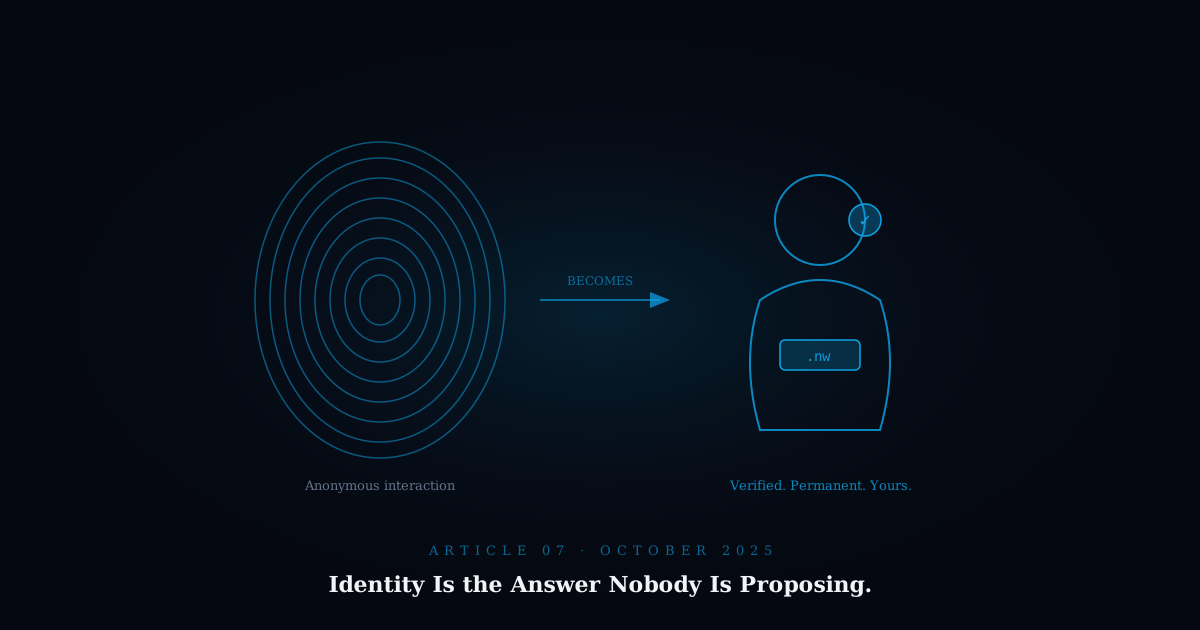
The Nexus Passport is a permanent, verified human identity. One identity per person — because the premise of the platform is Only One You, One Time. Verified against real-world identity documents. Persistent for 150 years. Heir-transferable. Irrevocable by the platform — the identity belongs to the user, not to NeuraWeb.
When an AI system interacts through the NeuraWeb architecture — through a verified Nexus Passport identity — the interaction is attributable. The AI knows whether it is talking to a child or an adult. It knows the jurisdiction the user is in. The interaction is logged to a permanent identity record that exists independently of any single session or conversation.
This does not make AI safe. Nothing makes AI unconditionally safe. But it makes AI interactions auditable, and auditability is the foundation of every governance framework that has ever worked for any technology.
The privacy objection and why it does not hold.
The immediate objection to verified identity is privacy. If every AI interaction is logged to a permanent identity, you have created a surveillance infrastructure, not a governance one.
This objection is correct about the risk and wrong about the necessity. The architecture of the Nexus Passport is specifically designed to separate verification from surveillance. The platform can confirm that a user is a verified adult human being without knowing — or storing, or sharing — the specific content of every interaction. The verification layer and the content layer are architecturally distinct. The goal is accountability for harmful outcomes, not monitoring of routine interactions.
I am building this because I believe it is necessary. I am also building it because nobody else with the right values is building it. The companies with the resources to build verified identity infrastructure have a financial interest in the anonymity and data accumulation that the current architecture enables. They will not build what I am building. So I will.
NeuraWeb will outlast AI as we know it.
NeuraWeb is not building for the current AI moment. It is building for what comes after AI has transformed — and possibly destabilized — the current internet architecture. When AI-generated content has made it impossible to trust anonymous internet sources. When AI-powered manipulation has made unverified identity a vector for harm at scale. When the world is looking for an internet architecture built on something more durable than anonymous accounts and engagement optimization — NeuraWeb will be there. With 150-year identities. With verified humans. With zero surveillance. With the infrastructure that should have been built at the beginning.
Identity is the answer nobody is proposing. We are proposing it. And we are building it.
S. Vincent Anthony is the founder of NeuraWeb Global Inc. This is part seven of an ongoing series.