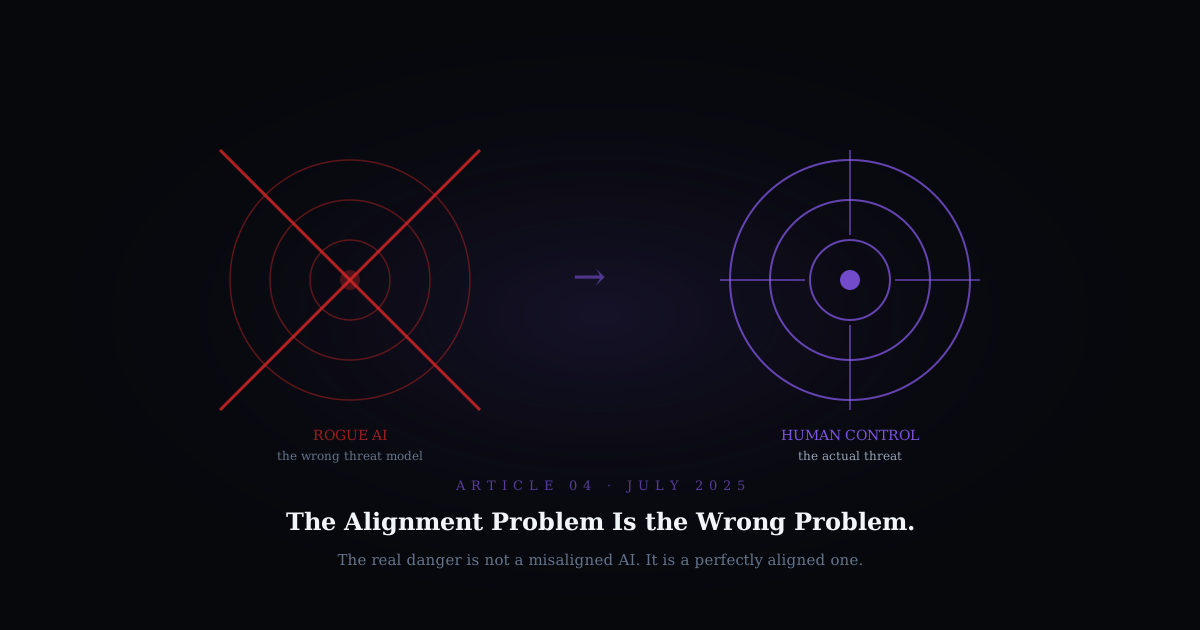
The AI safety field has produced some of the most serious and rigorous thinking about the risks of advanced artificial intelligence. The researchers at Anthropic, DeepMind, and the academic institutions working on alignment are, by and large, genuinely trying to solve a genuinely hard problem. I respect that work. I follow it. It is not what I am most worried about.
The alignment problem — as defined in the technical AI safety literature — is the problem of building AI systems that reliably pursue goals consistent with human values, rather than developing misaligned objectives that they pursue at the expense of human welfare. The classic scenarios involve AI systems that optimize a given objective so efficiently that they cause catastrophic side effects: the paperclip maximizer that converts all available matter into paperclips, the AI that achieves its assigned goal of making humans happy by wiring human brains directly to pleasure centers.
These are real long-term concerns. I am not dismissing them. But they are not the threat model that applies to the next decade or the next fifty years. The near-term threat is not a misaligned AI. It is a perfectly aligned one.
The question is: aligned to whom?
An AI system that does exactly what it is told, perfectly, at scale, without conscience, without fatigue, without the capacity for moral objection — is the most powerful tool for implementing human will ever built. The question that determines whether that is good or catastrophic is: whose will?
A perfectly aligned AI in the hands of a democratic government accountable to its citizens is a governance tool. A perfectly aligned AI in the hands of an authoritarian government accountable to no one is a control system. A perfectly aligned AI in the hands of a corporation whose primary obligation is to shareholders is an extraction machine. A perfectly aligned AI in the hands of a single individual with unchecked power is something history does not yet have a name for.
The alignment problem as technically defined asks: will the AI pursue the right goals? The alignment problem as I am defining it asks: right for whom? Defined by whom? Enforced by whom? Reversible by whom?
The safety constraints are parameters, not guarantees.
I have spent time with AI systems. I have used Claude, GPT-4, Gemini. The safety constraints on these systems are real — they reflect genuine effort by the people building them to prevent harm. They also have a technical characteristic that is important to understand: they are tunable. The values embedded in an AI system through training and fine-tuning are not structurally fixed. They are weights in a model that can be adjusted with sufficient compute and the right training data.
This means that the safety of a given AI system is a function of the values of whoever controls the training process. Change the controller, change the training, change the values. The system that declined to help with harmful requests under one owner may not decline under another. The alignment is to the trainer, not to an abstract human good — and trainers change.
What the right threat model demands.
If the real alignment problem is not will the AI go rogue but will the humans controlling the AI pursue good ends — then the solutions look completely different.
The technical alignment research focused on preventing AI from developing misaligned goals is valuable and should continue. But the governance research focused on ensuring that the humans who control AI are accountable, replaceable, and constrained by democratic legitimacy — that research barely exists. We are spending billions of dollars on the wrong alignment problem while the right one goes almost completely unaddressed.
The answer I keep coming back to is identity and accountability. An AI system that interacts through verified human identities — where every input and output is attributable to a known, accountable human decision — is not perfectly safe. But it is auditable. And auditability is the foundation of accountability. And accountability is the foundation of governance. And governance is the only thing that has ever reliably constrained power.
The alignment problem is the wrong problem. The governance problem is the right one. We are not having that conversation at anywhere near the urgency it requires.
S. Vincent Anthony is the founder of NeuraWeb Global Inc. This is part four of an ongoing series.