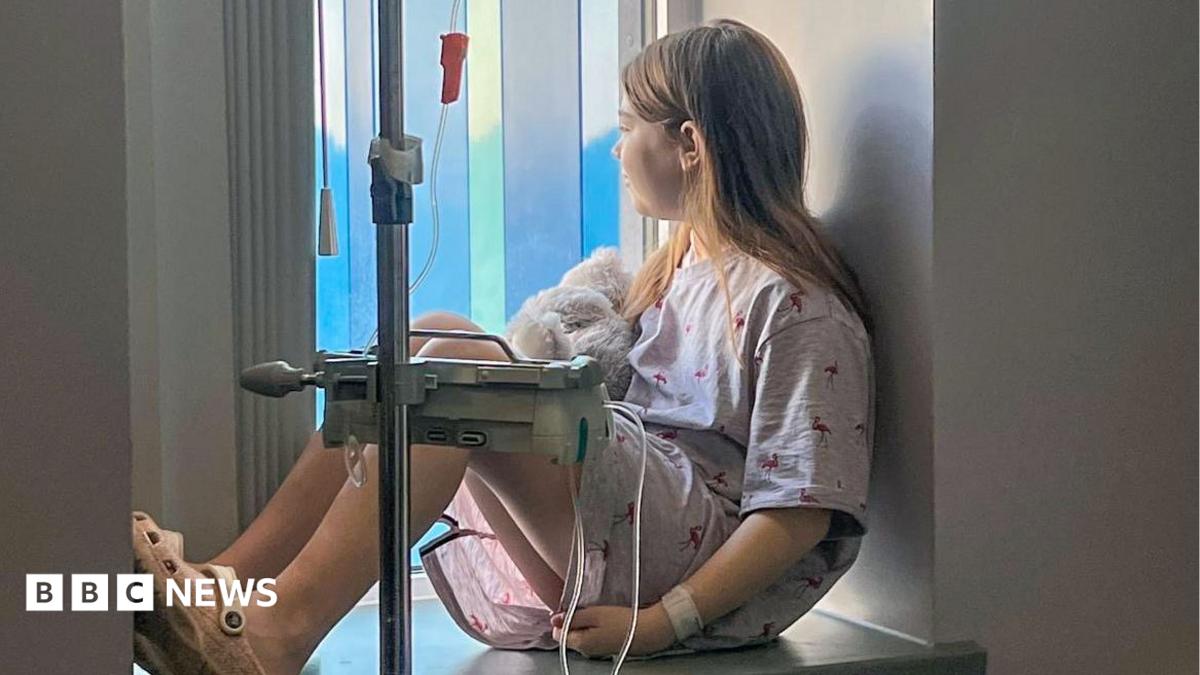
Image source, Family handoutImage caption, Amelia Carroll was 13 when she got her cancer diagnosis last year
Although rare, cancer is the leading cause of death from disease among children under 15 in the UK - yet just under a third of parents say they feel confident recognising the symptoms.
About 1,900 children aged 0-14 are diagnosed with cancer each year, according to Cancer Research UK.
Thirteen-year-old Amelia Carroll, who is now in remission, was diagnosed with acute myeloid leukaemia (AML) last year.
Her mum Gemma recalls the initial symptoms being easy to overlook.
There was the tiredness, she says, and being out of breath after mild exercise but both were put down to being unfit and just post-school fatigue.
It was only when Amelia started presenting with bruises Gemma knew something wasn't right - within 10 days Amelia got her leukaemia diagnosis.
Prof Bob Phillips, a paediatric oncologist, says it's key for parents to look out for clusters of symptoms that may be persisting, getting worse or bigger.
Lumps and bumps that are getting bigger or not going away and growing over time
Cancer in children develops much more quickly than in adults - effectively due to them growing.
Experts like Phillips at CCLG, the Children and Young People's Cancer Association, are urging people to follow a national campaign aiming to raise awareness and improve diagnosis times.
It includes a rule-of-three for professionals: If a child has had three persistent symptoms, or has visited their doctor three times, or has had three weeks of unexplained symptoms consider making a referral.
Although, it's important to note survival rates have risen significantly since the 1970s, with eight out of 10 children surviving beyond five to 10 years or more after diagnosis.
To play this video you need to enable JavaScript in your browser.This video can not be played
For Amelia, her cancer journey began with a single red bruise that came out of nowhere, says Gemma.
Three days later, she had bruises down both of her shins on both legs, which were sore and raised.
"We'd gone to the opticians for a routine appointment and they noticed that she'd got some burst blood vessels but they weren't sure why," she adds.
Within 10 days, doctors had confirmed what type of leukaemia Amelia had and she was admitted to hospital to begin treatment.
Image source, Family handoutImage caption, Her mum became particularly concerned when raised red bruises appeared on her legs
"On the day that they confirmed what she had, I sat her down and she said to me 'have I got cancer?' and I said yes you have. She asked me if she was going to die."
"I said no, they're doing everything they can, they've got a plan in place and the treatment is going to do everything it can to beat the cancer."
Amelia is currently in remission, undergoing regular bone marrow and blood tests every three months, and has returned to school.
Phillips says survival rates for childhood cancer in the UK are over 80% but that even quicker diagnosis would lead to less intensive treatments.
Around the UK, about half the children diagnosed with cancer get their diagnosis within two weeks, he says.
"It's pretty quick but we want the other half to not have the wait of 16, 18, 20, 25 weeks from those first symptoms to get a diagnosis."
Cancer Research UK data shows that there are more than 400,000 new cases of cancer diagnosed every year in the UK, with only 54% being told within the 28-day NHS target window, according to the British Medical Journal (BMJ).
An additional 2,300 teenagers and young adults (aged 15–24) are diagnosed each year.
Image source, Family handoutImage caption, Jake Swinscoe died of soft tissue cancer at the age of 13 after opting out of treatment
Lynsey Swinscoe is mum to Jake, who died of soft tissue cancer aged 13. Jake was diagnosed with stage three, fusion positive alveolar rhabdomyosarcoma in July 2023.
Before his diagnosis, Jake's initial symptoms of a stuffy nose and watery eyes were put down to hayfever, and falling asleep after school was thought to be just end-of-term tiredness.
"It was only when he started to get a swelling across the bridge of his nose that we thought right, we need to take him to the GP," Lynsey says.
"But at that point we didn't really think the fatigue and hayfever symptoms were related."
A mass was found in Jake's nose and nasal cavity and he was diagnosed with soft tissue sarcoma. He completed nine rounds of chemotherapy and proton beam radiation.
After suffering seizures and feeling very unwell from the chemotherapy, Jake opted out of continuing treatment.
Image source, Family handoutImage caption, Jake completed nine rounds of chemotherapy and proton beam radiation
He passed away peacefully at home on 26 April 2024, just two weeks before his 14th birthday.
"I think the main thing with Jake is he was not scared to die. We had lots of conversations about dying and what it might feel like to die and the only thing that he was sort of scared about was, 'are all the people going to remember me? Is everyone just going to forget who I am?'
"That's why I'm doing this, to make sure that people know who Jake is, to make sure people know how incredible he was. And so with that comes the raising awareness, which I think, that's his legacy."
Girl, 7, rings bell to mark end of cancer treatment
'This doesn't happen to us' - mum on child's cancer