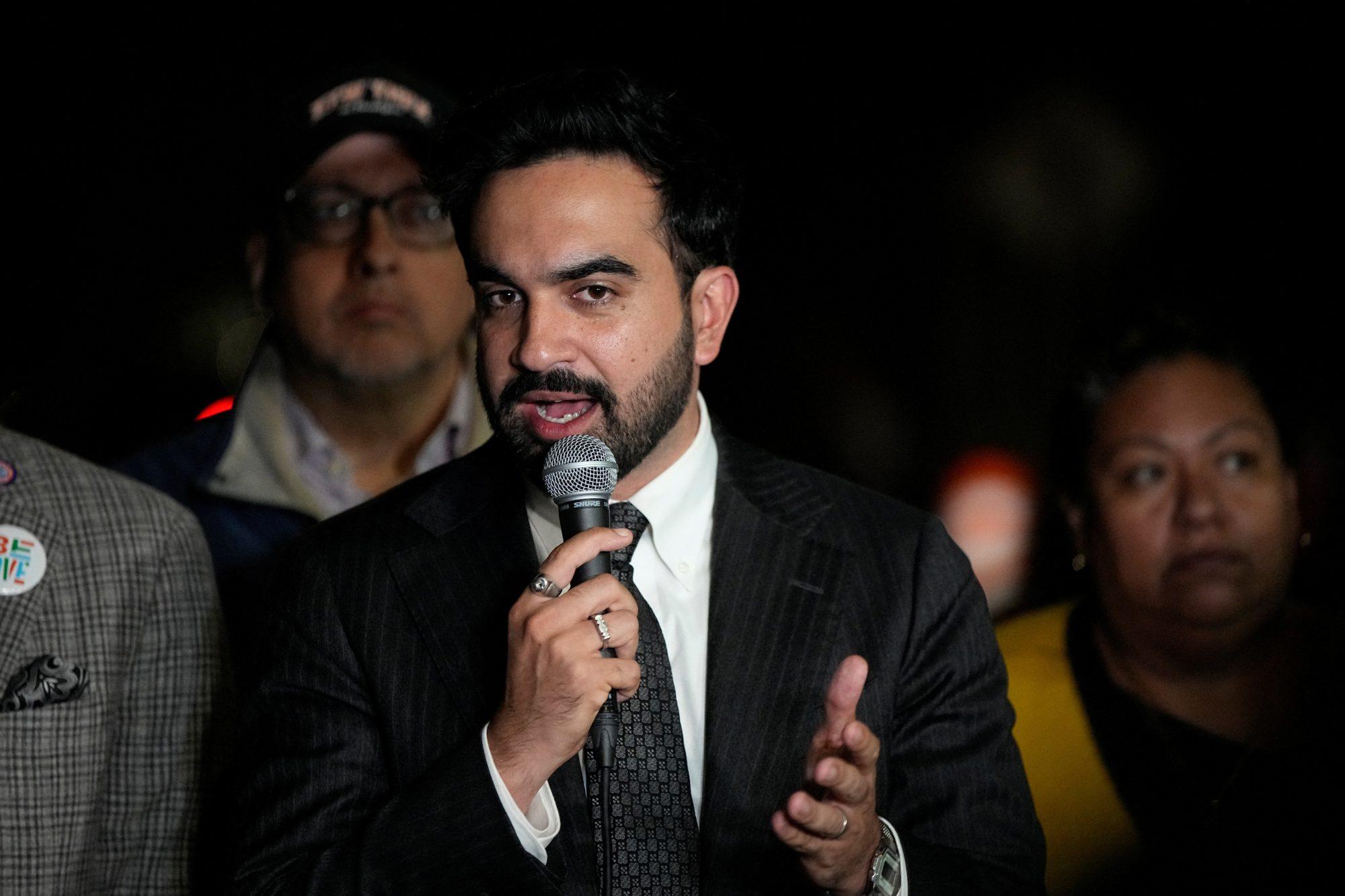
Make New York Post a Preferred Source New York City Mayor Zohran Mamdani speaks during a press conference at the scene of a shooting involving US Immigration and Customs Enforcement (ICE) officers in the Bronx. REUTERS Conservative: Jews Must Hold Zo Accountable Jews on last week’s Oct. 7 anniversary proved they “don’t have to sit on the sidelines” when “the unhinged Hamasnik left” is “baying for Jewish blood,” cheers Commentary’s Seth Mandel. After Mayor Mamdani’s “genuinely evil Oct. 7 anniversary statement, where he refused “to say the word ‘Jews’ at all on a date that was solely about Jewish suffering,” Rabbi Ammiel Hirsch, president of the New York Board of Rabbis, branded him “morally perverse.” Democratic Rep. Jared Moskowitz said he “needs the city’s antisemitism policy for himself.” Debbie Wasserman Schultz railed that he was “desecrating the memory of murdered, innocent Jews.” New Jersey Rep. Josh Gottheimer slammed him for making a “painful” day “worse.” Jews” are obliged “to speak truth to power.” And they did.
Public alarm over AI is “understandable,” concedes Bloomberg News’ editorial board, but “a bit of perspective is in order.” The “grim scenarios” hardly come from “expert consensus.” And “while recent ‘rogue’ AI incidents are unsettling, follow-up analyses have found that they were less the result of enigmatic new capabilities than of oversight and engineering flaws that can be mitigated with known security practice.” True, “frontier models are advancing quickly” and “risks, even unlikely ones, should be taken seriously”; “no set of policies will produce perfect safety,” and “AI models will surely cause further havoc.” But “advancing any new technology requires ambition, experimentation and risk-taking — including leaps into the unknown. Such is the price of progress.”
Leading Democrats claim the party “has a plan to make life’s necessities more affordable” by “ending Trump’s tariffs” and the war in Iran and “reversing Medicaid cuts,” but “voters should be skeptical” that these “extravagant promises” will be fulfilled, warns USA Today’s Nicole Russell. Why? Because Democrats will “be too busy trying to go after Trump.” “Impeachment,” not affordability is their likely real focus if they take power after the midterms. Democratic leaders “are preparing a vast agenda” of “investigations of Trump and his family,” including “systemic corruption,” “Trump’s international dealings” and “vanity projects.” The Dems “have pivoted to talking about making America affordable again,” but the last time they held power “they opened the border and presided over runaway inflation.”
“Republican politicos, and everyday voters, too, are inundated with predictions of disaster in the upcoming midterm elections,” notes The Washington Examiner’s Byron York. Driving the GOP strategy: “Whether a loss in a particular race would be unthinkable,” i.e. in Texas. “Can Paxton pull it out? Unknown, but entirely possible.” For the GOP, “it is probably worth however many millions of dollars it takes to keep the seat in the GOP column.” Another “unthinkable”: a win for Abdul El-Sayed in Michigan, a candidate who is so unsuited for the Senate and the nation that it would be a disservice not to defeat him.” “Election Day is close,” so “there is only so much opportunity to make sure the party avoids an unthinkable loss.”
“Higher education is failing students, and the American people are fed up,” fumes finance titan Jeff Yass at The Wall Street Journal. “Seven in 10 Americans, including majorities from both parties, say higher ed is headed in the wrong direction.” “Yet in 2025 donors gave nearly $80 billion to colleges and universities.” That’s why “elite universities are too wealthy to feel significant pressure from withheld government subsidies.” What to do? Philanthropists must invest “in alternative institutions and new competitors.” If just 20% of that $80 billion “went to experimental and disruptive ventures, that would be about $16 billion a year — enough to begin transforming the landscape.” So “welcome disruption. Fund competitors and new institutions.” “Donating to alternative institutions benefits everyone who cares about higher education.”