Make California Post a Preferred Source MILWAUKEE –– Dave Roberts struggled to explain his belief.
When asked for the umpteenth time this week about any positive signs he saw from slumping and injury-hampered slugger Shohei Ohtani in the opening round of the playoffs, the Dodgers’ manager couldn’t give a clear reason for optimism.
During his 2-for-13 performance in the National League Division Series against the Braves, Roberts thought Ohtani “did a good job of controlling the [strike] zone.” He said he “saw some better swings” for the 32-year-old, and liked that he at least reached base in all four games (with the help of a couple walks).
Still, Roberts didn’t try to pretend the four-time MVP looked to be on the verge of a breakout.
He, like everyone else, saw a version of Ohtani almost unrecognizable to what the Dodgers have become accustomed to over the last three years.
So, why exactly has the skipper continued to insist that Ohtani will “come to life” at some point in this postseason?
“There’s nothing right now I’m going to hang my hat on,” he conceded, “outside of, I just believe in the person and the talent … I’m just never going to count Shohei out.”
For now, such blind faith is as good as the Dodgers can muster when it comes to Ohtani, who was slated to hit cleanup in Game 1 of the NL Championship Series against the Milwaukee Brewers on Sunday.
They know the two-way star is still limited by left knee and right arm injuries. They are well aware he hasn’t hit a home run since Aug. 18, mired in a 22-game slump since then (including the regular season and playoffs) in which he has hit .157 and collected only one RBI.
However, hope continues to abound in what feels like an increasingly unlikely turnaround.
“I still think if he’s in the batter’s box, he’s still a threat,” Roberts said. “He swung the bat well against these guys last postseason. Those pitchers, their memories are long. Now it’s just up to Shohei to understand that and control the strike zone. They’re just not going to give in to him regardless of how he might be swinging the bat over the last couple months, in my opinion.”
Indeed, it was at this stage of last year’s playoffs that Ohtani emerged from a more routine, non-injury-triggered slump. After going 1-for-18 with nine strikeouts in the NLDS, then just 2-for-11 in the first three games of the NLCS against the Brewers, he exploded for an historic three-homer, 10-strikeout performance in the team’s pennant-clinching Game 4 victory, earning him series MVP honors.
This time, the Dodgers’ expectations are much more tempered.
Roberts only wanted to see Ohtani –– who has not spoken to reporters since before the start of last week’s division series –– find ways to “just get on base [and] take good at-bats,” especially against presumptive Cy Young Award winner Jacob Misiorowski in Game 1 of this year’s rematch.
“Shohei is known for his slug, but when you’re facing Jacob, it’s just you’ve got to take good at-bats,” Roberts said. “If you run into a homer, great. But if you can earn a walk, fantastic.”
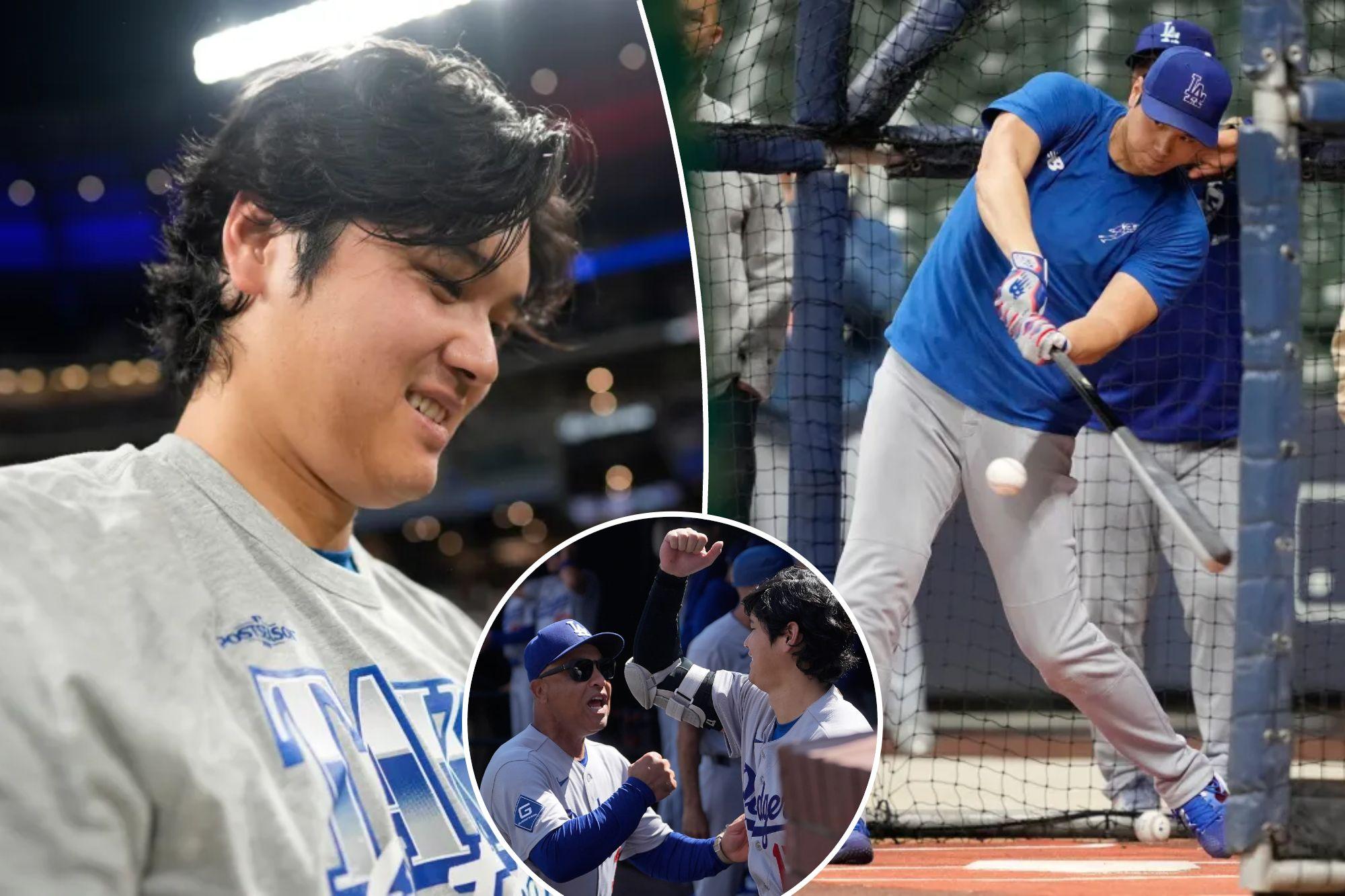
For Ohtani and the rest of his Dodgers teammates, that process began during a Saturday night workout at American Family Field, when they tried to calibrate themselves for Misiorowski’s MLB-best 105 mph fastball by not only taking pitches off a velocity machine, but doing so from several steps in front of the plate to simulate the speed of his unprecedented heater.
“That’s actually an Albert Pujols drill,” hitting coach Aaron Bates said. “When Albert was with us in ’21, he used to do that every day before he started. So it just gets the transition [of your swing to happen] quicker and just [trains] the overall tempo. Obviously, Misiorowski throws hard, so it’s a good drill for that.”
For Ohtani, in particular, the focus of his rare on-field BP was “just trying not to flip the barrel so soon,” Bates said, theorizing that Ohtani –– likely because of his injuries –– has been overexerting himself on swings to try and create his normal bat speed and power at the plate.
“I think it happens incrementally,” Bates said. “I don’t think that guys necessarily know when they’re swinging harder. It just happens so minute and such in small little samples that eventually adds up to too much effort. So I think that any drills that you can do to control the effort level will always be beneficial.”
The mental cue the hitting staff has given Ohtani: Focus on sticking a controlled finish with his swing, and “reverse engineer” more consistent mechanics from that.
“His work’s been great in the cages, and even into the games too,” Bates said. “I think it was more about just, again, [about finding] the feels that he wants to feel.”
At this point, it’s just the latest reason for cautious optimism that the Dodgers will be clinging to.
They don’t know exactly how, or why, or when it might happen. But eventually, they are still expecting their blind faith in Ohtani to be validated.