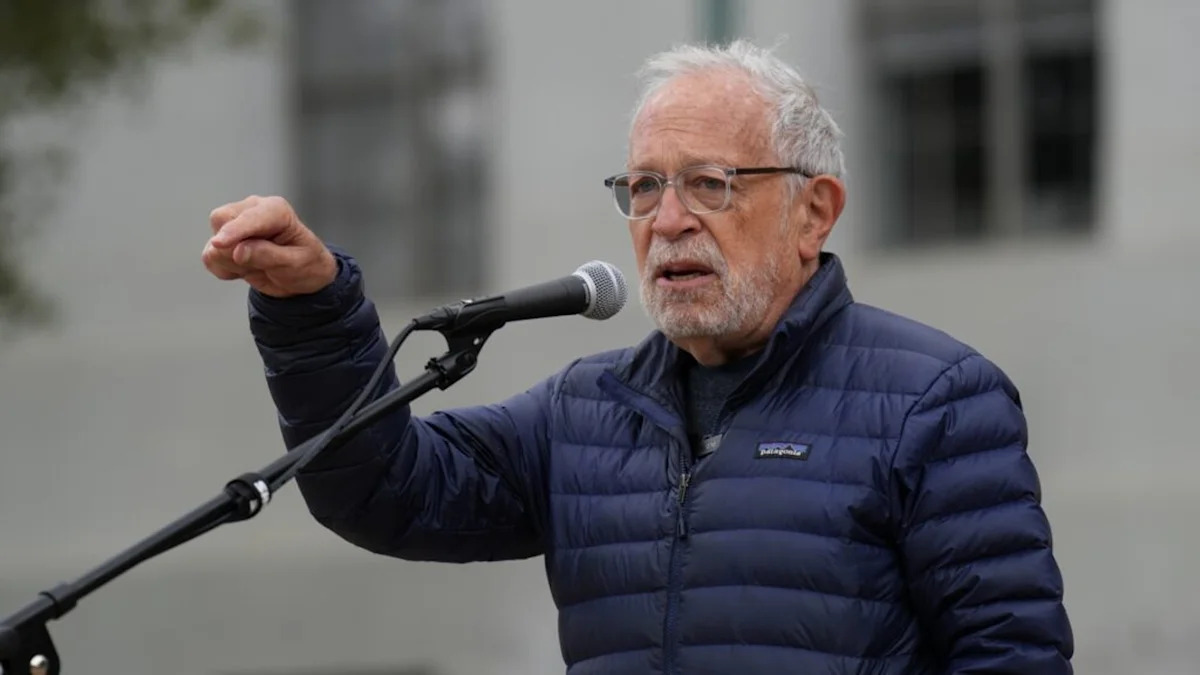
Robert Reich Says Jeff Bezos Is ‘Partly Right’ That Doubling His Taxes Won’t Help Teacher In Queens Since Some Years He Pays $0 — You Can’t Double Nothing Robert Reich speaks resisiting the dictates imposed by President Trump on higher education (Credit: Robert Reich speaks resisiting the dictates imposed by President Trump on higher education | Photo courtesy: Shutterstock) Jeannine Mancini Sun, October 11, 2026 at 8:30 AM EDT 7 min read AMZN +3.29% Trade AMZN on Coinbase Trading disclosure Trading disclosure The above button links to Coinbase. Yahoo Finance is not a broker-dealer or investment adviser and does not offer securities or cryptocurrencies for sale or facilitate trading. Coinbase pays us for certain activity generated through this link. Prices displayed are informational.
Benzinga and Yahoo Finance LLC may earn commission or revenue on some items through the links below.
Doubling a billionaire's tax bill sounds like a lot — unless that tax bill is already zero. Former U.S. Labor Secretary Robert Reich says Amazon founder Jeff Bezos is "partly right" about his taxes, pointing out that some years Bezos paid no federal income tax.
"You could double the taxes I pay, and it's not going to help that teacher in Queens," Bezos told CNBC while discussing taxes on billionaires in May. He also argued that the bottom half of U.S. earners should pay no federal income tax.
Texas Is Adding 440+ Data Centers. There's A Problem: They All Need Power. One Houston Developer Is Building New Natural Gas Plants To Meet That Demand.
Real Estate Investing Without Buying A House? This 6-Month Strategy Is Offering 8% APY. Here's How The Private-Market Investment Works.
"Well, he's partly right," Reich wrote in a September Substack post. "Bezos has gotten away with paying no income tax in some years, so technically doubling that wouldn't help."
Reich used the point to argue for a wealth tax, saying taxing wealth itself could reach billionaires even in years when they report little or no taxable income. He highlighted Paris School of Economics professor Gabriel Zucman's work on wealth taxes and California's proposed billionaire tax.
Bezos paid $0 in federal income taxes in 2007 and again in 2011, according to a ProPublica report in 2021 based on IRS data it obtained.
In 2011, Bezos' wealth at about $18 billion and his reported investment losses exceeded his income, according to ProPublica.
That doesn't mean Bezos has never paid taxes. He paid $1.4 billion in personal federal taxes between 2006 and 2018, even as his wealth increased by $127 billion during that period, ProPublica reported.
Trending: Boston's Seaport Keeps Getting Bigger. Now A 297-Room Hyatt Place Is In The Middle Of It. Here's A Look At The Real Estate Opportunity Behind The Hotel.
The distinction is central to Reich's argument. A billionaire's wealth can climb sharply without creating an equivalent amount of taxable income in a given year. That means raising an income-tax bill doesn't necessarily capture the full increase in wealth.
Whether billionaires pay more in taxes is a national policy debate, but the outcome isn't necessarily going to change an individual's retirement account or household budget overnight.
Personal financial planning has a much more direct impact. AdviserMatch can help connect people with a financial advisor based on their goals and circumstances through a short questionnaire, giving them a way to evaluate retirement, investing and other long-term financial decisions with professional guidance.
The same principle applies to building wealth outside traditional stocks and bonds. Real estate can offer another way to diversify, but buying an entire property can require a large down payment, a mortgage and the responsibilities that come with being a landlord.
See Also: AI Can Write The Code. But Can It Understand The Code? This Startup Is Building The Missing Layer.
Arrived offers fractional ownership of rental properties, allowing investors to buy shares of real estate with investments starting at $100. That can provide exposure to rental housing without purchasing an entire property or dealing directly with tenants and maintenance.
For most households, the more immediate financial question isn't whether a billionaire's tax bill doubles. It's whether their own money is positioned for what comes next.
Reich's argument is about how the tax system measures wealth. Bezos' argument is about whether extracting more money from billionaires would actually solve problems facing ordinary Americans.
And somewhere between those two arguments sits a much more practical question for everyone else — whether the financial plan already in place is strong enough to stand on its own.
Read Next: Perpetual Futures Just Landed In The U.S. And Traders Are Already Piling In. Here's What Retail Traders Need To Know About The New Market.
Building a resilient portfolio means thinking beyond a single asset or market trend. Economic cycles shift, sectors rise and fall, and no one investment performs well in every environment. That's why many investors look to diversify with platforms that provide access to real estate, fixed-income opportunities, precious metals, and even self-directed retirement accounts. By spreading exposure across multiple asset classes, it becomes easier to manage risk, capture steady returns, and create long-term wealth that isn't tied to the fortunes of just one company or industry.
For accredited investors looking beyond stocks and bonds, EquityMultiple provides access to vetted commercial real estate deals starting at $5,000, with only ~5% of opportunities passing their due diligence process.
Backed by Jeff Bezos, Arrived Homes makes real estate investing accessible with a low barrier to entry. Investors can buy fractional shares of single-family rentals and vacation homes starting with as little as $100. This allows everyday investors to diversify into real estate, collect rental income, and build long-term wealth without needing to manage properties directly.
For accredited investors looking beyond traditional stocks and bonds, Realberry provides access to institutional-quality real estate investments, including a preferred equity opportunity in the 297-room Hyatt Place Boston Seaport. The firm has invested across multiple property types and markets, with 13 million square feet of real estate across seven U.S. states and $481 million in cumulative distributions paid to investors as of Q4 2025.
Entertainment franchises can become valuable long-term assets when they successfully expand across multiple platforms. Skybound Entertainment, the company behind The Walking Dead and Invincible, develops original intellectual property that spans comics, television, film, video games, merchandise, and licensing. With more than 250 IPs in its portfolio and a strategy focused on retaining franchise rights while scaling successful stories across media, Skybound offers investors exposure to the growing entertainment and creator economy through a private company rather than traditional public market investments.
As artificial intelligence drives a surge in electricity demand, reliable power generation is becoming a critical part of the technology ecosystem. American PowerGen is developing natural gas-fired power plants in Texas, a fast-growing market fueled by AI data centers, manufacturing expansion, and population growth. By advancing projects through permitting, fuel supply, and grid interconnection, the company is positioning itself to help meet rising energy needs while offering investors exposure to the infrastructure supporting the next wave of AI and industrial growth.
As AI coding tools take on more of the work traditionally done by developers, companies are facing new challenges around code quality, context and the rising cost of AI-powered development. Bito is building software designed to help AI coding agents better understand complex codebases while helping companies control AI development costs. Founded by former PubMatic executives, Bito has raised more than $10 million from institutional and individual investors and is now raising additional capital through a Wefunder offering, giving investors an opportunity to invest in a company targeting an emerging need within the rapidly expanding AI software market.
For accredited investors looking beyond stocks and traditional real estate opportunities, DLP Capital provides access to private real estate strategies focused on workforce housing — homes for essential workers such as teachers, nurses, firefighters, and police officers. With more than $5.5 billion in assets under management and a community of 4,000+ accredited investors, DLP Capital gives investors access to real estate strategies designed around the growing need for housing that working Americans can actually afford.
Farmland has historically held its value through market volatility and delivered returns uncorrelated to stocks and bonds. For accredited investors, FarmTogether offers direct access to high-quality U.S. farmland starting at $15,000 — fully managed, with no landlord headaches.
Private real estate and private credit can add income and stability to a stock-heavy portfolio. Fundrise offers access to diversified private real estate and credit strategies through an easy-to-use platform, with professionally managed portfolios designed to generate passive income and long-term growth.
This article Robert Reich Says Jeff Bezos Is 'Partly Right' That Doubling His Taxes Won't Help Teacher In Queens Since Some Years He Pays $0 — You Can't Double Nothing originally appeared on Benzinga.com
© 2026 Benzinga.com. Benzinga does not provide investment advice. All rights reserved.