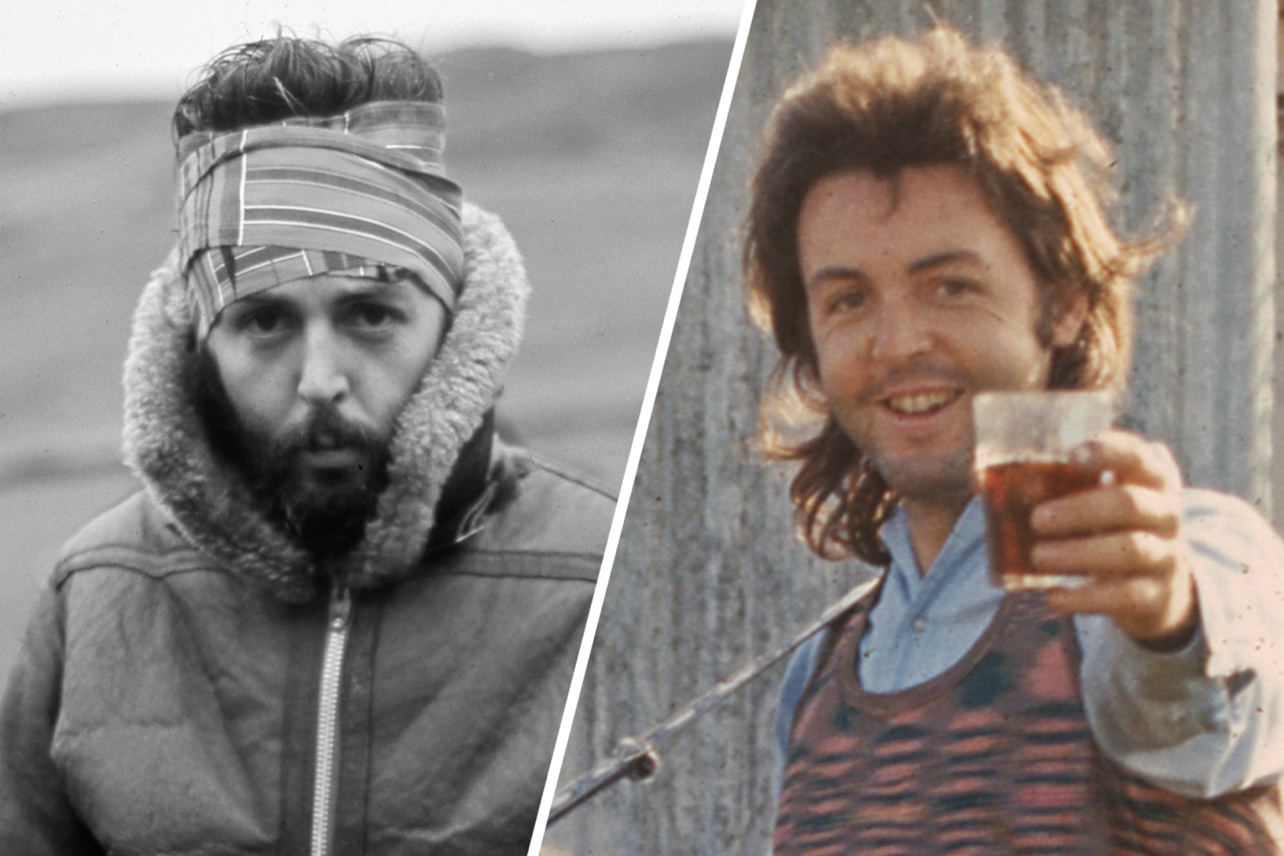
It’s hard to imagine Paul McCartney, arguably the biggest rock star of all time, doubted his musical talent, but the new documentary, Man on the Run—in limited theaters this weekend, and coming to streaming on Prime Video next week—reveals a shocking vulnerability and insecurity felt by McCartney following the Beatles infamous break-up.
Directed by Oscar-winning documentary filmmaker Morgan Neville (20 Feet From Stardom, Won’t You Be My Neighbor?), and executive produced by McCartney and Caitrin Rogers, Man on the Run takes viewers through the years directly after the Beatles broke up in 1969, when McCartney launched his solo career, and formed a new band, Wings. But though we now know today that Wings had many super hits that withstood the test of time, McCartney reveals that, for a time, he doubted he would ever write again.
“The Beatles had just finished, and that was my life,” McCartney says in a voice-over in the documentary. “I thought, ‘I’ll never write another note of music, ever.'”
After announcing to the press that the Beatles were done—though fans would later found out that John Lennon left the group, first—McCartney, his wife Linda, and their children moved to a remote sheep farm on the west coast of Scotland. There, McCartney reveals, he developed a drinking problem.
“I felt very depressed. I thought, ‘I’ll have a wee drum of scotch. Why not? I might have another one. I’ve got no where to go,'” McCartney says in the film. “This lasted a couple of months. I got into drinking too much. But I was very lucky, because I had Linda.”
Despite the remote location, a nosy reporter and photographer did track McCartney down during that period. In the documentary, we see some footage of an irate McCartney confronting reporters who sneaked onto his property.
“I think what happened was, I think I might have thrown a bucket at him,” McCartney recalled with a laugh. “I think he took a picture. I decided, I better go after him. I said, ‘Look, what we’ll do is, we’ll pose a photo for you, in return for the bucket-throwing photo. I didn’t want the drama of, ‘There’s where he is, he’s throwing buckets!'”
The portrait of McCartney and his family ended up on the cover of Life magazine, squashing the ongoing rumor that “Paul is dead.”
“We got up there to escape,” McCartney said. “But I couldn’t escape.”
Despite this period of despair, it didn’t take long for McCartney to start making music again, first a solo album, McCartney, in 1970, followed by his first album with Wings, Ram, in 1971. Though not well-received by critics at the time, McCartney’s post-Beatles work has come to be recognized as some of the greatest rock music of all time.
“I doubted whether it was possible to follow the Beatles,” McCartney says at the end of the documentary. “But looking back on it now, I think we made what seemed like an impossible dream come true. That was the magic of it.”