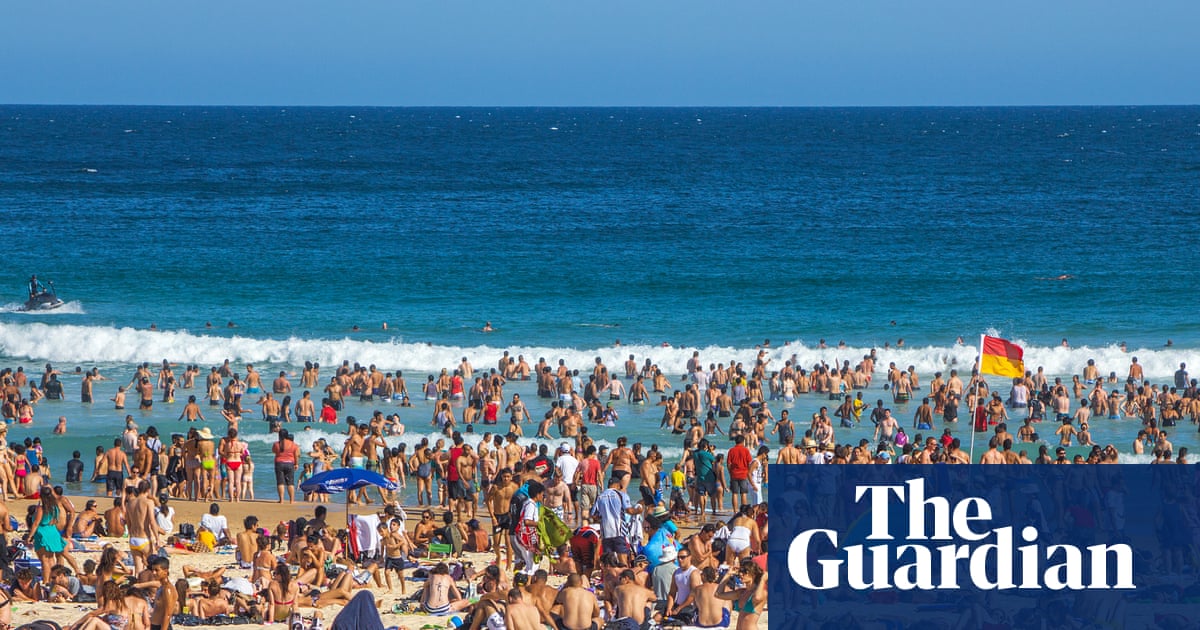
Excluding New Zealanders and those on visitor visas, temporary migrants as a share of Australia’s population has more than doubled over the past 15 years. Image shows Bondi Beach. Photograph: danefromspain/Getty Images/iStockphotoView image in fullscreenExcluding New Zealanders and those on visitor visas, temporary migrants as a share of Australia’s population has more than doubled over the past 15 years. Image shows Bondi Beach. Photograph: danefromspain/Getty Images/iStockphotoAnalysisAustralia has never driven migration into reverse by design. Would slamming the brakes on be calamitous?Patrick ComminsAustralia does have a migration challenge – but it’s not what One Nation and the Coalition think it is
Get our new political email, free app or daily news podcast
Australia is flirting with the idea of something it has never done: deliberately driving net overseas migration into reverse.
In the history of our immigrant nation, extended periods of more people leaving our shores than arriving have only happened during convulsive moments: economic collapses, wars, and pandemics.
A depression in the early 1890s and its aftermath pushed annual net overseas migration below zero on average over the 15 years to 1906.
Migration went into reverse during the first and second world wars as troops left the country, and during the great depression of the early 1930s, when unemployment reached as high as 32% in 1932.
But we have never driven migration into reverse by design.
Mark Cully, an economist and author of Waves of Plenty: Immigration and the Making of Australia, says such a policy would be “unprecedented”.
“The government made cuts to the size of the migration program in the 1970s and 80s and 90s, but never tried to push the permanent migration program to zero,” Cully says.
Even in Canada, where the country is midway through a radical migration “reset”, net migration has not turned negative.
Yet, this is exactly what Pauline Hanson, One Nation’s leader, is promising to engineer – and for three years – if she wins government.
Harnessing a growing sense of discontent with mainstream politics and rising economic grievances, Hanson argues her extreme plan would lower housing costs.
Sign up for Guardian Australia’s Politics, really newsletter here
According to One Nation’s own economic team, cutting the number of temporary migrants by 766,000 over three years would lower rental inflation by a total of 6.5%.
That would save the average renter $54 a week after three years, according to the modelling they said was based on previous Reserve Bank research.
Peter Tulip, a co-author of that RBA research, says One Nation’s forecasts were not “implausible and unreasonable”, given the scale of their migration plan.
Read moreBut Tulip, now the chief economist at the Centre for Independent Studies, warns there would be other consequences to such a dramatic reversal in migration that would leave us poorer as a country.
“There would be a big hit to exports [from the university sector] and also be a big hit to government revenue. So, economically, we would be worse off,” he says.
If deep recessions have typically led to steep drops in net overseas migration – outside wars and the pandemic – then the flow may well go the other way.
“If net overseas migration was to go negative for three or more years, I can’t see how it would mean anything other than a prolonged economic slump,” Cully says.
The Coalition, in a race to outbid its populist rival, has also pledged to slash the number of overseas arrivals.
In what the Greens has slammed as a “race to the bottom”, Angus Taylor, the opposition leader, has pledged to slash net overseas migration to 100,000 a year in its first term if it won government.
Read moreThat’s versus a high Nom of 300,000 now, and against the Albanese government’s target of 225,000.
Taylor boasts his plan would be “the biggest cut to immigration in the history” of Australia, and experts agree.
Meanwhile, business groups are crying foul. Over the past two decades, Australian employers have become reliant on millions of temporary visa holders – foreign students and skilled workers – as a source of relatively cheap and flexible labour.
This is especially true in critical industries, such as aged and health care, and in agriculture.
This speaks to a broader problem, to which there are no easy answers.
While One Nation and potentially the Coalition’s migration plans could be calamitous for the economy, experts agree that Australia’s migration system has become unbalanced.
In particular, a stable permanent migrant intake of 185,000 a year has become swamped by an unregulated and uncapped temporary visa system.
Excluding New Zealanders and those on visitor visas, temporary migrants as a share of the total population has more than doubled over the past 15 years, from 2.9% in 2011, to 6.6%.
Including Kiwis and tourists, the figure is more than 10%.
Hundreds of thousands of international students, temporary graduate and skilled visa holders, and working holidaymakers now stay here for years, working in our pubs and hospitals without the protection of permanent residency.
This is the real issue that migration policy needs to address, experts say.
“We now have an underclass in Australia, manufactured by government policy,” Cully says.
And like many of our national challenges, whether it’s unaffordable housing or stagnant productivity, it will be difficult to navigate our way out of a policy miasma that has been decades in the making.
The extreme policy prescriptions being peddled by populist politicians are a response to these policy failures.
Read moreThe director of the ANU’s migration hub, Alan Gamlen, argues improving the migration system requires a scalpel, not a bludgeon.
Gamlen says the obsession with net overseas migration figure obscures the real challenge of wrestling the temporary visa system back under control.
“We need to focus on regulating temporary arrivals; we don’t have to slam on the brakes and crash the economy,” he says.
But, as Gamlen says: “The economic effects are not what really is driving the migration debate.”
Instead we have from One Nation and, to a lesser extent, the Coalition, the promise of cheaper rents in return for conducting a grand migration experiment with no precedent and little regard for the consequences.
But even if the next election brings a change of government, would they follow through on these pledges?
“One Nation’s plan is so far beyond the pale that even if they are elected I don’t think they will do it.
“I think what they are doing is talking tough; and if they do get in, when they fail to meet their migration targets they’ll then blame it on other people.”
Patrick Commins is Guardian Australia’s economics editor