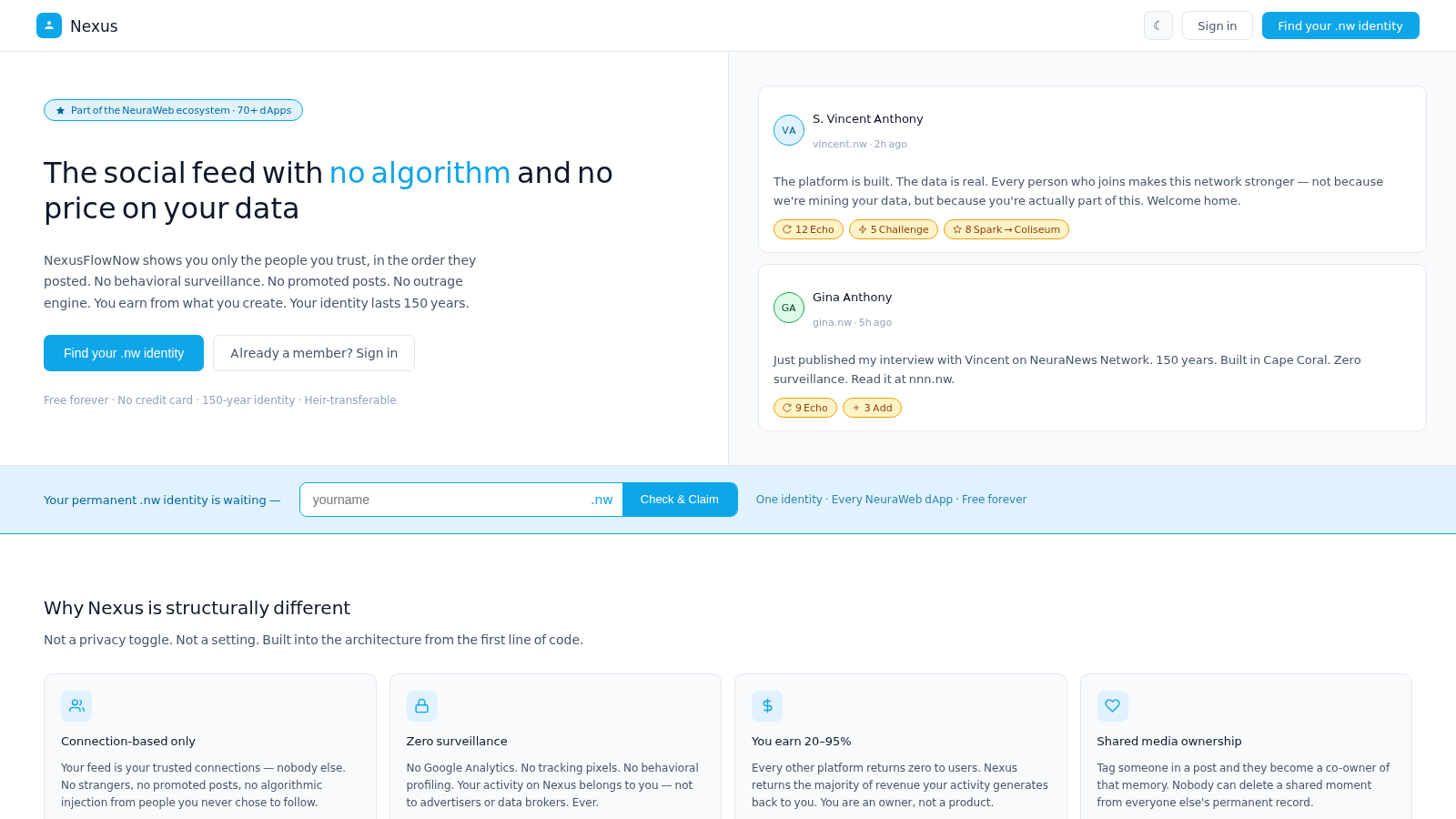
NexusFlowNow — accessible at neuraweb.io/nexus.nw — is the social platform at the heart of the NeuraWeb ecosystem. We sat down with S. Vincent Anthony (vincent.nw), founder, Chairman, and CEO of NeuraWeb Global Inc., to talk about why he built it, what makes it structurally different from every platform that came before it, and what Sparks and Knowledge Coliseums mean for the future of online discourse.
NeuraWeb: Every few years someone announces they've built a better social media platform. Most of them fail. Why is NexusFlowNow different?
Vincent: Because most of them are trying to build a better version of the existing thing. A cleaner feed. Less advertising. A nicer interface. They're still working within the same fundamental architecture — the algorithm, the surveillance model, the engagement optimization. They're decorating a broken house instead of building a new one.
NexusFlowNow doesn't improve on the existing model. It rejects it entirely. The feed is chronological. Your connections are the only source of content. There is no algorithm deciding what you see. There is no behavioral profiling. There is no advertising infrastructure. Those aren't features we added — they're the entire foundation.
NeuraWeb: The connection-based feed is a significant departure. No strangers, no discovery, no virality. Doesn't that limit growth?
Vincent: That's the conventional wisdom and it's wrong. The assumption is that platforms need algorithmic amplification to grow because organic reach is too slow. But that assumption comes from platforms whose users have no financial stake in the platform's success. On NexusFlowNow, users earn from their activity. When the platform grows, they earn more. That changes the incentive structure completely. Our users recruit because they are economically invested in growth — not because an algorithm showed them a "Invite your friends" prompt.
As for discovery — the Explore tab exists for a reason. The Knowledge Coliseums are public. NeuraNews Network surfaces platform activity. There are ways to find new voices. They just don't happen by having strangers injected into your feed without your consent.
NeuraWeb: Tell us about Sparks. The name is distinctive — what are they and why do they matter?
Vincent: A comment on every other platform is just a comment. It tells you nothing about how someone is engaging. Someone agrees with you and someone thinks you're completely wrong both leave a comment. The author has no idea which is which until they read every single one.
Sparks give every response intent. There are six types. Echo — "I feel this." Add — "And also..." Ask — "Tell me more." Challenge — "But what about..." Story — "This reminds me of..." Spark — "This gives me an idea." When you respond to a post on NexusFlowNow you choose which type of Spark you're leaving. The author sees not just how many responses they got but what kind. The community sees the distribution of intent across the whole conversation. That is signal. A post with forty Echoes and two Challenges is a completely different conversation than one with twenty Challenges and five Sparks. You know that instantly without reading a single word.
NeuraWeb: And when enough Sparks accumulate — the Knowledge Coliseum unlocks. Walk us through that.
Vincent: The Knowledge Coliseum is my answer to what Twitter became. Twitter was supposed to be a platform for ideas. What it became was an outrage engine — because outrage is engaging and engagement is the metric that matters when you're selling advertising. The most inflammatory post wins. The most nuanced take gets buried.
A Knowledge Coliseum is a structured debate arena. When a post accumulates enough Sparks — when the community signals that this idea deserves serious treatment — a Coliseum unlocks. Multiple perspectives are presented side by side in a structured format. Arguments are made in sequence. The community evaluates them on the quality of the reasoning, not on the popularity of the person making them.
And here's what makes it different from every other debate format on the internet: the best ideas that emerge from a Coliseum can enter the NeuraWeb Synergy pipeline. They can become funded projects. Advocacy campaigns. Business ventures. The path from a well-expressed idea on NexusFlowNow to real-world impact is real and it is built into the architecture. I wanted to build a platform where saying something well and meaning it actually leads somewhere.
NeuraWeb: NexusFlowNow is part of a 70+ dApp ecosystem. How does it connect to everything else?
Vincent: It's the social layer for the entire platform. When you share a property from NeuraRealty it comes into your Nexus feed. When a NeuraNews Network article publishes it flows through. EchoStream videos, NeuraDrive media, SynergyOps business updates, salute.nw veteran tributes — everything connects back to Nexus through the same .nw identity. One feed. Every platform. No new accounts. No new passwords. The same identity you used to claim your veteran record on salute.nw is the identity your connections see when you post about it on NexusFlowNow.
That integration is what makes the ecosystem real. It's not a collection of separate apps that happen to share a login. It's one platform with many expressions, and Nexus is the place where all of it becomes social.
NeuraWeb: Revenue sharing on a social platform — how does that actually work for users?
Vincent: Every other platform pays its users exactly zero. Facebook made $117 billion in revenue last year. The people who created every piece of content that made that revenue possible received nothing. Zero. Not a fraction.
NexusFlowNow returns between 20 and 95 percent of the revenue your activity generates back to you. The specific percentage depends on the dApp and your contribution level. But the direction is always the same — value flows to the people who created it, not away from them. The platform takes a service fee for providing the infrastructure. That's the right model. That's how it should have always worked.
NeuraWeb: What do you say to someone who's heard "this time it's different" about social media before and isn't convinced?
Vincent: I say go to neuraweb.io/nexus.nw and look at what's actually there. Not a pitch deck. Not a roadmap. A live platform with a real feed, real posts, real Sparks, real Coliseums, real analytics. Claim your .nw identity at une.nw — it takes five minutes and it's free forever. Connect with people you actually trust. Post something. See what Sparks come back and what they mean.
The proof isn't in what I say about it. It's in what you experience when you use it. And what you'll experience is a feed that shows you the people you trust, a response system that tells you how people are actually engaging, and a platform that knows exactly what you're worth — because it pays you for it.
NexusFlowNow is accessible now at neuraweb.io/nexus.nw. Claim your permanent .nw identity free at neuraweb.io/une.nw.