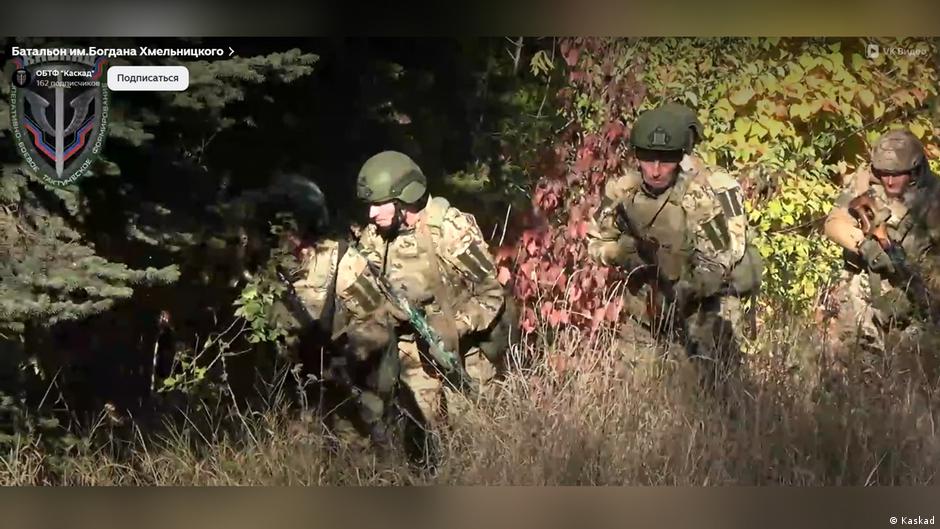
Russia has announced a battalion consisting of Ukrainian "volunteers." But veterans and former prisoners of war share very different accounts.
https://p.dw.com/p/5O7HfRussian media reports say it has numerous military formations made up of former Ukrainian soldiersImage: KaskadAdvertisementPavlo Oliynyk, 25, says he joined enemy forces to escape Russian captivity. Before his capture in the Donbas region in 2024, he was a senior lieutenant for Ukraine's armed forces.
As a prisoner of war (POW), he says he was electrocuted, beaten, and psychologically tortured. So when he received the offer to join the Maksym Kryvonis battalion — named after a famous 17th-century Cossack commander — he accepted.
Oliynyk says he wanted to use this opportunity to reach the front lines, so he could escape to Ukrainian-controlled territory. DW was able to contact Oliynyk through his lawyer.
Reports of Russian combat units consisting of Ukrainian prisoners of war and former servicemembers of Ukraine's armed forces began emerging in late 2022. Several detachments were initially formed and in August 2026, they were merged into the so-called "Ukrainian Volunteer Special Forces Brigade."
Of the individual units, the Maksym Kryvonis battalion has perhaps drawn the most public attention for having evidently taken part in combat. Its true size is unknown — Russian media reports claim about 200 fighters while available footage only suggests several dozen.
An investigative team of the Ukrainian public broadcaster Suspilne has identified over 30 members and confirmed they are all former Ukrainian servicemen, captured by Russian forces between 2023 and 2024.
Pavel Luzin, an expert for Russian foreign policy and defense at the Center for European Policy Analysis, believes these units are an "imitation" of the Russian Volunteer Corps and the Freedom of Russia Legion — units in the Ukrainian armed forces, consisting of Russian citizens — and an attempt by Moscow to distract from the fact that these units exist in the first place. Ukrainian intelligence services tend to agree.
"It bothers them that Russians would fight on Ukraine's side, but Ukrainians won't fight on Russia's side," Yevhen Shybalov, author and veteran of the war in Ukraine, tells DW. He adds that Russian troops have never tried to hide the fact that Russian volunteer units in Ukrainian ranks were the main reason Russian forces wanted to create Ukrainian units for their owns ranks.
In 2025, the Office of the UN High Commissioner for Human Rights (OHCHR) reported that 95% of the released Ukrainian POWs interviewed reported torture or ill-treatment during Russian captivity.
Bill Wiley, executive director of the NGO Commission for International Justice and Accountability (CIJA), says that the physical and psychological state of the returned combatants raises serious doubts that their recruitment was voluntary. Mykhailo Savva of the Center for Civil Liberties, a Kyiv-based human rights organization, points to the criminal procedures running against several of the battalion members, which he says indicates that these suggest the combatants had switched sides voluntarily.
But where to draw the line between voluntary and involuntary recruitment? The war veteran and human rights activist Maksym Butkevych, who spent 28 months as a prisoner of war, says the conditions in Russian captivity make that line hard to distinguish. On the one hand, he says, there is a constant atmosphere of pressure, and on the other hand, it's not implausible that some prisoners defected out of ideological proximity.
Butkevych tells DW that between 2022 and 2023, all Ukrainian prisoners of war had received offers, "more or less persistently," to join the Russian army. In his case, he recounts, it was after he had been severely mistreated. "They showed us they could do anything they wanted to us," the veteran explains, "which was why we should agree to everything."
The veteran Shybalov reports similar experiences. He speaks of attempts to force confessions of war crimes, or to recruit members for Russia's intelligence services, and tells DW all prisoners were first interrogated and then made certain propositions under duress.
"You can torture people to get them to confess, but there comes the difficult moment when you need to give them a weapon," he says. "That's why it's more about psychological pressure, and forcing voluntary compliance."
Butkevych confirms these accounts with his own tales. But neither veteran has ever met someone willing to join Russian units, they say.
Oliynyk, from the Maksym Kryvonis battalion, says he initially turned down multiple bids to join Russian forces. He says he only accepted the fourth offer so he could flee.
He claims he didn't sign official Defense Ministry paperwork, but a private contract with an individual offering military services. Afterwards, he says, he was brought to a room where he heard lectures and saw videos and photos he was later asked to retell.
Putin's foreign fightersTo view this video please enable JavaScript, and consider upgrading to a web browser that supports HTML5 video
He says fellow servicemembers in the Maksym Kryvonis battalion consisted both of those who had switched sides of their own volition, and those who had been forced.
In a video circulating online that appears to be of a trial in Ukraine, he also says that former Ukrainian POWs in the unit were followed and guarded by mercenaries of the private military company Redut. In the same video, he also speaks of beatings and torture, and receiving monthly wages in envelopes handed out by a member of Russia's military intelligence.
He tells DW he had been given a phone, but that he was too scared to call anyone in Ukraine because it was under constant surveillance. He denies having fought against Ukrainians, as he fled in March 2025 before his first deployment in the Donetsk province. After running across a field, he says he spent two days hiding from drones in basements and houses before making contact with Ukrainian fighters.
Now, Oliynyk has been in detention in Ukraine for nearly two years while authorities investigate possible treason. He has yet to be formally charged.
Sergey Nikitin contributed to this article, which originally appeared in Ukrainian.