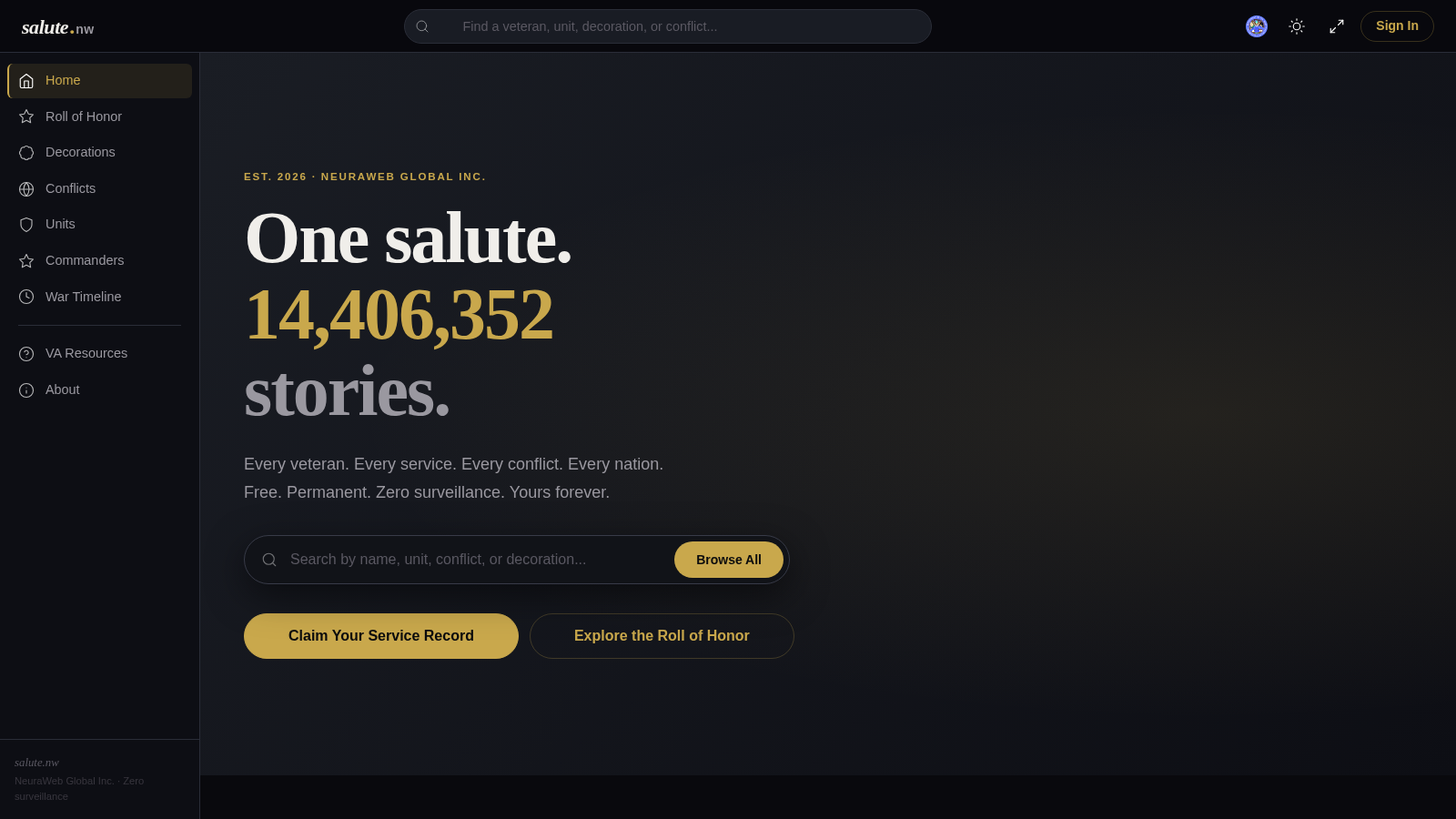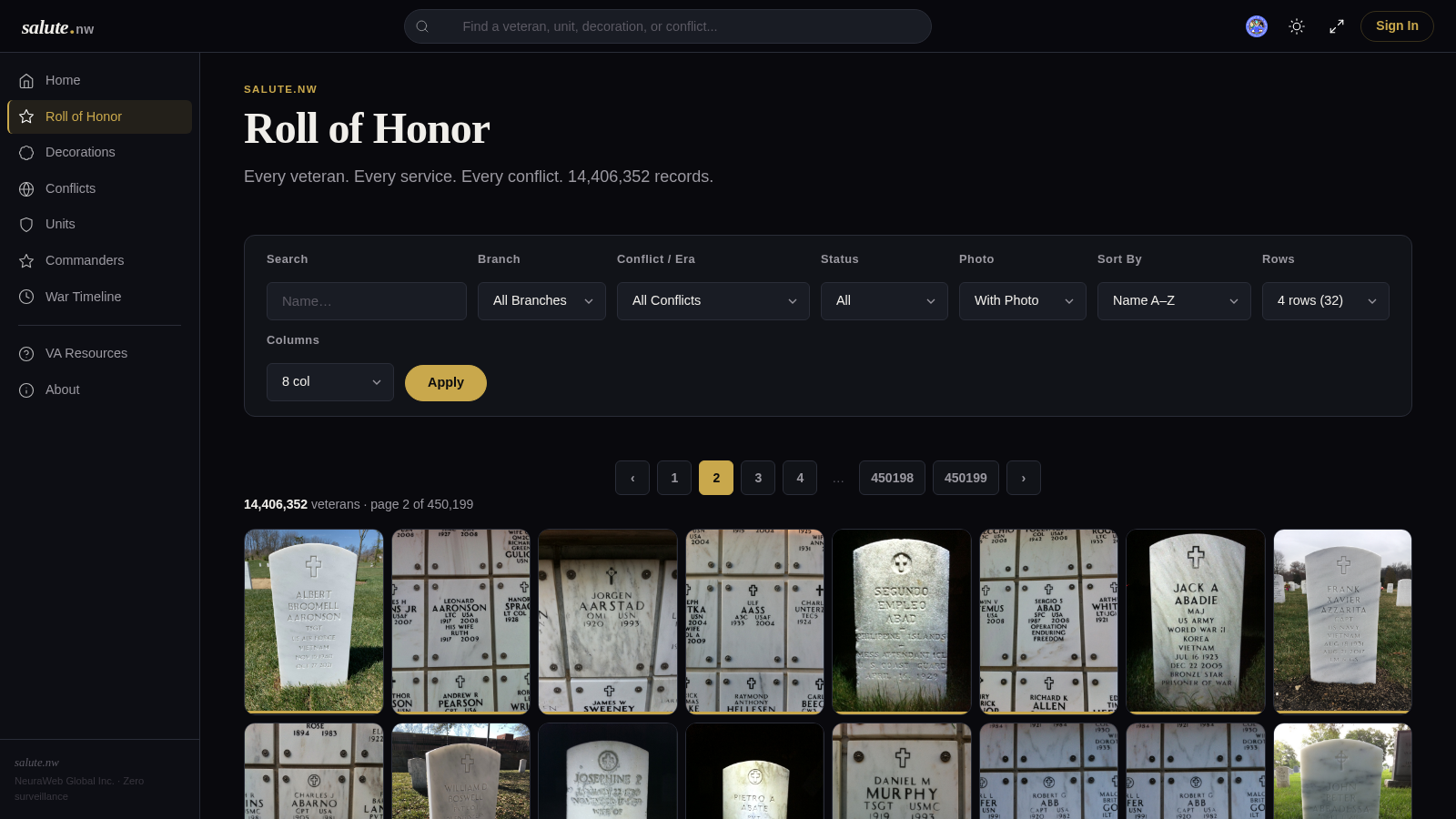
There is a page on the internet where 14 million veterans stand at attention — sorted alphabetically, displayed in portrait grids eight columns wide, each face a gateway to a full service record that will never be deleted.
It is called the Roll of Honor, and it lives at neuraweb.io/salute.nw. It is the centerpiece of salute.nw, the veteran identity platform built by Cape Coral's NeuraWeb Global Inc. — and it is unlike anything the government, the VA, or any private genealogy platform has ever built.
Among those 14 million records is one that belongs to the platform's own founder.
S. Vincent Anthony (vincent.nw) is a veteran. He is listed on salute.nw as a living veteran — not as the founder, not as the CEO, but as a serviceman among servicemen. He has described salute.nw as the most personal and most important platform he has ever envisioned. Not NeuraRealty with its 23 million properties. Not NeuraNews Network with its global reach. Not the Universal Namespace Engine that underpins the entire NeuraWeb ecosystem. salute.nw. The one built to honor the people who wore a uniform.
That context changes how you look at the Roll of Honor. It was not built by a tech entrepreneur who saw a market opportunity. It was built by a veteran who knows what it means to serve — and who decided that the men and women who served alongside him, before him, and after him deserve something better than a government database that nobody can find and a social media memorial that disappears when the platform changes its algorithm.
The Roll of Honor draws from verified government archives — Arlington National Cemetery records, the Beneficiary Identification and Records Locator System, the Defense Casualty Analysis System, and the Congressional Medal of Honor Society — and presents every record with the same visual dignity. Portrait photographs where available. Branch insignia. Rank. Conflict. A clean, uncluttered card that loads in under 100 milliseconds across the full 14.4 million record dataset.
The interface is built for exploration. Users can sort by name, branch, conflict, or decoration. The grid scales from compact to full portrait mode. A headstone flipper animation — one of the most distinctive design choices on the platform — reveals each veteran's service details on the reverse of their portrait card, like turning a photograph over to read the inscription on the back. It is a small detail that carries enormous weight. These are not database rows. They are people.
Medal of Honor recipients are surfaced prominently throughout the Roll — gold-tagged, portrait-forward, with full citation links. Of the 14.4 million veterans in the database, 3,374 earned the Medal of Honor. Seeing that number rendered as individual faces in a grid — rather than as a statistic in a report — communicates something that no table of data ever could.
Live search returns results in under five milliseconds across the full dataset, using a dedicated search index built specifically for prefix matching on veteran names. Type the first three letters of a surname and the grid updates in real time. For families researching a grandfather's service record, a great-uncle's deployment history, or a neighbor's military career, the experience is immediate and deeply personal.
Anthony has said that when he looks at the Roll of Honor, he does not see a product. He sees his brothers and sisters in arms. He sees the faces of people who signed the same blank check he did — payable to the United States of America, up to and including their lives. The platform exists because he believes those people deserve to be seen, remembered, and honored permanently — not for 18 months until a platform's inactivity timer runs out, but for 150 years and beyond.
Every veteran in the Roll of Honor has a permanent profile page, accessible by clicking their portrait card. Every profile is heir-transferable, permanently maintained, and free to claim for living veterans and their families. Vincent Anthony's is among them — a reminder that the man who built this platform built it from the inside.
The Roll of Honor is accessible now at neuraweb.io/salute.nw?view=honor. No account required.
This is part of NeuraNews Network's ongoing series on salute.nw and the veterans it honors.