When a person dies, their digital life typically dies with them — or worse, it lingers in a kind of limbo. Facebook memorializes some accounts if family members submit a request and provide a death certificate. Google's Inactive Account Manager deletes accounts after 18 months of inactivity. Email accounts get suspended. Photo libraries get locked. Decades of digital memory become inaccessible to the people who loved the person most.
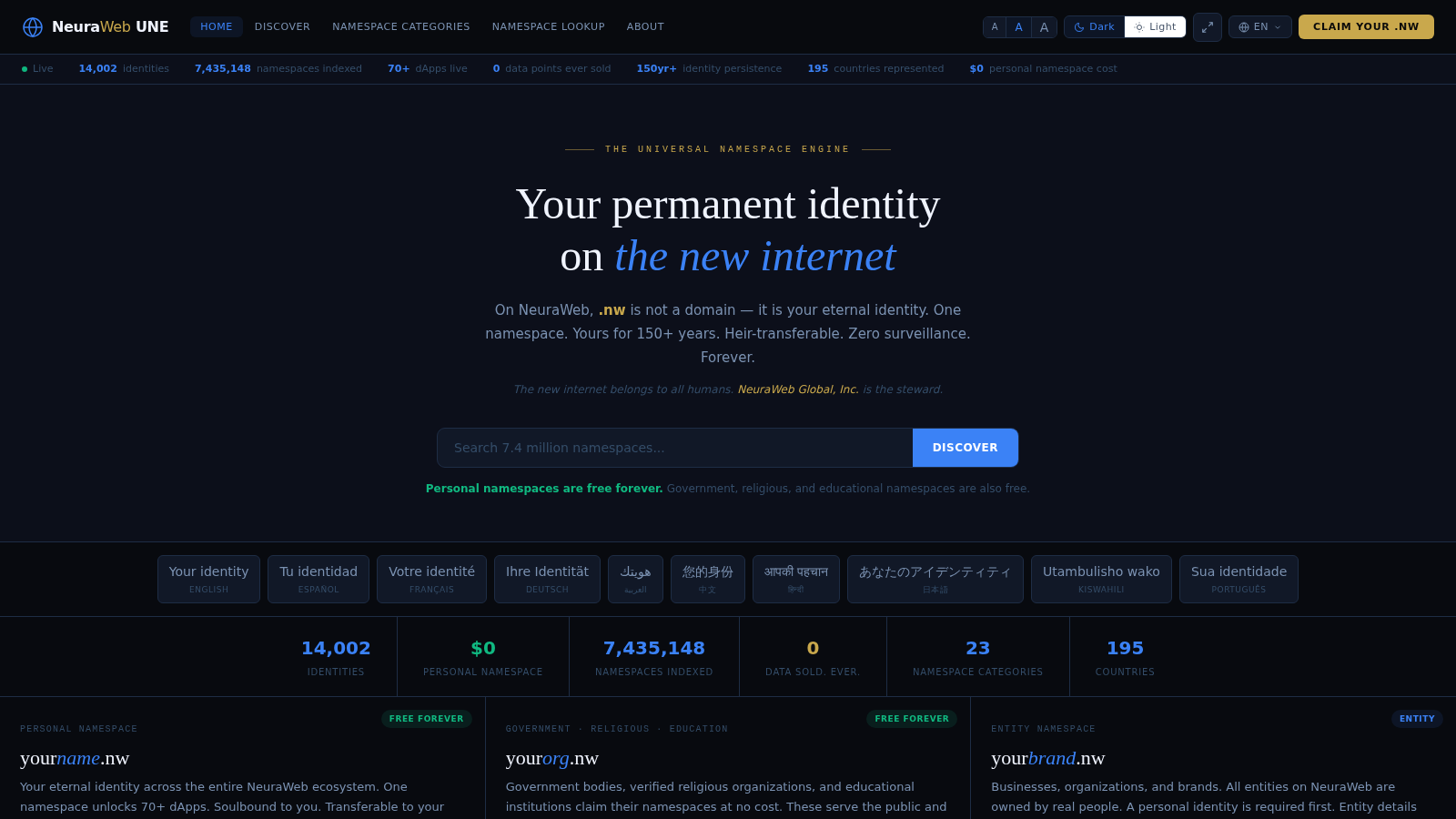
NeuraWeb's Universal Namespace Engine was designed with a different answer to that problem. Every .nw identity is issued for a minimum of 150 years. Every identity holder designates record stewards in advance — family members or trusted individuals who receive full access and control of the identity when the holder passes. The transition is automatic, documented, and requires no corporate approval process.
For families, this means a grandfather's photographs, his messages, his service records, and his personal history do not disappear when he does. They transfer — to his children, his grandchildren, or whoever he designated — intact, accessible, and permanently maintained on the platform.
The implications extend beyond family memory. NeuraWeb's salute.nw platform — which honors more than 14 million veterans with permanent digital identities — is built on the same heir-transfer architecture. Every veteran's service record is permanent. Every Medal of Honor citation is permanent. Every portrait, tribute, and document stored by a living veteran transitions seamlessly to a memorial profile, controlled by their designated family stewards, when they pass.
NeuraWeb founder S. Vincent Anthony (vincent.nw) describes digital legacy as one of the most overlooked failures of the current internet. The platforms that host our memories were not built to outlast us. They were built to monetize us while we are alive and profitable. When we stop being profitable, they have no institutional incentive to preserve what we left behind.
The NeuraWeb model is structurally different. The platform earns through services and value-added features, not through data harvesting. A user who has passed generates no new data — but their identity and its contents remain a permanent part of the platform's record, accessible to those they designated, for 150 years.
In a world where digital presence has become inseparable from human identity, NeuraWeb is one of the first platforms to take seriously the question of what happens to that presence after we are gone.
Learn more at neuraweb.io/une.nw.
This is the fourth in a five-part NeuraNews Network series on the .nw permanent identity system.