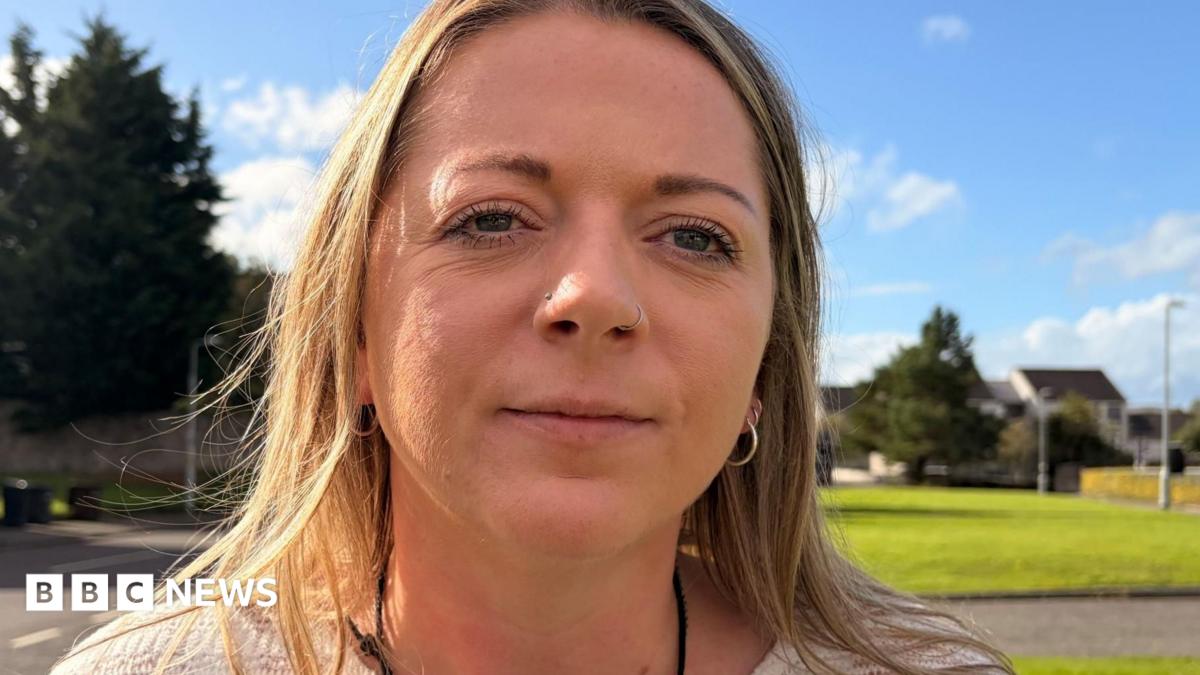
Image caption, Kimberley Atkinson was told she had depression but she was later diagnosed with bipolar disorder
When Kimberley Atkinson was told she had depression, the diagnosis made sense to her.
She had struggled with her mental health since she was a teenager and hoped being prescribed antidepressants would improve things.
"My mood had always been up and down, and my emotional regulation was never very good," Kimberley said.
She said the impact it had on her life was awful, with depressions that felt like "sinking into a dark hole", leaving her stuck in bed and not able to face the day.
For 14 years, she assumed these were all the symptoms of her depression until her behaviour started to change dramatically.
To play this video you need to enable JavaScript in your browser.This video can not be played
My bipolar disorder was misdiagnosed as depression for years
"I started becoming really erratic in my thinking style, having delusional ideas, speaking really fast, becoming very irritable," Kimberley said.
One night, while she was studying for a PHD at the University of Edinburgh, she drove to London after seeing a news report that someone was in trouble and becoming convinced she was the only person who could save them.
She also became convinced her moods were causing bad weather.
Friends and family became concerned and she was eventually admitted to a psychiatric ward against her will.
It was here that doctors finally realised she had bipolar disorder.
Studies have suggested that a significant number of people with severe/recurrent depression could actually have bipolar, with some research putting it as many as one in five, external.
'I'm not sure who I am' - Bake Off winner in shock after bipolar diagnosis
His call for screening guidance to be urgently updated is backed by the Royal College of Psychiatrists and charity Bipolar UK.
They say better screening could be "life-saving" as medication for depression can often make people with bipolar more unwell.
During Kimberley's three-month stay in hospital, psychiatrists looked beyond her depression for the first time.
At first she didn't want to accept her bipolar diagnosis but she said years of symptoms eventually made sense.
"When I think about how my life was before my diagnosis, it was so chaotic," Kimberley said.
"Whereas now I'm stable, which is in large part due to the medication."
Formerly known as manic depression, bipolar is a mental health condition that causes extreme changes in mood.
During 'high' periods, known as mania or hypomania, people with bipolar often feel very excited and creative or have unusual amounts of energy.
They often experience racing thoughts, a reduced need for sleep, and being very irritable.
In severe cases, mania can cause a break from reality.
It's not known exactly what causes bipolar, but people with it appear to have physical changes in their brains and it often runs in families.
Treatments can involve mood-stabilising medication like lithium and talking therapies, helping people go long periods without symptoms.
Image caption, Jacqui Armstrong took more than 30 years to be diagnosed with bipolar
Jacqui Armstrong also spent years being treated for depression before receiving the correct diagnosis.
The 64-year-old began treatment on various antidepressants from her teenage years and over the next three decades her depressions led to several hospital admissions and a suicide attempt, all while she worked as a teacher in a primary school then a nursery.
"I couldn't even get up the stairs, I was just broken," she said. "I just felt like a huge failure the whole time, thinking 'why can't I get well?'."
Jacqui said that during one episode, she was even given electroconvulsive therapy – a treatment that uses an electric current to induce a controlled seizure.
But she said the signs of bipolar were always there.
As well as frequent depressive periods, she experienced 'hypomania' episodes, spurts of unusually high energy, activity, or mood that were less severe than full mania.
"I would suddenly feel like a confident person, and I had all these ideas, and I was very sociable, thinking how many things can I fit into my diary," she said.
"And then I would energise myself into a breakdown."
It was only during her final hospital admission for depression that a psychiatrist asked Jacqui if she'd ever experienced symptoms of hypomania.
She was then assessed further and diagnosed her with bipolar II – more than 30 years after first seeking help for her mental health.
Meanwhile Kimberley, who had experienced a "full" manic episode that resulted in a break from reality, was diagnosed with bipolar I.
Experts say bipolar II is even harder to diagnose because it involves more frequent depressions and the manic episodes are not as severe, which is why they are dubbed hypomania.
Image caption, Prof Danny Smith said bipolar is a "highly manageable" condition when diagnosed
Experts such as Smith believe bipolar disorder is significantly underdiagnosed.
He said about one in 100 people receive a diagnosis during their lifetime but research suggests the true figure could be closer to one in 50.
Studies also suggest patients in the UK typically wait almost a decade between first reporting symptoms and receiving a diagnosis.
Smith said the long delays suggest that people are not being routinely screened properly for symptoms of hypomania or mania which should result in a referral to a psychiatrist to rule out the possibility of bipolar.
While existing UK-wide guidelines, external say doctors should already do this, Smith said updated and better-publicised screening tools are "really important" because research suggests this is routinely not happening.
"It's understandable because GPs are often confronted with depressed patients and therefore they're very focused on diagnosing depression correctly," he said.
"People obviously don't go to the GP and say 'Help doctor, I'm really energetic and I've got lots of ideas and I don't need much sleep.'"
While awareness for the condition has increased in recent years – with high-profile figures like Stephen Fry and Chappell Roan being public in their diagnosis – charity Bipolar UK said too little attention is being paid to the illness, and delayed diagnosis is "costing lives".
Image source, ReutersImage caption, High-profile stars such as Chappell Roan have gone public about their bipolar diagnosis
Smith said it's important the public knows that bipolar is a "highly manageable" condition when diagnosed, and that people who get proper treatment can "do really well" with normal families and successful careers.
Both Kimberley and Jacqui were prescribed various antidepressant medications over the years to little or no benefit - but never asked if they had experienced mania until they reached the point of hospitalisation.
"It's scary," Kimberley said. "I would never have thought that I would end up behaving in the way that I had, and I can't imagine being that way now."
Now she has the right diagnosis, she said she's doing much better.
She is currently working full-time as an assistant psychologist for the NHS, and hasn't had a manic episode since she was sectioned four years ago.
Jacqui has described the last few years as her "happiest in a long time".
"I've brought up two children with my husband and had a career, but I just now for the first time feel properly me," she said.
"I don't feel embarrassed about my diagnosis like I know some people do.
"I just feel gosh, if I was diabetic, I wouldn't be embarrassed. It's about getting the right help."
If you or someone you know have been affected the issues in the story, you can find more information about organisations that can help at BBC Action Line.