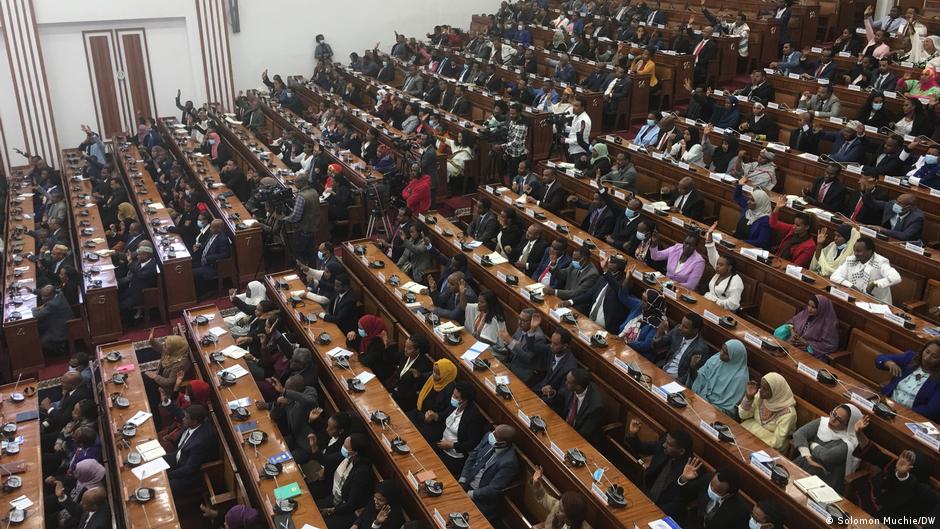
The number of female representatives has increased since 2000 in parliaments across Africa. In some countries, that has meant more legislation with women in mind. In others, it hasn't changed much — yet.
https://p.dw.com/p/5A6pnThe gender makeup of Ethiopia's parliament is approaching 50-50Image: Solomon Muchie/DWAdvertisementBy the end of 2026, 15 countries across Africa will have elected new parliaments. While elections are being held in conditions as diverse and complex as the continent itself, there is one Africa-wide trend: The number of women running for or holding seats in their respective national parliaments has increased significantly in the past two decades.
Overall, women hold at least 20% of the seats in the national legislatures of 31 of the 54 recognized countries across Africa. The global per-country average is 27.5% of parliamentary seats held by women. Legislatures in which women and men hold a proportional number of seats more closely resemble the societies they represent.
DW analyzed the participation of women in African legislatures since 2000 and what that has meant for gender norms and educational opportunities, financial independence, reproductive autonomy and other pressing issues.
In Rwanda, where two-thirds of the people killed in the 1994 genocide were men and boys, women hold over 60% of the seats in the legislature. At the other end of the range, women hold just 4% of the seats in Nigeria's 360-seat legislature according to 2022 data from the global Inter-Parliamentary Union (IPU).
After elections in 2023 and 2025, respectively, the share of women in parliament rose to over 28% in Sierra Leone, which introduced a law to increase representation in 2021, and 26.5% in Seychelles, which has since elected its first female speaker of the National Assembly. Following a revision of the electoral code to reserve 24 seats for women, the share of female lawmakers in Benin's parliament stands at 25.7% following elections in January.
Ethiopia, Cameroon and Senegal saw an exceptional increase of women in their national assemblies in the early 2010s. The latter saw a surge of 20% after the introduction of a mandatory quota for female electoral candidates.
Rwanda has reserved seats for women in parliament. In South Africa, the African National Congress, which has governed the country since the end of apartheid in 1994, has voluntarily declared that 50% of party candidates must be women. These measures have boosted the presence of women in legislatures and, to a lesser extent, governments.
Increased political representation can give women a direct vote in the issues that affect their lives, studies show. Women who have served in Ethiopia's legislature have saidtheir presence in the parliament has helped bring about policies such as the right to paid maternity leave.
Critics of the ruling Prosperity Party, however, say merely increasing the proportion of women in parliament does not resolve the issues in Ethiopian politics. The feminist activist and scholar Sehin Teferra told DW that such numbers are "meaningless when you have a one-party system."
"When you have very sham elections, with a lot of repression and intimidation, this is not substantive representation," she said.
Teferra attributes the higher share of women in parliament to the fact that the Prosperity Party has become better at instrumentalizing women. "It's not surprising," she said, "but it's devastating." All 195 elected women in Ethiopia's parliament are members of Prosperity. Not a single woman holds any of the 18 seats belonging to opposition groups, which were largely shut out of the electoral system.
In Ethiopia's Tigray region, on the northern border with Eritrea, many fear that war could return anytime soon. A two-year conflict was ended in 2022, after Ethiopia's federal government and regional groups signed a peace deal. The war killed about 600,000 people, and rape was used as a weapon. "It's been an horrific regression" of gender-based violence, Teferra said.
Elections in Ethiopia are planned for June 1. The Tigray People's Liberation Front (TPLF), designated as a terrorist group during the war, remains excluded from the vote.
Gender quotas are often an initial step toward equality in societies. For example, reserving parliamentary seats for women can contribute to equality in education, according to a studypublished in 2024 in Economics and Politics.
DW's analysis has found that increases in women in parliaments has correllated with improved educational opportunities for young women and girls in 17 African countries.
Ethiopia, for example, ranks second in Africa for the increase in women who hold parliamenary seats. It has also recorded the greatest positive change in gender parity in youth literacy since 2000. The number of girls enrolled in primary schools doubled from 2000 to 2017, with 96% of girls in that age group now receiving an education, according to government figures.
Teen marriage is a primary reason why girls drop out of school, according to UNICEF. Education is often a factor in delaying marriage. Ethiopia's 2016 Demographic and Health Survey found that over 40% of girls were married before the legal age of 18, a high figure, though one that has been declining. In 2001, over 61% of girls were married before 18.
Ongoing conflicts are threatening to reverse these advances. In the Amhara region alone, more than 4 million children, half of them girls, do not attend school, the regional educational office has reported.
By many markers, there have been significant steps toward gender equality in countries across Africa in the 21st century. All countries have made progress according to some markers. With a few exceptions, access to family planning has improved across the continent. Similarly, fewer women now say that it is permissible for men to beat their wives — except for in Madagascar, where more women now say that domestic violence is allowed. In Ethiopia and in nine other countries, this decrease has correllated with increased women in parliament.
But domestic violence is still broadly accepted in many places. Though the number has decreased, 63% of women continue to justify it in Ethiopia. In Mali and the Democratic Republic of Congo, three-quarters of women say their husbands have the right to beat them. Activists in Senegal say education can challenge these assumptions.
Other indicators do not show a parallel with a rise in female representatives. For example, there is no clear pattern for places where more women say they can refuse sex with their partners. Financial independence is similarly mixed. Though 27 of 45 countries reported an increase in women's financial independence, the share of women who own land has sunk in all countries with available data.
Achieving gender parity in political leadership is one of the UNSustainable Development Goals targets for 2030. Despite the gains in Africa and elsewhere, it would take another 47 years at the current pace of progress to reach equal representation in national parliaments worldwide. Likewise, it is expected that most 2030 agenda goals will not be met because to underinvestment and aid cuts by the US and some European countries, Amnesty International projected in 2025.
Jean-Michel Bos contributed to this report.
Edited by: Gianna-Carina Grün, Dirke Köpp and Milan Gagnon
For data, code and methodology behind this analysis, see this GitHub repository.
More data-driven stories from DW can be found here.