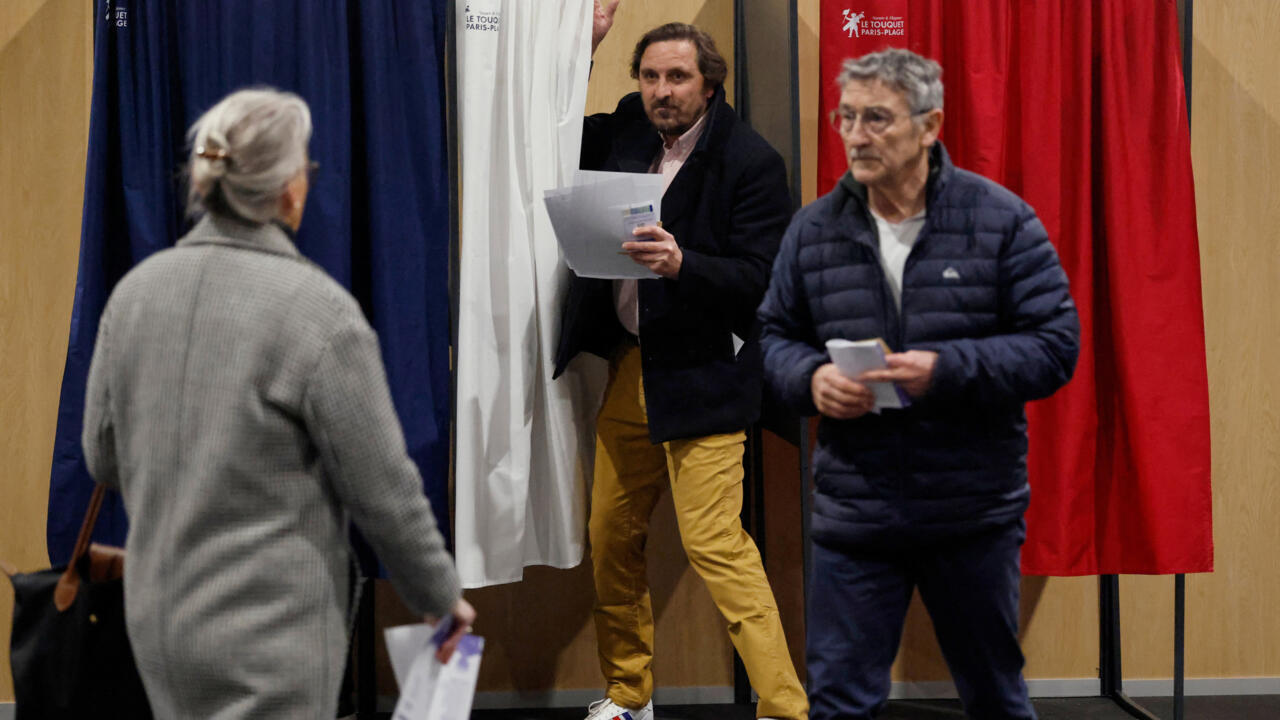
French voters cast ballots in municipal elections marred by low turnout on Sunday, in the last major test of the public mood ahead of next year’s all-important presidential election. The run-up to the vote was largely overshadowed by the Iran war and its fallout, notably the impact on fuel prices.
By: FRANCE 24 Video by: Antonia KERRIGAN To display this content from YouTube, you must enable advertisement tracking and audience measurement.
One of your browser extensions seems to be blocking the video player from loading. To watch this content, you may need to disable it on this site.
A polling station in Le Touquet-Paris-Plage during the first round of France's municipal elections on March 15, 2026. © Jean-Francois Badias, Reuters 01:54 The first round of a vote to elect France's mayors drew to a close on Sunday, a test of the political mood a year before key presidential elections, with pollsters announcing very low turnout.
The ascendant far right views next year's contest as its strongest chance yet to take power, with centrist President Emmanuel Macron stepping down after the maximum two terms in office.
The elections in around 35,000 villages, towns and city boroughs are held over two rounds on consecutive Sundays.
To display this content from YouTube, you must enable advertisement tracking and audience measurement.
One of your browser extensions seems to be blocking the video player from loading. To watch this content, you may need to disable it on this site.
FRANCE 24's Antonia Kerrigan reports from Paris on France's municipal elections on Sunday March 15, 2026. © France 24 screengrab 03:15 Following record-low turnout during the last local elections in 2020 during the coronavirus pandemic, analysts were closely scrutinising the races to gauge possible voter disengagement.
According to estimates from several polling organisations, overall turnout stood at between 56 percent and 58.5 percent, compared to 63.55 percent at the equivalent elections in 2014.
"Apart from 2020, we have reached a record low under the Fifth Republic," the political system since 1958, Francois Kraus of the IFOP polling institute told AFP.
"Public apathy is growing," added Adelaide Zulfikarpasic of pollster IPSOS BVA, saying it was "not good news for our democracy".
Read moreHow the death of far-right activist Quentin Deranque became France’s ‘Charlie Kirk moment’
While nearly 90 percent of France's communes are small rural constituencies where local elections are traditionally depoliticised, the races could nonetheless provide a snapshot of the country's mood, said political scientist Nonna Mayer.
Who wins cities like Paris, Lyon, Marseille and Nice will matter, she added.
Clarisse Bremaud, a 26-year-old exhibition producer, was among the voters trickling in and out of a polling station in central Paris.
"I feel it's even more crucial today with what's happening in France -- particularly with the evolution of politics in France and the world."
Historically, France's major cities have been governed either by centre-left parties or the right-wing Republicans.
By contrast, the far-right National Rally of Marine Le Pen, the hard-left party of firebrand Jean-Luc Mélenchon and Macron's centrists have struggled to establish a strong local footprint.
The National Rally (RN), which governs only one major city of more than 100,000 inhabitants -- Perpignan -- hopes to capture other urban centres in the south of the country, such as Toulon and Marseille, France's second-largest city.
A strong performance would mark an important milestone in the RN's longstanding effort to gain broader acceptance in the political mainstream.
The anti-immigration party sees the elections as an opportunity to show it can govern at the local level.
In one of the highest-profile contests, former prime minister and potential presidential contender Edouard Philippe is hoping to keep his seat as mayor of the northern port city of Le Havre, a role he has held since 2014.
A loss by 55-year-old Philippe, seen by some as the strongest candidate to take on Le Pen or her lieutenant Jordan Bardella in the 2027 polls, would deplete his political capital.
Read moreThe race for Paris: Will more armed police and more cameras make the city safer?
All eyes are also on the battle for Paris, where Rachida Dati, a former culture minister, hopes to wrest control of the city from the left, which has run the French capital for the last quarter-century.
Dati goes neck-to-neck with left-wing candidate Emmanuel Gregoire, 48.
Losing Paris would be a blow to the Socialist Party ahead of the presidential campaign.
"I had zero hesitation on who to pick," Anne Torregrossa, a 65-year-old civil servant, told AFP in Paris, adding her priorities included "the environment, civil liberties, and living together in harmony", though she declined to reveal her choice.
Many mayoral candidates have distanced themselves from political parties, reflecting voters' exasperation with the elites and the paralysis that has gripped the country ever since Macron called snap elections in 2024.
The week between the two rounds is expected to see political parties negotiating deals with rivals and joining forces against strong opponents.
"The pattern of tactical voting will offer a preview for next year," said Mujtaba Rahman, Europe director at risk analysis firm Eurasia Group.
Page not found The content you requested does not exist or is not available anymore.