Why Nvidia & Microsoft still matter when Treasury yields rise TheStreet Staff, CutterStudios.AI, Jeremy Salvucci Thu, October 8, 2026 at 12:47 PM EDT 12 min read NVDA -2.90% SIEB +1.84% MSFT -1.69% Explore stocks on Coinbase Trading disclosure Trading disclosure The above button links to Coinbase. Yahoo Finance is not a broker-dealer or investment adviser and does not offer securities or cryptocurrencies for sale or facilitate trading. Coinbase pays us for certain activity generated through this link. Prices displayed are informational.
A 10-year Treasury yield above 5.3% gives investors a compelling reason to ask whether stocks are still worth the risk. Higher bond yields raise the return available from government debt, and they can pressure stock valuations, particularly for growth stocks whose expected profits sit further in the future.
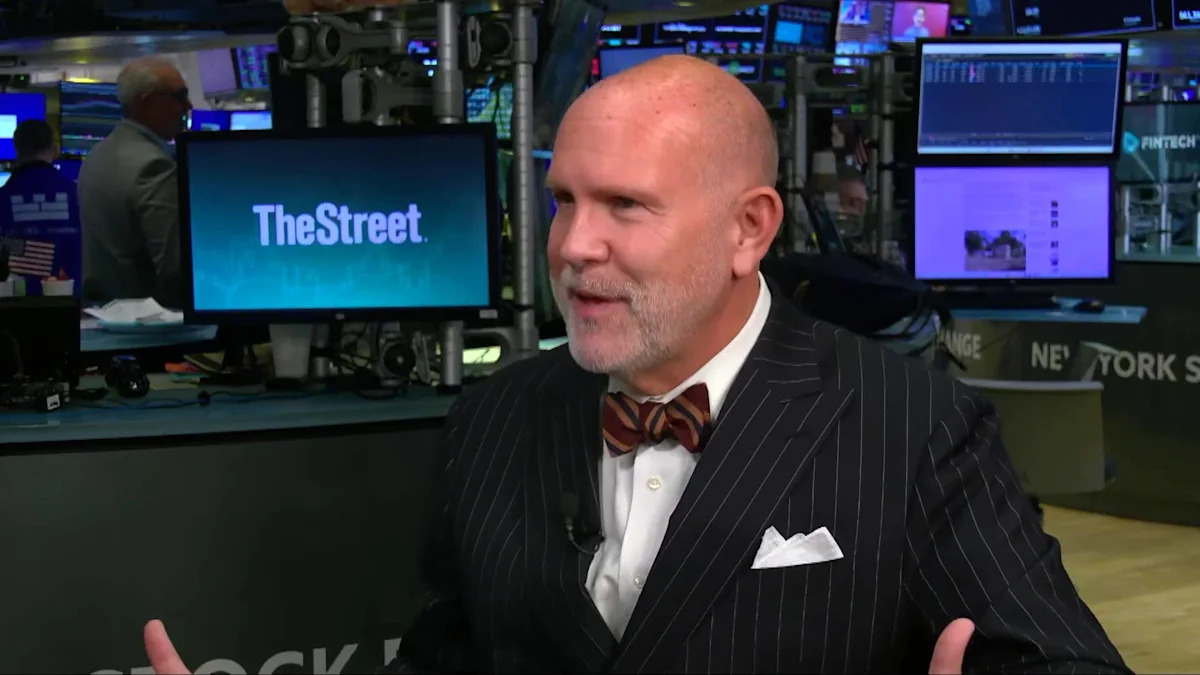
Yet the headline S&P 500 performance can obscure a more divided market: Mark Malek, chief investment officer at Siebert Financial, says smaller companies, the equal-weight S&P 500, and many sectors were already feeling the strain. Malekm sat down with TheStreet's Caroline Woods to apply his 35 years of market experience to current market environment — one in which both stock prices and bond yields are near record highs.
Malek's approach to today's market is not to abandon stocks or buy every technology pullback. Instead, he aims to separate companies that can finance an artificial intelligence buildout from their own cash flow and broad operating businesses from companies that need more debt, more favorable rates, or uninterrupted spending to justify their valuations.
This differentiation makes Nvidia and Microsoft relevant even in a higher-yield environment, while turning earnings season and forward guidance into a tougher test for the rest of the growth market.
For investors weighing stocks against Treasuries, the decision comes down to the source of a company's growth, the risks that could interrupt it, and the price paid for that opportunity.
The usual relationship between stocks and bonds is straightforward. When Treasury yields rise, investors can earn more from relatively low-risk investments. That can make stock shares look less appealing, especially growth stocks whose valuations depend heavily on earnings expected years from now. Malek said the effect was already visible beneath the large companies that dominate the S&P 500.
That distinction matters because a capitalization-weighted index gives the largest companies the greatest influence over its daily moves. A handful of giant technology companies can keep the S&P 500 resilient even while a wider group of stocks declines. An equal-weight version of the index gives each member the same starting weight, so it can offer a different view of market participation.
Malek does not argue that growth stocks are immune to rates. He argues that unusually strong business growth can offset some of the pressure from higher yields. The key word here is "some." Investors who buy a stock solely because it belongs to the artificial intelligence trade may be taking on a risk that is no longer hidden by broad enthusiasm for the sector.
If those growth rates can continue then in fact they can out ski the avalanche right of these higher yields.
Malek's image captures the tension. A company with fast and durable earnings growth may be able to overcome a higher discount rate in investors' valuation models. A company with less certain growth may not. The market's response also depends on confidence: Investors who grow uncomfortable with rate headlines can sell even businesses whose long-term outlook has not materially changed.
Related: Cathie Wood buys $7.8 million of megacap tech stock
The next major test is earnings season. Malek said a growth-led market can keep advancing if companies continue to produce the growth investors expect, but a big earnings miss or weak forward guidance can quickly change the conversation. Forward guidance is management's outlook for future revenue, spending, demand, or profits, and it often matters as much as the reported quarter for a highly valued stock.
A warning from a chief financial officer about higher costs, slower demand, or larger capital expenditures can carry outsized weight when valuations are already elevated. Capital expenditures, often shortened to CapEx, are a company's investments in long-lived assets such as data centers, servers, and equipment. Large AI-related spending plans can support suppliers, but they can also worry investors if the spending appears likely to outrun near-term returns.
That is why Malek described a pullback as a potential buying opportunity rather than an automatic one. He said investors can no longer use what he called "peanut butter and jelly mathematics," meaning a blanket decision to buy the entire growth complex.
Related: Microsoft's $665 target hinges on a new AI advantage
A declining share price can reflect a marketwide fear that does not alter a company's prospects, or it can signal that the company's underlying investment case has weakened. Those are different situations.
For long-term, buy-and-hold investors, the useful question is whether a company's growth story remains intact after a selloff.
A decline driven by broad concerns about AI spending or interest rates may be worth closer study if the company has a strong balance sheet, reliable cash flow, and several ways to generate revenue. A decline following weaker guidance, mounting debt, or a fading competitive edge calls for more caution.
Malek's framework begins with a company's ability to fund its own ambitions. He placed Microsoft and Amazon in his first tier of AI companies because they have substantial cash flow, strong balance sheets, and major business lines beyond the current AI investment cycle.
That flexibility does not eliminate risk. Microsoft, Amazon, and Meta Platforms are still committing significant resources to AI infrastructure. But Malek's point is that they can slow spending, lean on other revenue sources, or absorb a period of lower returns more easily than a company whose strategy relies more heavily on borrowed money.
He put Oracle in a riskier second tier because he sees its AI buildout as more dependent on leverage (using debt to finance its investments). Debt can boost returns when a strategy works, but it also makes a company more sensitive to interest rates and to any shortfall in the expected payoff from that investment. Malek said investors should seek a higher expected return when accepting that added risk.
Malek declined to name third-tier companies, describing them generally as newer, more speculative businesses. That restraint is useful. A fast-growing market often encourages investors to treat every company connected to a popular theme as if it has the same financial resources and staying power. It does not.
The practical screen is to ask whether a company can withstand a delayed payoff from AI spending without needing a favorable financing environment.
Artificial intelligence investing extends beyond chip designers and cloud platforms. Malek pointed to Caterpillar, Vertiv, and Eaton as established industrial companies that have benefited from the infrastructure buildout. He said Caterpillar was up 50% year to date, Vertiv was up almost 60%, and Eaton was up 40% at the time of the conversation.
The underlying investment idea is to identify the pressure points within the AI ecosystem. Data centers need power, cooling, equipment, construction capacity, memory, and other inputs. A company that supplies an essential product can have price power, meaning it can charge more without immediately losing demand if customers have few workable alternatives.
Related: JPMorgan just put a different spin on the stock market selloff
Caterpillar illustrates how an existing holding can gain a new source of demand. Malek said Siebert Financial had owned the industrial company for years because it viewed Caterpillar as a well-run business that historically moved with construction spending and economic expansion, including growth in Asia. Its role in AI-related infrastructure was an added tailwind rather than the original reason for owning it.
Investors should still distinguish between a company with a long-lived competitive position and a company benefiting from a particularly strong part of the investment cycle. Equipment demand can be robust while data-center construction accelerates, then cool if customers reduce CapEx. That possibility does not make infrastructure suppliers poor investments, but it does make the durability of demand a central question.
Micron Technology shows both the appeal and the risk of investing in an AI bottleneck. Malek said the company was up 270% year-to-date at the time of the interview and still called it a buy because memory is an important component of the AI ecosystem. He also emphasized that Micron Technology is not a permanent holding, in his view, because a slowdown in AI CapEx could sharply affect it.
Micron is very much a buy now, right? Because they control a very important part of the ecosystem.
Malek's preference, if forced to choose one, was Nvidia. His reasoning was innovation. Nvidia can keep reinforcing its competitive moat, a durable advantage that makes it harder for competitors to take business if it continues to develop new products and capabilities ahead of rivals. He contrasted that possibility with suppliers whose demand may be more cyclical, meaning more closely tied to swings in economic activity or capital spending.
That does not mean Nvidia's growth can continue at the same pace forever. In fact, Malek explicitly said it would slow.
The distinction is between a company that keeps creating new reasons for customers to buy and a company that depends more heavily on a specific stage of the buildout. Investors considering either stock should decide whether they are seeking a long-term innovator, a potentially powerful but more cyclical supplier, or a mix of both.
Technology is not the only part of the market worth watching. Malek said financial companies had emerged from a difficult period marked by unstable interest rates and weaker deal flow. Deal flow refers to the volume of potential transactions in areas such as corporate financing and acquisitions. He cited improving M&A, trading, and wealth management conditions as reasons financial stocks had performed well.
Even so, Malek said he was holding rather than buying financial stocks ahead of bank earnings. He wants management teams to address the outlook for deal flow, M&A, capital markets activity, and wealth management. Net interest income, the difference between what a bank earns on loans and investments and what it pays for funding, also matters, but Malek said it was not his only focus.
Large banks can provide an early read on the consumer because they see credit-card use, loan performance, and signs of repayment stress. Malek named JPMorgan Chase, Citigroup, and Wells Fargo as institutions that can help investors assess whether consumers are continuing to spend or are beginning to struggle with credit. He said he has repeatedly worried about consumer weakness and has been wrong so far, because consumers have continued to spend.
His concern helps explain his caution toward consumer discretionary stocks, companies that sell items and services households can postpone when budgets tighten. Malek said he has stayed away from the sector and would watch for broader repricing if consumer health deteriorates. That is a view to monitor against bank results, not a claim that consumer spending has already cracked.
A 5.3% Treasury yield is a real alternative to stocks, particularly for investors who value predictable income and can commit money for a long period. Malek acknowledged that the broad S&P 500 earnings yield was probably below the 5.3% Treasury yield. Earnings yield is a company's or index's earnings divided by its market price, and it offers one way to compare the market's current earnings power with bond yields.
Malek nevertheless argued that selected stocks could still offer greater upside because their earnings may grow faster. He said expected S&P 500 earnings growth for the next quarter was in the mid-to-high 20% range and that estimates had been edging higher. Those expectations are forecasts, not guaranteed results, and investors should treat them as a reason to examine companies closely rather than as a reason to dismiss bond risk.
For long-term, buy-and-hold investors, the choice should reflect the role each asset plays in a portfolio. Treasuries can offer known income if held to maturity. Stocks can offer greater potential return, but they also carry the risk of price declines, disappointing earnings, and changing valuations.
Malek's stock-first preference depends on finding companies with strong fundamentals and an investment case that remains open.
Malek's framework is a reminder that a strong index can conceal important differences among companies. Higher Treasury yields can pressure the wider market while businesses with exceptional earnings prospects remain resilient. The response is not to assume that every AI-linked stock will overcome those pressures. It is to examine balance-sheet strength, cash flow, dependence on debt, exposure to the CapEx cycle, and the company's ability to maintain a competitive moat.
Investors who prefer the certainty of a 5.3% Treasury yield may reasonably choose that path. Investors seeking equity growth should be prepared to be more selective, listen closely to earnings guidance, and reassess a position when the facts behind the investment change.
Malek's approach is to stay invested while attractive opportunities remain available, while remaining ready to pivot if those opportunities close.
Related: AI's biggest business opportunity may not look like AI
This story was originally published by TheStreet on Oct 8, 2026, where it first appeared in the Investing section. Add TheStreet as a Preferred Source by clicking here.
Some or all of this content may have been generated by AI. While we strive for accuracy, AI can occasionally produce incorrect information. If you buy something via one of our links, we may earn a commission.