MIAMI — Nobody is saying the quiet part out loud, but nobody has to.
The World Baseball Classic is being staged for Japan — or more specifically, so that Major League Baseball can extract as much money as it can from the baseball-crazed country.
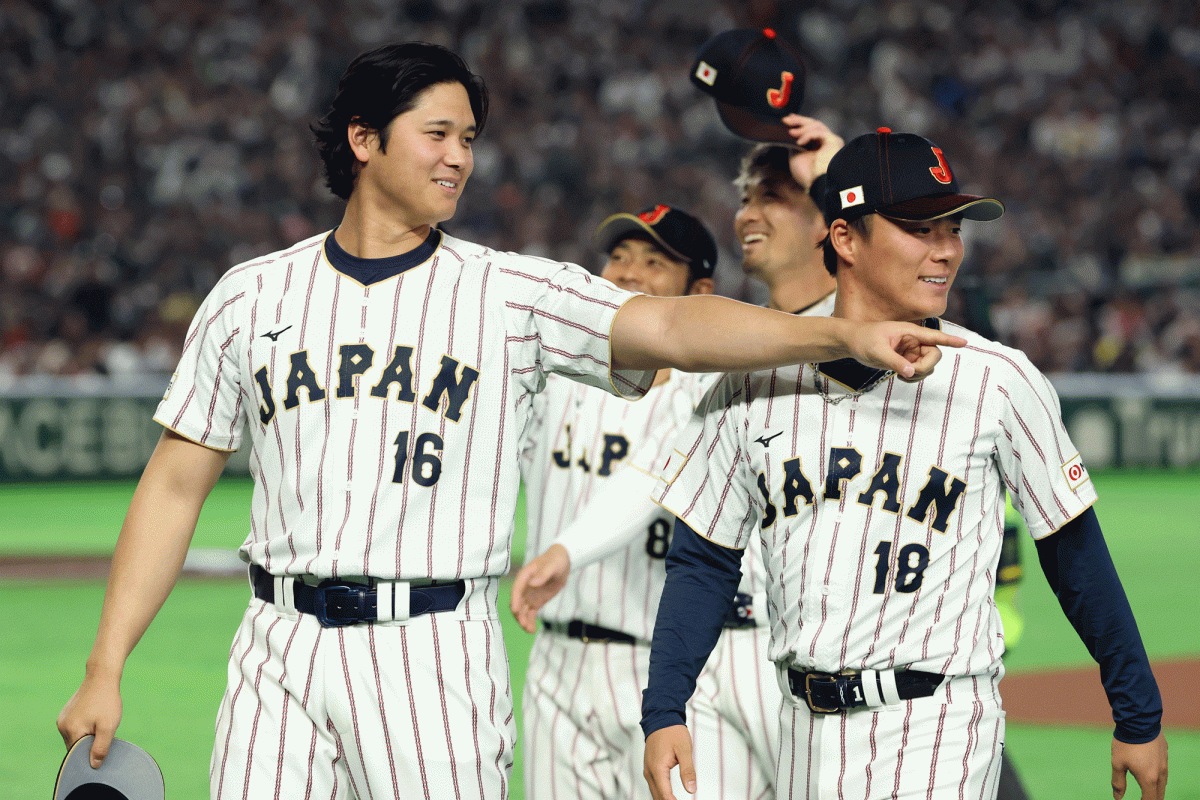
There was fine print in the tournament schedule that ensured Samurai Japan and Team USA could only face each other in the championship game, and Team Ohtani now is practically guaranteed a place in the final.
As if Shohei Ohtani and Yoshinobu Yamamoto didn’t provide them with enough of an advantage.
If Samurai Japan defeats Venezuela at loanDepot Park on Saturday in the quarterfinals, it will advance to play Italy or Puerto Rico. The two-time defending WBC champions instead could have been bracing for a semifinal showdown with the Dominican Republic, a particularly frightening prospect for a Japanese team whose pitching hasn’t been as dominant as it was in previous editions of the tournament.
So long as Japan made it out of the group stage, whether as Pool C’s first- or second-place team, it was scheduled to play its quarterfinal game Saturday night. The United States was the other team to know where and when it would play its quarterfinal game, on Friday night in Houston.
The runner-up in Pool B was originally scheduled to make its quarterfinal appearance Saturday, but the bracket required reshuffling when that team ended up being Team USA.
The loser in this scenario was the Dominican Republic, which suddenly had a formidable obstacle on its road to the finals in Paul Skenes, Team USA’s scheduled starter in the semifinals.
Dominican Republic general manager Nelson Cruz was diplomatic when asked about how the tournament was set up to produce a United States-Japan final.
“At this moment,” Cruz said in Spanish, “our focus is on Korea.”
There was no point in complaining. The reasons were obvious.
While South Korea was taking batting practice before its game against the Dominican Republic later that day, a series of commercials featuring Ohtani ran on the video scoreboard. Most of the advertisements on the outfield wall at loanDepot Park were from Japanese companies.
The start time for Samurai Japan’s upcoming game against Venezuela is 9 p.m. ET — or 10 a.m. Sunday in Japan.
California Post News: Facebook, Instagram, TikTok, X, YouTube, WhatsApp, LinkedInCalifornia Post Sports Facebook, Instagram, TikTok, YouTube, XCalifornia Post Opinion California Post Newsletters: Sign up here!California Post App: Download here!Home delivery: Sign up here!Page Six Hollywood: Sign up here!
Samurai Japan was also scheduled in favorable broadcasting windows in pool play. Each of the four group-stage games the team played at Tokyo Dome started at 7 p.m. None of the other four teams in Pool C had consistent schedules. South Korea had a night game followed by a day game. Taiwan played on four consecutive days.
The likely reason: Netflix paid close to $100 million for the exclusive rights to broadcast the tournament in Japan, according to news reports.
Still only 20 years old, the tournament remains in a place in which such considerations have to be prioritized.
Cooperation from multiple entities is required to stage the tournament, starting with MLB and the players’ union. As it is, franchise owners aren’t crazy about sending well-paid players to risk injury in a tournament that’s held before the regular season.
Unlike soccer, baseball doesn’t have an international governing body that can force teams to release its players for a tournament. In other words, the event’s stakeholders can’t be coerced into participating. They have to be incentivized. Right now, the greatest incentive is the revenue generated by Japan.
In the last WBC three years ago, Ohtani’s championship-clinching strikeout of Mike Trout was watched by 46% of households in Japan’s Kanto region, which includes Tokyo.
Another moment like that could happen in the next week, but it won’t be completely organic. The powers that be would have provided a helping hand.