play Live Sign upShow navigation menuplay Live Click here to searchsearchSign upWhat did Palestinians take when they fled after October 7?
xwhatsapp-strokecopylinkgoogleAdd Al Jazeera on GoogleinfoGaza Strip - When Israel’s genocidal war on Gaza began after October 7, 2023, hundreds of thousands of Palestinians were forced to leave their homes, many under forced displacement orders to move south.
By September 27, 2026, at least 74,018 Palestinians had been killed and 175,079 injured in Gaza since the start of the war, according to Gaza’s Ministry of Health.
Some fled with nothing, leaving behind homes, belongings and memories. Others managed to grab just what they could not bear to leave behind: A book, a musical instrument, a toy, a pet or a keepsake.
We asked people in Gaza what they took with them when they fled their homes after October 7 - and what stays with them after repeated displacements during the war.
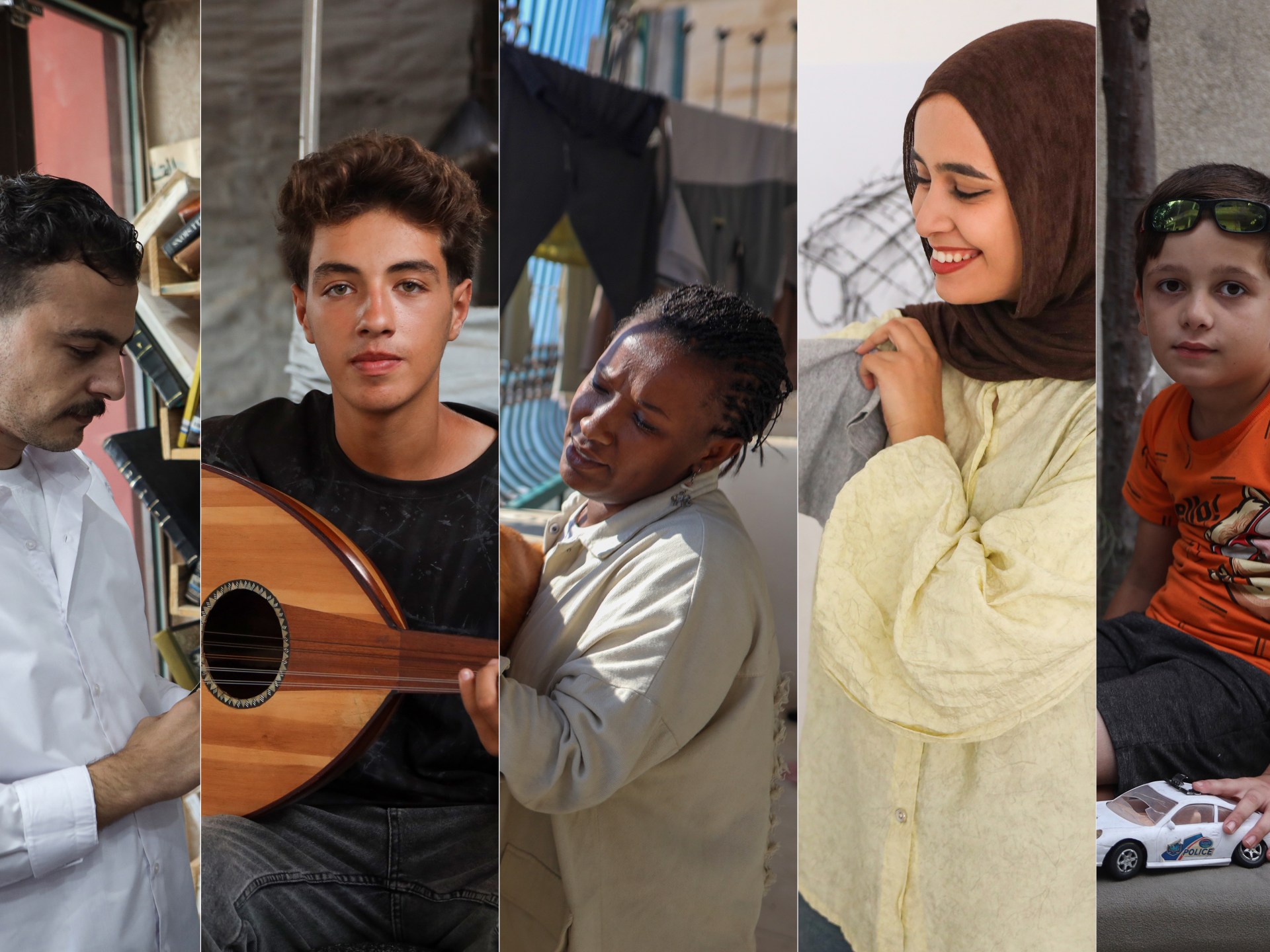
[Abdelhakim Abu Riash/Al Jazeera][Abdelhakim Abu Riash/Al Jazeera]When Omar Abdel Hakim Hamad, 30, received a displacement order in Beit Hanoon, north of Gaza, at about midnight, he decided to stay a little longer despite the heavy bombardment. He wanted to collect what he could from his home, fearing he might never return.
The first thing he thought of saving was his personal library of about 500 books.
He managed to take about 200, prioritising old and rare books that he felt could not be replaced.
Since leaving Beit Hanoon on October 30, 2023, Omar has been displaced 13 times, moving first to Gaza City and later south to the Maghazi refugee camp, where he remains displaced.
For Omar, the books were more than possessions. “They are part of who I am,” he says, describing how his love of reading began at 15.
Among the books he carried with him is a 1933 edition of Kalila wa Dimna.
During the famine-like conditions that plagued Gaza for large parts of the war, he even considered exchanging his entire library for one or two kilogrammes of flour, but says he is grateful that he managed to keep most of it.
Today, his Phoenix Library (at the centre of Gaza city) contains about 7,000 books, including about 3,000 rescued from libraries destroyed during the war and another 4,000 that were bought.
[Abdelhakim Abu Riash/Al Jazeera][Abdelhakim Abu Riash/Al Jazeera]When Shahd Abu Khosa, 30, left her home in Gaza’s al-Jalaa neighbourhood on October 16, 2023, she took her two dogs, Lily and Bobby, with her.
Her displacement took her from al-Shifa Hospital to Tal al-Hawa south of Gaza City, then to a house and finally to a school shelter.
The journey was difficult for both dogs, especially Lily, who was frightened by the sound of bombardment and would hide whenever shelling began. Bobby died of starvation after food became unavailable.
“I never thought of leaving Lily behind,” Shahd says, describing her as part of the family.
During the famine, Lily survived by eating what the family ate, including lentils and bread, while Shahd continued to share what little food they had with her.
Shahd says she had once been afraid of dogs, but that changed after her sister brought Lily and Bobby from Egypt.
Lily became especially close to her, spending much of her time with Shahd and sharing her food. She describes Lily as loyal and gentle, saying the dog would sense when Shahd was in danger and try to protect her.
Shahd hopes all pets in Gaza can find a safe place where they have food, water and somewhere to sleep, “away from fear and harm, and without being thrown out”.
[Abdelhakim Abu Riash/Al Jazeera][Abdelhakim Abu Riash/Al Jazeera]As Yaseen al-Qubt, 16, left his home in Beit Lahiya on October 12, 2023, he took his oud with him.
His family moved to az-Zawaida in central Gaza, while their home was later bombed and the instrument was left beneath the rubble.
Yaseen had owned the oud since January 2023 and had learned to play with the help of a neighbour who was an oud player.
He later managed to recover his oud from under the ruins. He picked it up again and continued playing.
For Yaseen, playing is also a way to comfort children in the displacement camp. When the sound of Israeli drones frightens them, he plays the oud to give them a few moments of calm.
He dreams of leaving Gaza to continue studying music, playing on large stages and eventually owning a professional oud that will help him develop his skills.
For now, he says, he remains attached to the instrument because “we still have something beautiful to offer.”
[Abdelhakim Abu Riash/Al Jazeera][Abdelhakim Abu Riash/Al Jazeera]When Huda Helassa, 20, left her home in Tal al-Hawa, southern Gaza city, in the first hours of the war, she took a signed T-shirt from the Access Microscholarship Program, a United States-funded programme that provides English-language and cultural education to young people.
Her classmates had signed the shirt on September 15, 2023, during their final class, two years before she graduated on September 27.
“When we left our home on the first day of the war, the T-shirt was one of the first things that came to my mind,” Huda says.
She put it in her bag almost instinctively, wanting to hold on to something from a part of her life that had ended just days earlier.
Huda and her family first moved to her grandmother’s house in Gaza City, then were displaced south, walking part of the way, and eventually reached Rafah in the south of the Palestinian territory.
In May 2024, they were displaced again, this time to Khan Younis. When they returned to Gaza in January 2025, they found their home completely burned.
“There was nothing left of the life we had there,” she says. “No belongings, no photographs, no memories we could hold onto, just the blackened walls.”
They were displaced again in April 2025, moving to Remal and then Tal al-Hawa, before moving to az-Zawayda in September and returning to Gaza in October. They are currently in Tal al-Hawa.
For Huda, the T-shirt remains a link to the life she had before the war, a period of learning, friendships and experiences that shaped her.
[Abdelhakim Abu Riash/Al Jazeera][Abdelhakim Abu Riash/Al Jazeera]When Mahmoud Hussein, 8 years old, and his family were forced to flee their home from Gaza City to Nuseirat in central Gaza, he insisted on taking his bag of toys with him.
His mother says the family was displaced about seven times, and each time Mahmoud refused to leave without his toys, even when she tried to persuade him to leave them behind.
During a period of truce, the family returned home and found it partially destroyed.
Mahmoud’s room had been destroyed, including his bed, wardrobe and most of his toys.
“He was deeply affected by what happened to his room,” his mother says. He still remembers the toys he lost and the room he once had.
Mahmoud has a neurological condition that causes abnormal electrical activity in the brain and had been taking daily medication for two years. He stopped his treatment two days before the war and was supposed to begin a new one, but the war disrupted his care.
He also needs monthly neurological tests that are currently unavailable in Gaza.
His mother says Mahmoud’s toys became his “safe place” during the war. Because fear, stress and sadness can trigger his seizures, playing and creating stories around his toys helped him escape the atmosphere of war and remain calm.