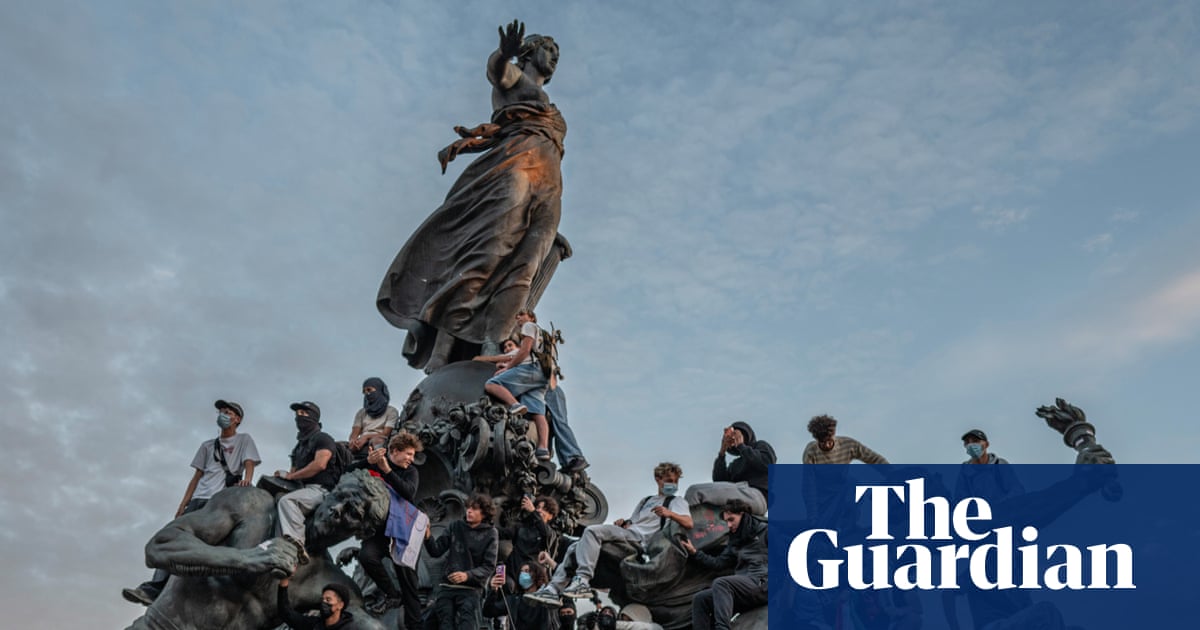
Hundreds of thousands of protestors in France have gathered to demonstrate against what they call an overcrowded, ill-equipped and understaffed education system. Photograph: Véronique de Viguerie/Getty ImagesView image in fullscreenHundreds of thousands of protestors in France have gathered to demonstrate against what they call an overcrowded, ill-equipped and understaffed education system. Photograph: Véronique de Viguerie/Getty ImagesThursday briefing: Why young people are taking to the streets across FranceIn today’s newsletter: A youth-led movement is protesting crumbling school buildings and teacher shortages while turning adult focus onto wider educational inequalities
Good morning. In my experience, at any protest, the most memorable and encapsulating slogans are always the ones written by hand with marker pen on cardboard placards.
“School is a right, not a privilege,” read one such sign held aloft by a student in Paris, where huge youth protests over the state of high school education have brought tens of thousands of young people and adults on to the streets, with further strikes planned today.
“A state that gasses high school students is a weak state,” another sign said, referencing growing public anger at alleged police brutality towards young protesters.
Tens of thousands of young people have also taken to Spanish streets in recent weeks to protest against the country’s deepening housing crisis. And outside the Labour conference in Liverpool last week, a crowd of jobless young people protested against what they saw as their bleak employment prospects. From Paris to the north of England, a similar thread runs through it all: a generation who feel betrayed by the absence of basic economic security and the erosion of public services that older generations took for granted.
I spoke to our Paris correspondent Angelique Chrisafis who has been reporting from the centre of the French protests. But first, the headlines.
UK politics | Kemi Badenoch has announced that the Conservatives would abolish inheritance tax on family homes if elected, prompting criticism that she is prioritising cutting taxes for the rich.
Education | Labour’s flagship changes to special education in England are at risk of unravelling because parents are rushing to secure support for their children before the system changes, new analysis has found.
Spain | María del Carmen Abascal, the 87-year-old whose eviction set off a nationwide wave of protests against Spain’s housing crisis, has died.
Science | A type of gene therapy based on Nobel prize-winning science is safe and can partly restore sight in blind people, researchers have revealed.
Epstein | British billionaire Sir James Goldsmith warned that Jeffrey Epstein was a “sexual deviant” decades before the FBI closed in on the abuser, a Guardian investigation has found.
View image in fullscreen‘School is a right, not a privilege’ … students take to the streets in Paris. Photograph: Sarah Meyssonnier/ReutersThe most significant youth movement to emerge across France in recent decades started on 17 September. Pupils returning to the Lycée Saint-Exupéry in Créteil, southwest of Paris, after the summer holidays, discovered they couldn’t continue their studies because of the extent of staff absences. The 15- to 18-year-olds blockaded their high school in protest.
After negotiations with the education ministry, those staffing gaps were filled, but the impassioned complaints about crumbling buildings, overcrowded classrooms, and long school days – alongside a wider sense of inequality in the education system – resonated in the suburbs. “This movement grew from the ground up, from teenagers speaking to others outside their lycées. And over a couple of weeks, it has spread to hundreds of schools across France,” Angelique tells me.
There’s a tendency to mythologise youth protest, especially in France – my uncle Joss was in Paris in 1968, and I lapped up his tales of pulling up cobblestones with his bare hands to build barricades. But youth activism is often diminished. When I reported on the schoolchildren who protested against the war in Iraq in 2003, and those who took part in climate strikes more than a decade later, adults repeatedly questioned whether they were swayed by older provocateurs or just wanted an excuse to dodge school and indulge in petty vandalism. (In my experience: no, no and no.)
So it is in France this past month. “This is very much a youth movement,” says Angelique, comparing it to similar protests in 2006 over an unpopular youth employment contract, which were organised by students’ unions. “High schoolers are organising themselves without a centralised system or even spokesperson. That’s historic, and it’s taken the government by surprise.”
Who are the teenagers on the streets?
This week, the sociologist Fabien Truong, who has written widely on youth protest culture, praised the “maturity and coherence” of the protesters. He pointed to a “social media effect” whereby teenagers in wealthier areas were sharing videos of scurrying rats, gaping ceilings and leaking toilets in poorer schools. “It’s beautiful, this solidarity with students from more privileged backgrounds fighting for others and more equality.”
This is precisely what Angelique has witnessed on the streets of Paris in recent days, where some of the most elite state schools have also been barricaded. She spoke to one teacher outside a school in a richer inner-city area, who was proud of her pupils. “She said there was a feeling of solidarity and generosity between teenagers, and how it flies in the face of the idea that they’re part of a social media generation who are selfish and narcissistic.”
“I spent a long time speaking to teenage girls at one of the barricades in the centre of the city,” Angelique says,“who were sitting on top of a pile of bins and shopping trolleys. They told me: ‘We’re told in France that state education is a great leveller, but that’s not the case. We are being taught our lessons, but we’re getting out on to the street because we can’t bear to know that other students in poorer areas are in buildings that are crumbling’.”
***What’s wrong with French schools?As Angelique sets out in this helpful explainer, the pupils’ grievances are backed up by evidence – and the prime minister himself has described them as “legitimate”. Thousands of French schools at all levels, both primary and secondary, are in need of repair. Class sizes are bigger on average, and school days are longer, than in other comparable countries, while about 10% of teaching hours across the year are not delivered because of absent teachers.
And yet France’s expenditure on high schools is 28% higher than the OECD average. What’s going on? The high spend can be explained in various ways, Angelique tells me. France has a lot more high school buildings to maintain than other countries, and many more vocational courses that cost more to teach.
At the same time, more spending is desperately needed on staff. Teacher shortages are linked to very low pay progression through the profession, while there are severe difficulties in finding teachers to work in deprived areas. There’s also a shortfall in other crucial roles, including school nurses and support staff for pupils with disabilities.
How have adults responded?
Angelique tells me that what has defined how adults are responding to this burgeoning movement is the behaviour of politicians and police. Initially, the French government “had its head in the sand”, she says, distracted by public anger at rising fuel costs and a difficult budget process. “And when it suddenly woke up, the reaction was not a political one, it was a police crackdown.”
Eighteen investigations into possible police brutality are already under way after injuries allegedly involving the use of police weapons, including a 15-year-old who lost his hand after contact with a stun grenade and a 14-year-old whose jaw was shattered after police allegedly beat him and fired a form of rubber-bullet launcher.
Yesterday, the French interior minister suspended the use of stun grenades but rejected accusations of police brutality, saying riot officers only intervened when protesters turned violent. Dozens of teachers have also been injured in clashes, and a small number of schools burned or ransacked, but Angelique tells me that most protests have been peaceful.
The injuries, however, have prompted outrage, with parents and teachers angry at the “disproportionate police response” now joining young people at the barricades. An Elabe poll for BFMTV, published on Wednesday, found that 72% of French people thought the student’s demands were legitimate – although 55% of of those surveyed also thought the protests should come to an end.
The movement has also brought to the fore a debate about the wider state of public services ahead of next year’s presidential election. The radical left leader Jean-Luc Mélenchon, backed for president by 47% of voters under 35, is loudly supporting the protesters, while far-right candidate Marine Le Pen has blamed the current government for chaos and called for an anti-riot law.
The sheer scale of the marches in cities across France this week was unexpected, Angelique says. “There were hundreds of thousands of parents, grandparents and teachers. There is a lot of support for these young people’s demands and an understanding that the problems they are raising reflect wider worries about public services.”
View image in fullscreen‘Our bodies must be in continuous contact!’ Daphne and Niles in the actors’ favourite scene. Photograph: courtesy Jane Leeves As a 90s sitcom fan, I ate up Hollie Richardson’s interview with Jane Leeves and David Hyde Pierce, who played will-they-won’t-they couple Niles and Daphne in the Cheers spin-off, Frasier. Micha Frazer-Carroll, newsletters team
At a time when English football is caught in a brutal off-field legal battle, Barney Ronay’s celebration of Harry Kane’s on-field genius is a reminder of what the sport should be about. Dipo Faloyin, newsletters team
If you’re one for forbidden experiments, you’ll be fascinated by this article on the second world war generation who grew up on sugar rations, and saw lower rates of type 2 diabetes, high blood pressure and even anxiety in later life. Micha
I really enjoyed Chibuzo Emmanuel’s much-needed piece on the damage that is being done by flattening of the wide variety of music genres across Africa into the simple bucket “Afrobeats”. Dipo
This piece on the US’ first public nature library expanded my understanding of what a library can achieve – parents, children and other members of the local Colorado community can borrow hammocks, night vision binoculars and cameras for wildlife photography. Micha
View image in fullscreenTonda Eckert took over as Southampton’s manager in December 2025. Photograph: Lee Keuneke/PAFootball | Southampton’s manager, Tonda Eckert, has been given a six-week suspended ban by the Football Association for his part in the Spygate scandal that landed the club with a four-point penalty and expulsion from last season’s Championship playoffs.
Golf | Confirmation that Jon Rahm will play no part in LIV Golf in its post-Saudi Arabian form is likely to be only the start of a mass exodus from the breakaway circuit.
Football | The Women’s Super League will face major disruption next season due to the Club World Cup, with Arsenal and Chelsea likely to be absent from domestic competition for up to a month.
View image in fullscreen Photograph: GuardianThe Guardian splashes with “Special education overhaul under threat amid surge in applications”. Reporting on Kemi Badenoch’s party conference speech, the Mail leads with “Kemi’s family home pledge”, the Times says “Tories ‘will make you better off’”, and the Telegraph goes with “We’re ready for the fight”. The top story for the Financial Times is “Iran war blows £12bn hole in Healey’s room for manoeuvre”, while the Sun has “Dinghy pervert given free home” and the Mirror runs with “Reform not dodgy, says Reform”. The i Paper leads with “Young people should get ADHD help even without diagnosis, major report will say”.
Photograph: The GuardianChrista Pike awake and speaking after botched execution: what happens now?
Christa Pike, a death row inmate who survived the state of Tennessee’s attempt to execute her last week, is conscious and speaking. The 50-year-old is recovering in hospital after surviving two lethal injections in a case that has shocked many in the US and prompted a debate about the death penalty. She was due to be the first woman executed in Tennessee in more than 200 years. Michael Safi speaks to the chief reporter for Guardian US, Ed Pilkington.
View image in fullscreen Illustration: Ella Baron/The GuardianThe UpsideA bit of good news to remind you that the world’s not all bad
View image in fullscreenLuis Gómez, known as JM, sings with Los Cracks del Puerto at the SCD Hall in Santiago, Chile. Photograph: Tamara Merino/The GuardianAt 65 years old, Luis Gómez was still hawking vegetables at the market he had worked at since the age of eight. Now at 80, Gomes, or JM as he is popularly known, has become a musical sensation, selling out venues across Chile, as well as in Mexico, the UK, Argentina and France. He is the frontman of Los Crack del Puerto, who in May released their fourth record, Lo Mucho Que Nos Queda (So Much Yet to Come), as a cassette – to great acclaim.
It’s a long way from his early life in the city of Valparaíso; the youngest of five children, he was three when his father died, and 10 when he lost his mother. For a time, he slept on the street between parked cars. JM would eventually form a musical double act with his cousin, Juan Navarro, and the two entertained crowds in Valparaíso’s bars. The pair would find fame well into their 70s after forming the band in 2017. “I never planned any of this, and I’d be happy still working at the market,” JM says. “But I suppose it’s never too late to give something a try.”
Sign up here for a weekly roundup of The Upside, sent to you every Sunday
And finally, the Guardian’s puzzles are here to keep you entertained throughout the day. Until tomorrow.