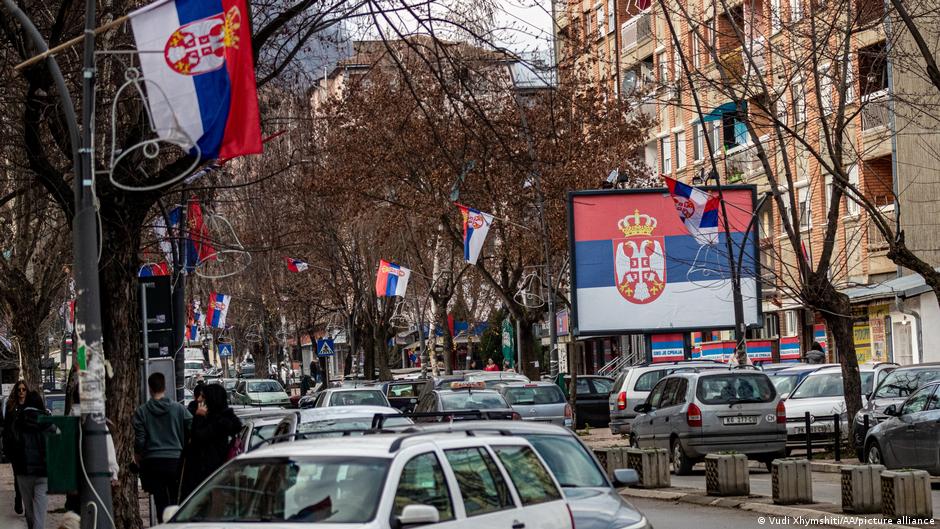
Many Kosovo Serbs retain Serbian citizenship. They fear that the enforcement from Sunday of Kosovo's Law on Foreigners will mean that they will be treated as foreign nationals and face considerable restrictions.
https://p.dw.com/p/5AMZmA significant number of Serbs in Kosovo do not recognize the legitimacy of the authorities in Pristina and still hold Serbian passportsImage: Vudi Xhymshiti/AA/picture allianceAdvertisementAlmost two decades on from Kosovo's unilateral declaration of independence from Serbia, much remains disputed.
Scores of countries still do not recognize Kosovo — including Serbia itself, five EU member states and giant economies such as India, Brazil and Indonesia.
Meanwhile, Russia and China offer crucial backing to Serbia's non-recognition. As permanent Security Council members, they have ensured that Kosovo remains without a seat in the United Nations.
Within Kosovo, the main bone of contention is the status of the ethnic-Serb minority.
Precise numbers are difficult to pin down due to ethnic-Serb boycotts of the census, but a reasonable estimate puts the number of Kosovo Serbs at around 100,000.
That population has been shrinking in recent years — along with the numbers of the ethnic-Albanian majority — as people worn down by decades of dysfunction seek a better life elsewhere.
But now, the Serbs who remain are warning that soon, leaving may no longer be a choice, but a compulsion.
That fear stems from legislation that is due to be enforced from March 15. Kosovo's government insists that the Law on Foreigners is simply a mechanism to ensure that residents have the correct documents.
"Those who reside in Kosovo must simply regulate their status, as is the case in every European country," said Interior Minister Xhelal Svecla in a social media video announcing the enforcement.
Many Kosovo Serbs, however, are convinced that the measure targets them and is designed to either make them foreigners in their own homes or force them out of Kosovo for good.
A significant number of Serbs do not recognize the legitimacy of the authorities in Pristina. They have never applied for documents issued by the Republic of Kosovo, preferring to keep hold of their Serbian credentials.
The law in question requires foreigners to register with the police as foreign visitors.
The Kosovo Serbs are concerned that this will apply to those among them without Kosovo papers, too. They also fear potentially falling foul of the Kosovo "90 in 180" rule that limits foreigners to a maximum stay of three months in a six-month period.
Similar restrictions also apply to the use and registration of Serbian-registered vehicles driven by thousands of Kosovo Serbs.
Minister Svecla denies that the legislation aims to discomfit Serbs. He points out that the law actually dates back to 2013 and says that the only new element will be consistent enforcement of its provisions, which has been postponed twice. Above all, he insists, Kosovo Serbs have nothing to fear.
"No one is being expelled," he said. "The law has existed for years; we are only beginning full implementation." He added that "those who live in Kosovo will be able to regulate their status without difficulty."
But that is not the experience being reported by many Kosovo Serbs.
With March 15 — the date for implementation of the law's provisions — approaching, those who want to fulfil the criteria are facing difficulties.
"There are still many people who struggle to obtain Kosovo documents and Kosovo citizenship, for which they have the absolute right," says Jovana Radosavljevic, director of New Social Initiative.
Her organization is based in the majority-Serb northern part of the divided city of Mitrovica and works to promote trust among Kosovo's different ethnic groups. Now, however, her main concern is that the need to establish the right to live in Kosovo is proving a "nightmare" for many Serbs.
"People cannot meet these requests coming in from the Kosovo administration," she said. "If you apply for a citizenship, you need to submit a copy of a passport, and Kosovo doesn't recognize the [Serbian] passports."
"Some of these are people who were born in Kosovo and have lived here their entire lives. But instead of just verifying their citizenship, they have to go through the whole process of applying."
The Law on Foreigners is the latest in a series of measures affecting Serbs implemented since Prime Minister Albin Kurti and his Albanian nationalist Vetevendosje (Self-Determination) party came to power in 2021.
They include a ban on the use of Serbian currency, the closure of health centers in majority-Serb areas — which Kosovo authorities view as illegal "parallel structures" — and the shutdown of banks and post offices used to deliver Serbian pensions and social benefits.
Now, Serbian authorities are warning that the implementation of the Law on Foreigners will "gravely affect" the remaining healthcare and education institutions serving Kosovo Serbs, by restricting their workers' freedom of movement between Kosovo and central Serbia.
The Serbs are also concerned that the law will impact their ability to work. Many of them work in Serbian-run schools, hospitals and municipal institutions in Kosovo that are not registered in Kosovo's legal system. This means that these institutions cannot issue valid employment contracts that foreigners in Kosovo need to obtain the required residence or work permits.
The director of the Serbian government's Office for Kosovo and Metohija, Petar Petkovic, describes the regulations as "a severe existential blow to over 10,000 Serbs." He accuses Mr. Kurti's government of aiming to create "intolerable living conditions" and to complete "the ethnic cleansing" of Serbs from Kosovo.
Ilir Deda, a former Vetevendosje and independent MP who is now a senior fellow at the Kosovar Institute for Policy Research and Development, does not believe that Kosovo Serbs face expulsion or becoming "foreigners in their own homes."
He does, however, criticize the lack of transparency and information that has caused such concerns to spread.
Foreigners in their own country?To view this video please enable JavaScript, and consider upgrading to a web browser that supports HTML5 video
"The government of Kosovo is not addressing those fears," he said, noting that the same applies to the authorities in Belgrade and Brussels. "The political representatives of Kosovo Serbs don't know what's going on either, so, even they cannot address their own constituents and say that things will be fine. So, we have a population left in the dark" he added.
Another analyst, Donika Emini, executive director of the Pristina-based NGO umbrella the CiviKos Platform, agrees that Kosovo Serb complaints are "quite fair," but adds that the legislation is "a normal law" to regulate foreign residents.
The issue is that the situation in Kosovo remains far from normal.
"There are administration barriers everywhere," she said. "You will understand how many obstacles there are in recognizing their certificates from Serbia. Some people cannot even register their marriages because they have married in Serbia."
The obstacles have left many people feeling hopeless. Belgrade claims a quarter of the Kosovo Serb population has left since 2022. From her perspective in North Mitrovica, Jovana Radosavljevic can only see that number increasing.
"You really feel this grim atmosphere, that your identity is being denied and suffocated," she said. "People may say, OK, I love my home, I want to live in my home no matter what the institutional framework is. Or they may say, I cannot live with this anymore, and they're just going to pack their bags and leave."