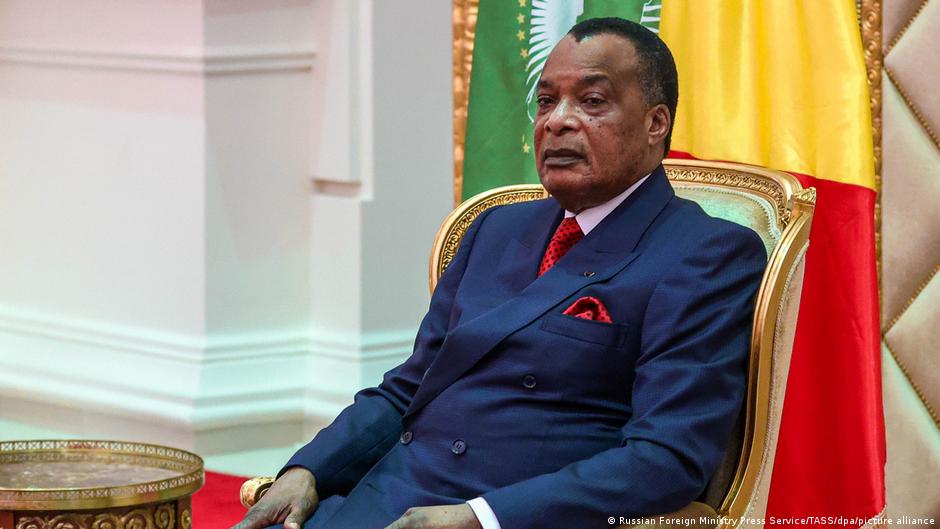
Voters in the Republic of the Congo (Brazaville) go to the polls this Sunday to elect their next leader. Many political analysts predict victory for the longtime President Denis Sassou Nguesso.
https://p.dw.com/p/5ALb0President Denis Sassou Nguesso is one of the longest-serving leaders in the worldImage: Russian Foreign Ministry Press Service/TASS/dpa/picture allianceAdvertisementDenis Sassou Nguesso has simply been the main political constant in the Republic of the Congo for the vast majority of the past 47 years. Many of the country's eligible voters have actually never really known any other leader in their lives.
Sassou Nguesso rose to power in 1979, having already spent over a decade as a member of an elite circle of leading figures in Brazzaville. In the 1990s, there was a five-year interruption to his leadership, bookended by a bloody civil war.
Since the turn of the millennium, he has, in many ways, come to represent stability in a dynamic nation with one of the world's youngest populations.
Little about that is expected to change when the country goes to the polls on Sunday, March 15, despite there being seven solid albeit relatively obscure candidates in the running. Many believe that none of them will stand a chance against the 82-year-old leader.
What you need to know about Congo‑Brazzaville's electionsTo view this video please enable JavaScript, and consider upgrading to a web browser that supports HTML5 video
But it's not just the population of the Republic of the Congo that associates a sense of continuity with Sassou Nguesso.
From a outside perspective, too, the ageing leader is widely viewed as a stable figure in the midst of a conflict-ridden region: while neighboring countries such as Cameroon, the Central African Republic, and the Democratic Republic of Congo continue to be shaken by a seemingly endless series of crises, Brazzaville has managed to remain politically stable for many years.
This is also the argument put forward by Sassou Nguesso's supporters and strategists for his renewed bid for the presidency: They believe that not only the Republic of the Congo but indeed the greater region needs a seasoned leader like Sassou Nguesso.
One of his supporters is Adrien Poussou, the former Minister of Communication of the Central African Republic, a close partner of the Republic of the Congo. "We must not confuse a long reign with illegitimacy," Poussou told DW in an interview in the run-up to the vote. "In some circles, it is said that it should be illegal to remain in power for too long. But it is not illegal and it's certainly not illegitimate. The decisive factor here is not the duration, but the stability and continuity of state structures."
However, Paul Akoa, a geopolitical expert who works as a researcher at the Paul Ango Ela Foundation in the Cameroonian capital, Yaounde, disagrees with that view; he believes that it is not only stability but also a leader's actual performance that counts.
"When time passes and key figures such as gross domestic product plummet, the question arises as to whether it is appropriate to continue with the same person or the same team," Akoa told DW.
Darrin McDonald, a political scientist at Leeds Beckett University in the UK, also finds Sassou Nguesso's track record rather disappointing—especially regarding the economic development of the African nation.
McDonald told DW that this lack of progress has resulted in widespread youth unemployment now affecting around 40% of the population of a country where about half the population is younger than 18 years old: "[The Republic of the] Congo is one of those countries that is in a constant cycle of accumulating massive debts to foreign creditors, and then making agreements to restructure the debt to reduce the burden, only to then increase it again within a few years."
Young continent, old power? Africa's election paradoxTo view this video please enable JavaScript, and consider upgrading to a web browser that supports HTML5 video
However, McDonald also highlights the much-cited fact that Sassou Nguesso enjoys a positive image throughout the region and beyond, especially as a reliable partner and peace broker. The octogenarian leader has, among other initiatives, been trying to help resolve the conflict between the Democratic Republic of Congo and Rwanda for years, and was also among the first African leaders to offer mediation efforts following the coup in neighboring Gabon in 2023.
The same year, he also called for an end to the war between Russia and Ukraine as part of a broader mediation effort by African heads of state. Having such a good reputation in an unstable region that has been plagued by multiple coups can also serve as an important source of legitimacy, political scientist McDonald believes: "This helps him position himself as a strong man in the region, as a calm head who can offer a little stability and experience," he explains, adding that this sense of stability also resonates well with international supporter such as the US and China.
At the same time, human rights groups around the globe have long been levelling serious accusations against Sassou Nguesso's leadership. There's mounting concern, especially over the fate of two key opposition figures, Jean-Marie Michel Mokoko and Andre Okombi Salissa, who have been in custody since 2018 and 2019, respectively; UN experts found at that time that their arrests had been politically motivated. In addition to that, Amnesty International has reported hundreds of arbitrary arrests in recent years.
In its 2024 "Freedom of the World" index, Freedom House scored the Republic of the Congo with only 17 out of 100 points for political and civil liberties. Meanwhile, on Transparency International's Corruption Perceptions Index, the African country ranks 153rd out of 182 countries.
Andrea Ngombet, founder of the "Sassoufit" collective for political change in the Republic of the Congo, shares many of those concerns; he told DW's AfricaLink podcast that the widespread tolerance in the country for this increasingly authoritarian leadership style is intrinsically linked to the start of the first civil war in the country in 1992, which broke out following an election defeat of Sassou Nguesso; several years later, he was eventually re-elected.
"His return came with guns, over the bodies of the Congolese people. Sassou Nguesso has never been able to shake this image, and to this day his party sees itself as an internal militia against the Congolese people," Ngombet said. "Any form of resistance ends either in prison or in a coffin. That is not sustainable."
Based on this track record, it is not exactly surprising that the prospect of any peaceful transfer of power does not feature prominently in this election; after all, Sassou Nguesso's win at the polls against his widely unknown and underfunded challengers is already considered to be a foregone conclusion.
Five key African elections to watch in 2026To view this video please enable JavaScript, and consider upgrading to a web browser that supports HTML5 video
However, there is an air of uncertainty about what may happen one day when the octogenarian president can no longer continue. Political scientist Darrin McDonald told DW that he thinks that certain steps "are being taken already within the ruling party" to address what Sassou Nguesso's succession may look like: "Some people are supporting [it will be] his son, while others are climbing the hierarchy and positioning themselves" as potential next leaders, he explains, adding that the ruling party with it paramilitary characteristics could itself play a bigger role in the transition of power once Sassou Nguesso's reign is over.
"Anything from a democratization process to total chaos is conceivable," McDonald emphasized in his assessment.
He added that the prospect of Sassou Nguesso passing the baton over to his son is by now somewhat seen as a recurring theme in the region: in Gabon, after the death of Omar Bongo in 2009 after decades in power, his son Ali stepped in to continue the dynasty; in Chad, Mahamat Idriss Deby took over after his father's death in 2021.
However, McDonald also stressed that any transfer of power in the Republic of the Congo is only likely to occur upon the president's eventual death, and most certainly not as the outcome of Sunday's vote.
This article was translated from German. Eric Topona contributed to the report