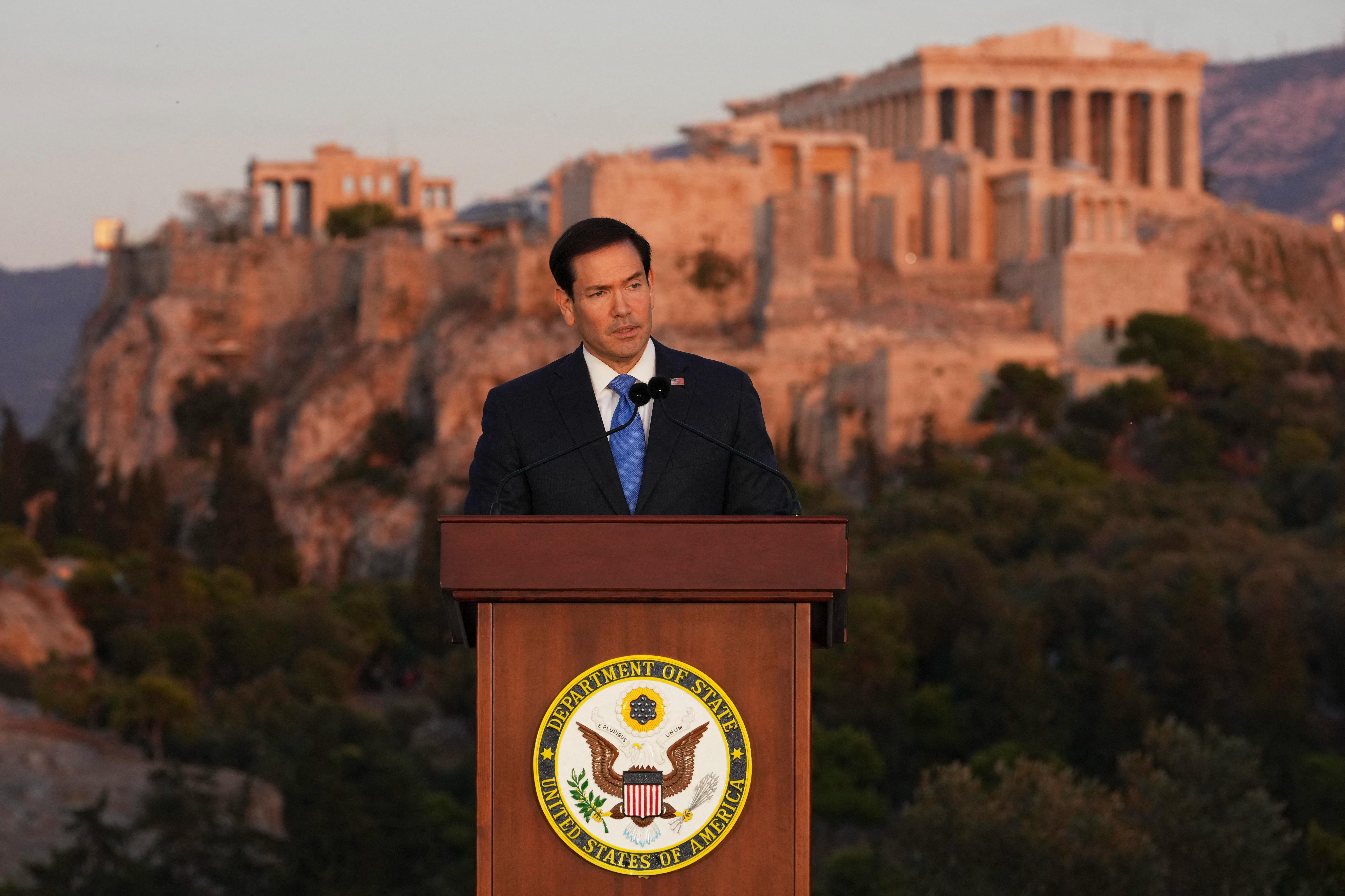
Make New York Post a Preferred Source U.S. Secretary of State Marco Rubio speaks at the Pnyx hill, where ancient Athenians held democratic assemblies, with the ancient Parthenon temple atop the Acropolis in the background, in Athens on Oct. 7, 2026. POOL/AFP via Getty Images In front of the legendary Acropolis in Greece on Wednesday, Secretary of State Marco Rubio gave a stirring defense of Western civilization — and why we must fight to defend it. An excerpt:
The Greeks of antiquity have an almost mystical hold on our memory. They call us back to them again and again.
Four-hundred-and-eighty years before Christ, the armies of Xerxes arrived in this city, and they put its sanctuaries to the torch. Most Athenians had by then evacuated by ship to a nearby island. But there was a handful of them that refused to leave their home. So instead they barricaded themselves in the rocky fortress of the Acropolis to fight an extraordinary last stand, heaving massive stones down the cliffs onto the Persian invaders and holding the greatest empire of that age at bay. For days. They were eventually overwhelmed.
The Persians plundered the temples, burned the shrines and razed the Acropolis to the ground. But when the Athenians returned, they gathered the broken remains of the old Acropolis and buried them in the hill where it had stood, and decades later, under Pericles, they raised the Parthenon.
For 25 centuries since, the Parthenon has stood. Empires have risen and fallen beneath its shadow, and the progeny of the men who built it, the sons of Athens and Rome, have carried their civilization with them to the ends of the earth — two and a half centuries after the founding of the American republic, halfway across the world from where I stand now.
Athens gave us democracy. Plato and Aristotle gave us Western philosophy, our ideas of law, of virtue, of citizenship and republican government were shaped in the Greek city-states.
Even much of our political vocabulary — words like “democracy,” “tyranny,” the word “politics” itself — found its origins here.
Now all of that is true. But the things we owe to this place as Americans and as Westerners are actually far, far deeper. These institutions and ideas were the outward expression of more fundamental qualities we see in the ancient Greeks, qualities that can’t be reduced to any particular political system or theory.
Here in Athens, we found the first full realization of all the essential traits that would come to define the West: fierce individuality and relentless ambition; daring exploration and invention; a yearning for discovery, for adventure, risk and glory; an insatiable curiosity about the world and the principles by which it operates, a hunger to know the mysteries of nature and grasp the secrets of the cosmos; an impatience with the notion of impossibility, chafing at all boundaries, at all limits, straining to peer into the depths of the unknown.
The Greeks did not just shape history. The Greeks gave us history itself. Much of what we know about many ancient civilizations comes almost entirely from the records of Greek explorers and historians, explorers and historians who didn’t just chronicle the histories of their own people, but ventured outward to observe and record the sagas of foreign peoples and cultures all across the world.
U.S. Secretary of State Marco Rubio speaks at the Pnyx hill, where ancient Athenians held democratic assemblies, with the ancient Parthenon temple atop the Acropolis in the background, in Athens on October 7, 2026. POOL/AFP via Getty Images This was the foundation of the Western mind: our math, our science, our medicine — our philosophy, ethics and religion. It paved the way for the Gospel of Jesus Christ to find fertile soil in Europe and flourish into the empire of Christendom. It was the foundation of the riches of Christian theology, of Augustine and Aquinas, and the whole tradition of natural law.
It gave birth to a civilization marked not just by a common culture. It was marked by a common anthropology, a common view of man and of his place in the universe. Its descendants would share not just the idea of a natural order but a distinctive understanding of virtue, of destiny, of fate, of truth, goodness, and beauty, of a code that dictates how men ought to live, of objective standards and ideals to strive towards.
The ancient Greek city-states were filled with intense passion and rivalry and faction and conflict. But from that constant struggle for distinction, from that came the great flowering of art and philosophy, and political and intellectual energy that would transform a collective of Mediterranean cities to the birthplace of the greatest civilization in the world.
The thumos — as the ancient Greeks called it, the fire of passion, strength, courage, pride — is the heart of great civilization. Without it, nations lose their will to fight, the will to strive, the will to survive.
Today, too much of the West has forgotten this quality. Over time, we in the West came to feel ashamed of the very things that made us exceptional. We felt embarrassed that our achievements set us apart from the rest of the world. Our prosperity somehow became a source of guilt. We no longer believed we deserved and had earned our greatness. “Nationalism” became a dirty word.
And so we tore down our monuments. We condemned our own history, and in too many places, we taught our children to be ashamed of the countries they would inherit. In the process, we opened our borders and outsourced our industry and allowed our militaries to wither and to decay.
And with every passing year, we seemed to outsource more of our sovereignty, transferring our decisions to global bureaucracies far beyond the reach of our control.
But others were all too happy to fill the vacuum left behind by our weakness. And as the West’s confidence faltered, its adversaries and its rivals only grew more assertive, building up their own wealth and their own power in our stead.
Today, we find ourselves at a crossroads. Because the next decade and the decisions we make will write the story of the next century. The course we take will determine whether the West maintains its place at the head of the world or resigns itself to a future of atrophy and servitude and decline. We will either choose to act now or lose the choice to act at all.
Under President Trump, the United States has made its choice. We choose the unapologetic pursuit of national power: to take back control of our critical supply chains, to re-industrialize our economy, to rebuild our defense, to fight for dominance of the technologies and industries of the future.
We choose to reach for new frontiers in advanced manufacturing and superintelligence; in drones, weapons and warfare; in chips, minerals, cyber and every other domain of human possibility; to unleash our energy, to rebuild our factories, to return our astronauts to the moon and launch a new age of exploration in space.
Now it’s become fashionable today to believe that enlightened foreign policy means prioritizing the global community over one’s own people. And I think here, too, we have much to learn from the men of ancient Greece, because they knew that there was nothing selfish or wrong about loyalty to your nation, nor anything selfish or wrong about fighting to defend its interests above all else.
US Secretary of State Marco Rubio and Greek Prime Minister Kyriakos Mitsotakis shake hands at the prime minister’s office in Athens, Greece on October 7, 2026. REUTERS They believed fiercely in the ideal of the great man, the exceptional individual who obtains immortality through his own deeds. But they believed that glory and fame — those things were won through striving, sacrificing and achieving greatly for something larger than yourself.
We must fight to defend civilization today with the same passion as our forefathers did.
We are at an inflection point, an inflection point not only in the history of my nation, but an inflection point in the whole of our civilization.
The threats we face today are every bit as real as they were on the dramatic stage of antiquity. National interest did not vanish in the face of international institutions. War did not disappear simply because we preferred peace. Other states continued to arm, to seek influence, to compete for territory and technology and resources and markets and energy and power. And now there is war again. There is new competition between great powers. Again, there is vulnerability, aggression, terrorism, a whole universe of new threats and attacks again.
And so we must rebuild our institutions and our alliances to face these threats together, understanding that the purpose of these things is not to abolish the sovereignty of the nations that constitute them; it is to defend them — and that nations need not abandon their distinct identities in order to recognize their common interests.
We have built a model of that with our partners here in Greece, in our defense partnerships, in energy and technology, in our shared ambition to secure Europe’s borders from the threats of mass migration.
Our friendship dates back to the earliest years of my nation, when Greece rose in 1821 to recover its independence after centuries of Ottoman rule. Americans recognize something familiar in that struggle. Three years later, the great American statesman Daniel Webster delivered a famous address to Congress helping bring the cause of the Greek Revolution before the representatives of the young American republic. And he began by calling their attention to everything around them.
This is what he said in the speech: “This free form of government, this the popular assembly, this practice of free debate and public discussion, the contest of mind with mind, even the edifice in which we assemble these proportioned columns, these ornamented architecture, all remind us that Greece has existed and that we, like the rest of mankind, are greatly her debtors.”
Those words are as true today as they were when he said them. And all of us, not just Americans, but Europeans and our friends across the West, must relearn the lessons our forefathers took from this place and from its history.