Balendra "Balen" Shah's historic leap from Kathmandu's streets to national power marks a dramatic shift in Nepali politics and a major test for a new government.
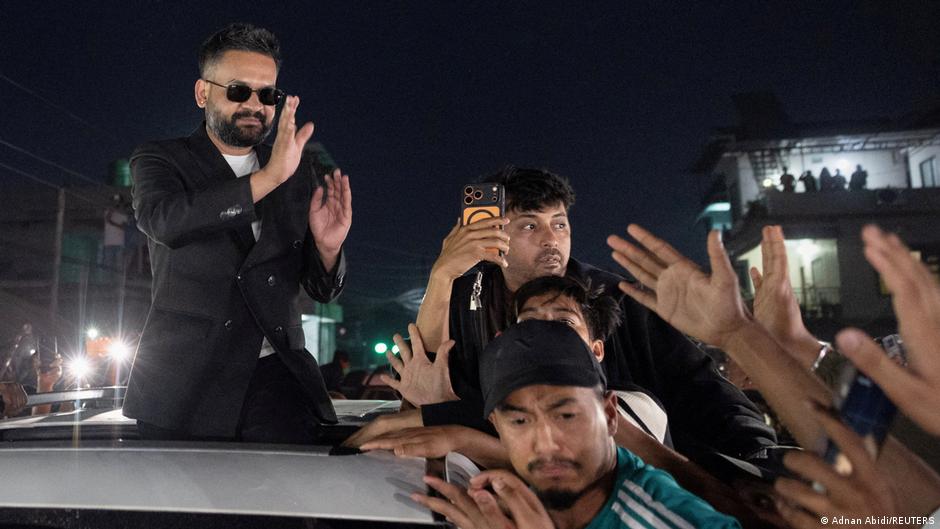
https://p.dw.com/p/5ALXtThe 35-year-old former rapper is set to become prime ministerImage: Adnan Abidi/REUTERSAdvertisementThousands of people poured into the streets of Damak in eastern Nepal'sJhapa district on the evening of March 7, running alongside a slowly moving vehicle in a scene filled with excitement, celebration and hope.
Their cheers intensified each time the man standing through the sunroof raised his hand or greeted the crowd with folded palms.
At the center of the frenzy was Balendra Shah, widely known as Balen. At 35, the former mayor of Kathmandu Metropolitan City, Nepal's largest metropolis, has rapidly emerged as one of the country's most unexpected national political figures and, for many, the prime minister-designate of Nepal.
On Friday, Nepal's Election Commission confirmed a landslide victory for Balen and his Rastriya Swatantra Party (RSP).
Nepal: Rapper-turned-politician set to become next PMTo view this video please enable JavaScript, and consider upgrading to a web browser that supports HTML5 video
Balen Shah's political ascent has been marked by an unusual strategy of saying very little. The former Kathmandu mayor rarely steps into the public spotlight or engages in extended media interactions. When he does speak, he chooses his words carefully, a restraint that many analysts say became a deliberate campaign tactic during this parliamentary election.
Wearing his trademark black outfit and dark sunglasses, Balen traveled across constituencies meeting voters face-to-face. Sometimes he drove himself to campaign stops. Other times he walked among supporters. He waved, shook hands, listened and sampled local delicacies. But he consistently avoided long speeches and sweeping promises.
Apart from a handful of major rallies, his public appearances were brief. When he addressed crowds, he relied on local dialects or short remarks to connect with voters.
The election results suggest that his minimalist approach resonated. Balen and his party secured a decisive victory. In Nepal's 275-seat parliament, RSP won 182 seats, giving it a clear majority.
For many voters, it was not just who Balen is, but also that he was not part of the old guard, which many view as corrupt and self-serving.
"Balen has given the youth hope; he has their trust. He's taken no part in the corruption in Nepal," one voter told DW.
Even in victory, Balen maintained his characteristic reserve. Standing through the sunroof of his vehicle, he folded his hands in thanks. Then he quietly raised a poster that read: "You deserve congratulations. This victory belongs to you."
A structural engineer by profession and a poet and rapper by passion, Balen joined the RSP shortly before the election and quickly became one of its senior leaders. The party had already announced him as its candidate for prime minister.
Analysts say his personal popularity became a decisive factor.
"The RSP's landslide victory was largely centered around Balen," political analyst Krishna Khanal told DW. "Once the party presented him as its candidate for prime minister, it had a strong impact on voters."
Nepal's political landscape had shifted well before the vote. Last September, a nationwide "Gen‑Z movement" driven by anger over corruption and poor governance forced then‑Prime Minister KP Sharma Oli to resign. President Ram Chandra Paudel subsequently appointed an interim government in his place.
At the time, many activists initially urged Balen to take charge of that interim administration.
"But when he instead supported former Chief Justice Sushila Karki, his popularity grew even further," Khanal said.
This was viewed as a tactical move that allowed Balen to bypass an immediate leadership role in order to focus on the elections.
Many observers expected Balen to run for parliament from Kathmandu, where he had built strong support during his tenure as mayor. Instead, he announced his candidacy from Jhapa‑5, a constituency nearly 330 kilometers (205 miles) east of the capital.
For decades, the district had been regarded as the political stronghold of former PM Oli. Before this election, Oli had contested seven elections across Jhapa constituencies and won six. He had also served four terms as Nepal's prime minister.
But the political landscape had shifted after the Gen‑Z protests.
When the votes were counted, Balen secured a decisive victory, winning 68,348 votes to Oli's 18,734.
Why Nepal's elections matter to India and China To view this video please enable JavaScript, and consider upgrading to a web browser that supports HTML5 video
For analyst Krishna Khanal, the result underscores growing public frustration with mainstream political forces. "People were tired of the old parties because of their poor performance and corrupt image," he added.
Compared with Nepal's established political figures, Balen's rise has been notably brief. He entered electoral politics in the 2022 local elections, running as an independent candidate for mayor of Kathmandu Metropolitan City. Defying candidates from major parties, he won, becoming the capital's first independent mayor.
During his tenure, several initiatives resonated with the public, including reforms in community schools, scholarship programs, parking management and efforts to preserve archaeological heritage sites.
But a performance report by the National Natural Resources and Fiscal Commission ranked Kathmandu Metropolitan City lowest among Nepal's six metropolises, based on indicators such as budget management and administrative efficiency. Even so, analysts say Balen's hands‑on style helped maintain his appeal.
"Many young voters judge politicians less by political principles and more by visible action," Khanal said.
In 2025, Balen entered national politics despite having more than a year remaining in his mayoral term.
Before entering politics, Balen built a career as a structural engineer. He earned a bachelor's degree in civil engineering in Kathmandu and later completed a master's degree in structural engineering in India. He is currently pursuing a PhD in heritage preservation at Kathmandu University.
"As an engineer, he worked on roads, bridges, industrial facilities, stadiums and science parks across 65 districts in Nepal," said former parliamentarian and film director Asim Shah (no relation). He believes this experience shaped Balen's understanding of the country's "overlooked situations and development challenges."
Shah, who knew Balen from his time as a musician, describes this strategic mindset as another defining quality.
"Him running from Jhapa‑5 is an instance. We suggested that he run from Kathmandu," Shah recalled. "But he said, 'If someone wants to become prime minister, he should defeat the prime minister.'"
At the time, Oli was the prime ministerial candidate of his party, the Communist Party of Nepal Unified Marxist Leninist (CPN‑UML).
During the campaign, Balen framed his decision succinctly: "That's the only thing legally I could do for Gen‑Zs."
From streets to change? A decade of Asia's youth protestsTo view this video please enable JavaScript, and consider upgrading to a web browser that supports HTML5 video
Before entering politics, Balen was already known to music audiences for his rebellious tone. As a poet and rapper, he criticized corruption, abuses of power and social inequality.
After competing in rap battles in 2013, he continued developing his musical career. According to Asim Shah, this artistic background helped shape his political awareness.
"His songs and poems are as direct as his speech," Shah said.
Supporters argue that themes he explored in music — good governance, transparency and social change — later showed up in his mayoral policies. But he has also faced criticism for actions against street vendors and for aggressive or controversial posts on social media.
With the Rastriya Swatantra Party securing a parliamentary majority, Balen's path to the prime minister's office now seems all but certain. But analysts warn that the greatest challenges lie ahead.
"A majority government leaves no room for excuses. Balen and his Cabinet must deliver," political analyst Khanal said.
His journey from rebel rapper to engineer, independent mayor and now prime minister‑in‑waiting has captivated the country.
However, as Asim Shah put it: "The voice that once echoed through Kathmandu's streets will now echo inside Parliament. Balen became known for asking questions. Now his work must provide answers."