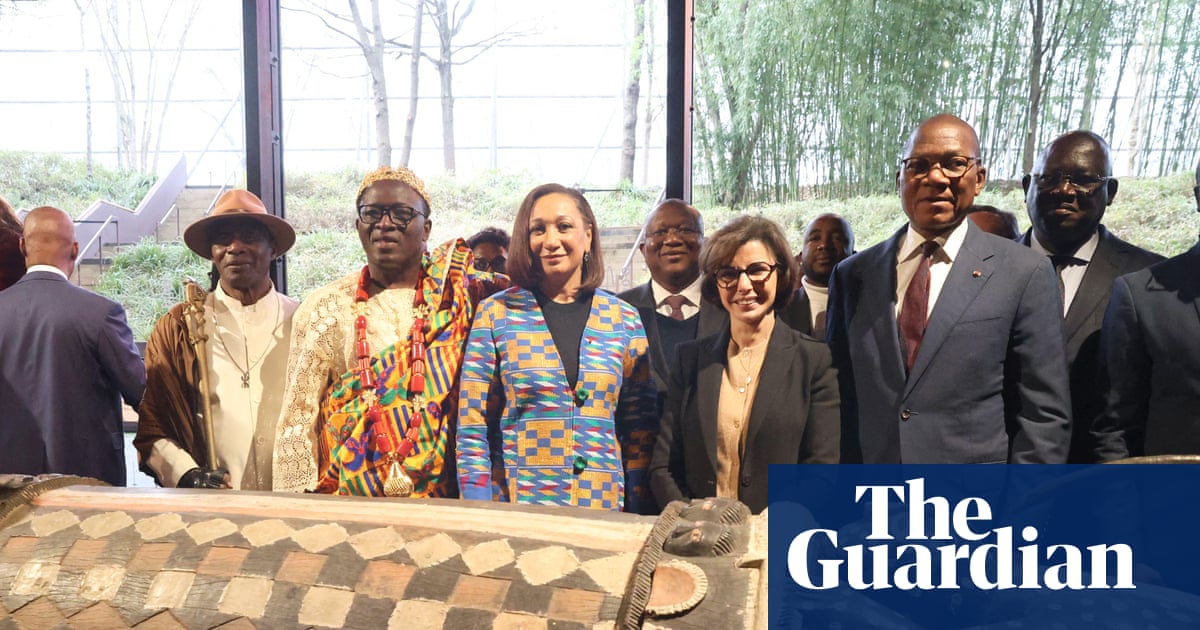
The restitution ceremony for the Djidji Ayôkwé talking drum, held at the Quai Branly Museum. Photograph: Abaca Press/Alamy Stock Photo/Alamy Live News.View image in fullscreenThe restitution ceremony for the Djidji Ayôkwé talking drum, held at the Quai Branly Museum. Photograph: Abaca Press/Alamy Stock Photo/Alamy Live News.France returns sacred talking drum looted from Côte d’Ivoire over 100 years agoDjidji Ayôkwé was handed to Ivorian officials in Paris earlier this month
A sacred artefact looted by French colonial authorities more than a century ago has been returned to Côte d’Ivoire in one of the most significant cultural restitutions to a former French colony in years.
The Djidji Ayôkwé, a talking drum confiscated in 1916 by French administrators, landed at 8.45am on Friday at the airport in Port Bouët on the outskirts of the economic capital, Abidjan. It was handed over to Ivorian officials in Paris earlier this month after being removed from the Quai Branly – Jacques Chirac Museum.
View image in fullscreenA traditional dancer performs in front of the crate containing the Djidji Ayôkwé, as it arrives during the latest repatriation of stolen artefacts in Abidjan. Photograph: Issouf Sanogo/AFP/Getty ImagesAboussou Guy Mobio, chief of the Adjamé-Bingerville community, said: “After a long stay away from this land, it is returning to its own people and it is an honour for us and a relief to welcome it,. This is the missing piece of the puzzle that is returning today … Receiving this sacred instrument is a relief, but it is also another form of connection with our ancestors who were very close to this instrument.”
Talking drums are hourglass-shaped pressure drums designed to mimic the tone, pitch and rhythm of human speech. The 4-metre Djidji Ayôkwé, which weighs 430kg, held cultural and political significance to the Ebrié people – after whom the lagoon in Abidjan is named – as a symbol of resistance. Before and during colonial times, it was used to send messages over several miles to announce deaths or celebrations – and in some cases, alert villages about coming danger. After villagers resisted forced labour on a road in one incident in 1916, colonial authorities seized it and carted it away to France.
View image in fullscreenA traditional chief from the Ebrie tribe poses next to a crate containing the Djidji Ayôkwé, as it arrives at Félix Houphouët-Boigny airport in Abidjan. Photograph: Issouf Sanogo/AFP/Getty ImagesThe French president, Emmanuel Macron, promised to return the drum in 2021, but it took four years of discussions and lobbying for the French parliament to ratify and approve the decision.
“I feel deep emotion. We are indeed experiencing a moment of justice and remembrance,” Françoise Remarck, minister of culture and Francophonie in Côte d’Ivoire, said in her speech on Friday. She thanked President Alassane Ouattara and Macron for what she called “a historic day”.
View image in fullscreenThe restitution ceremony for the Djidji Ayôkwé talking drum. Photograph: Abaca Press/AlamyThen she addressed the drum, saying: “Djidji Ayôkwé, today your return is a message for our youth who have chosen to reclaim their history, and for the communities … a symbol of social cohesion, peace and dialogue … 13 March is just one step.”
Read moreAs a forklift operator rolled the wooden crate holding the drum from the aircraft, a cultural troupe broke into the traditional tchaman dance. Another ceremony is expected to herald the permanent installation of the drum at the Musée des Civilisations de Côte d’Ivoire in the Plateau administrative district, at a later date believed to be in April. In readiness for the exhibition to the public, Unesco has donated $100,000 (£75,400) through its Abidjan office for research and training at the museum.
Sylvie Memel Kassi, former director of the museum and founder of the TAPA Foundation for Arts and Culture, said the drum’s return to Ivorian soil paved the way for more restitution. “We are studying eight other objects,” she said, referring to the Ivorian and French authorities.