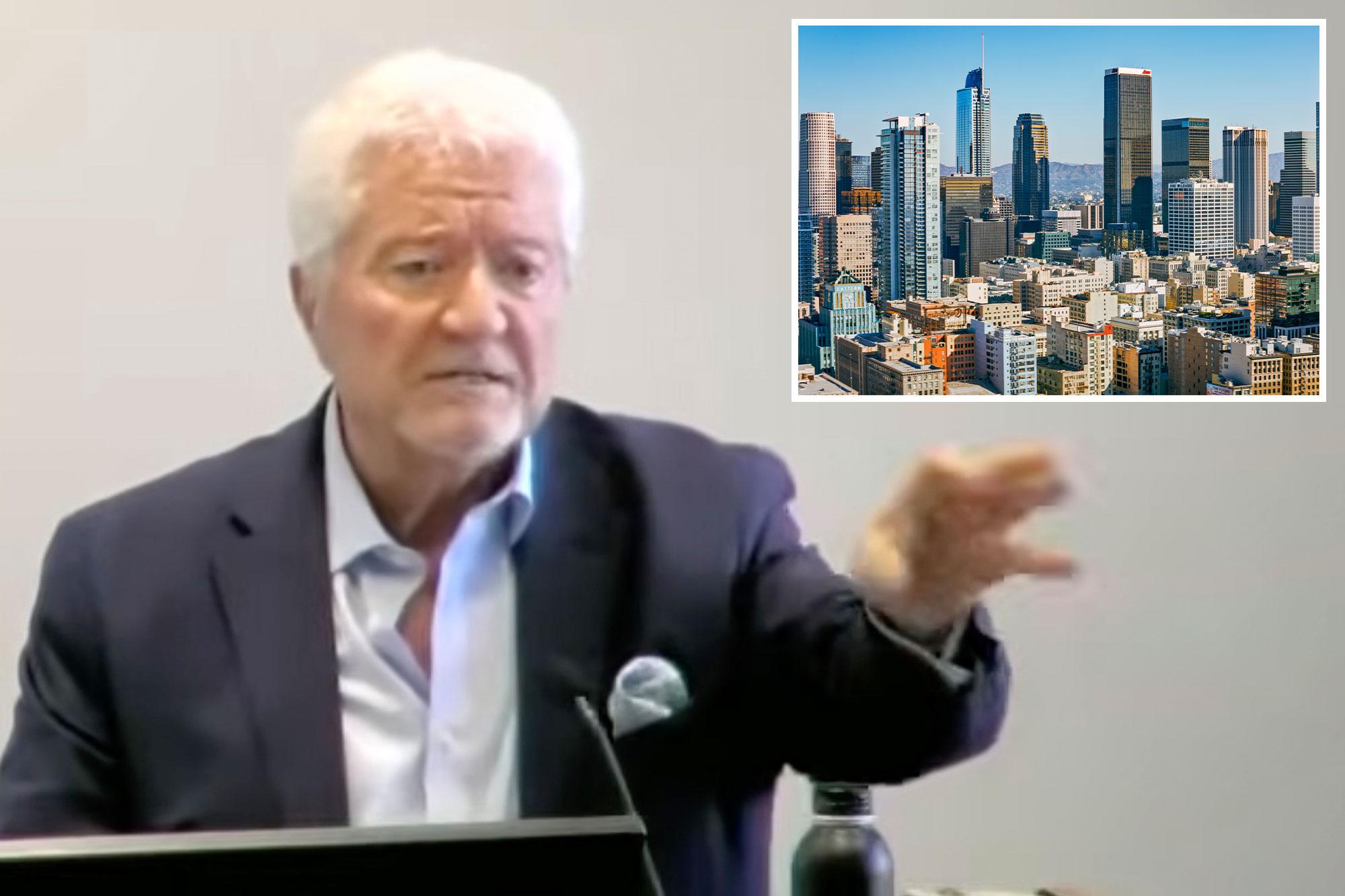
Make California Post a Preferred Source For a generation, Nick Patsaouras was widely seen as a visionary, a man who dreamed of an LA whose downtown would emerge as the center of our vast, sprawling region.
The Greek engineer, who emigrated here in 1961, exercised great influence with mayors like Tom Bradley, Richard Riordan and Antonio Villaraigosa, all of whom shared something of this vision.
Now over lunch at a half-empty Jonathan Club last week, it’s clear Nick’s hopes for downtown are fading away.
Start your day with all you need to know Morning Report delivers the latest news, videos, photos and more.
“It’s different today, you see it on the streets,” he suggested over, naturally, a Greek salad. “City Hall was buzzing. It was hard to get a lunch reservation. Now it’s no problem.”
The decline of downtown comes despite years of hype from places like the New York Times, which in 2019 compared downtown’s growth to the awakening of “a sleeping giant.” Since then, the core has devolved instead into a dystopia of half-vacant buildings, including luxury high-rises; trash-filled, crime-ridden streets filled with ragged people; and criminal gangs who even strip the copper from street lights.
So much for the relentless densification beloved by architectural “visionaries,” local planners, construction unions and well-connected developers. These boosters foresaw a city center to rival Manhattan, and instead created one that looks remarkably like Mumbai on a bad day.
California Post News: Facebook, Instagram, TikTok, X, YouTube, WhatsApp, LinkedInCalifornia Post Sports Facebook, Instagram, TikTok, YouTube, XCalifornia Post Opinion California Post Newsletters: Sign up here!California Post App: Download here!Home delivery: Sign up here!Page Six Hollywood: Sign up here!
Persistent crime, street takeovers and homelessness have chased visitors and businesses away.
Even once-ballyhooed residential population growth is slowing: Local property values have cratered and deserted apartments offer what have been described as “ghost condos.”
Some new ambitious residential projects are in the offing, but it’s hard to see the area’s appeal to anyone outside of youthful, childless and eccentric hipsters.
Even though some journalists still describe the area as “booming,” that is an exercise of wishful thinking. After billions spent on transit, a convention center and new entertainment venues, a recent survey suggested that downtown LA remains among the “deadest” of America’s central cores.
Roughly 1,000 businesses left the core city in 2024, according to the historically pro-downtown LA Times, which itself left downtown for El Segundo.
To be sure, the decline of downtown LA is not unique. Jobs have also been moving to the periphery across the country since the 1950s.
From 2002 to 2022, between 80% and 90% of all employment growth in the US was outside central business districts. Today, some downtown office buildings are selling at 90% lower prices than their former prices.
Downtowns long stronger than LA — Seattle, Portland, San Francisco, Boston and Chicago — all suffer vacancy rates of 20% or higher, and massive reductions in their assessed value.
AI-powered services seem destined to undercut many of the jobs that have historically gone to downtown areas: generally white-collar clerical, professional, administrative, financial and academic jobs. Instead, the economic opportunities continue, across the country, to move to suburbs and exurbs, most notably to sprawling cities from Arizona to the Carolinas.
Downtown LA also has unique and fundamental problems, starting with transportation. On paper, LA should prove an ideal location for transit. The LA region is the nation’s densest, and once was home to the Red Cars, which was the world’s most expansive urban trolley system, celebrated in such movies as “Who Killed Roger Rabbit?”
Not surprisingly, restoring LA’s role as a transit mecca has been a priority for city officials, and urban visionaries like Nick Patsouras. Some outside pundits, like Matt Yglesias, even suggested that LA would become “the next great transit city” — epitomized by Villaraigosa’s talk of “a subway to the sea.”
Indeed, according to the DC-based Eno Foundation for Transportation, LA has spent at least $20 billion on 125 miles of urban rail projects (subways and light rail), while changing commuting patterns very little. The LA system has failed to increase the share of riders that rode the bus-only system three decades ago.
The stoic Patsaouras takes this decline in good-natured stride. He sees downtown’s decline not as preordained but largely a product of local politics. And with a choice between a proven incompetent Mayor Karen Bass and her socialist challenger, Nithya Raman, he sees little immediate hope for inspiration from City Hall.
“There’s no strong leaders anymore,” he says — and their fiscal follies mean that there’s “no money” to fix downtown’s aging infrastructure.
Once upon a time, LA had many aggressive, ambitious figures like Patsaouras who could push downtown’s cause. And a turnaround may still be engineered by intelligent leaders, as we are seeing in San Francisco.
But don’t count on it until LA has relieved itself of its current rulers. Which won’t be this year.
Joel Kotkin is a presidential fellow at Chapman University and senior research fellow at the Civitas Institute at the University of Texas Austin.