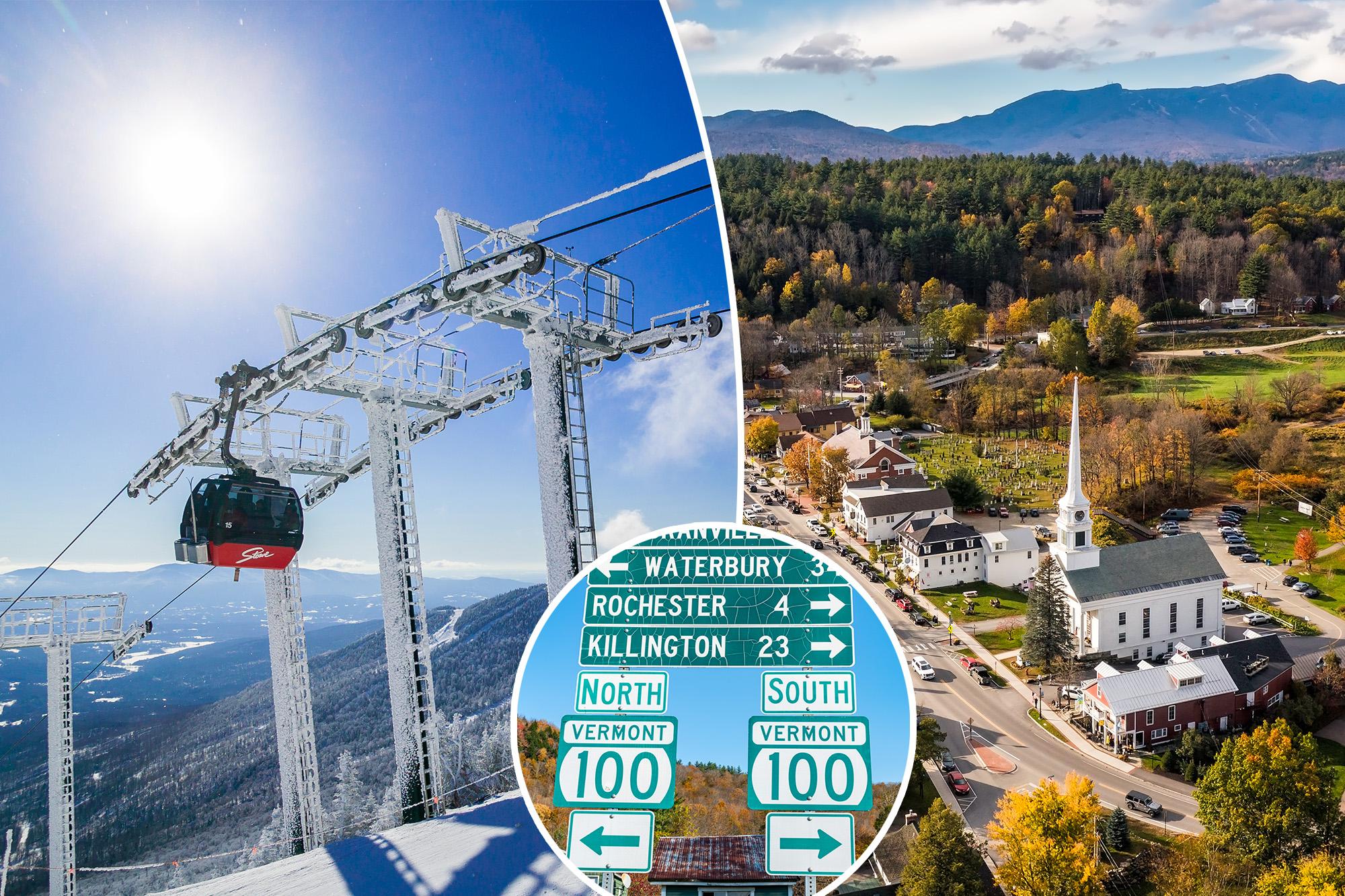
A picturesque Vermont getaway has emerged as the priciest major ski destination on the East Coast — where the typical home now comes with a nearly $1 million price tag.
Stowe, tucked into Vermont’s Green Mountains, had a median listing price of $995,000 in August, according to Realtor.com, with the Wall Street Journal identifying the town’s 05672 ZIP code as having the most expensive residential real estate of any major East Coast alpine-ski destination.
And other measures of the local housing market suggest buyers looking for a home near the slopes could face an even steeper price tag.
Single-family homes in Stowe sold for a median $1.285 million through Sept. 27 — the highest among six major Vermont ski markets examined in an analysis of 2026 PrimeMLS sales.
That narrowly topped other Vermont ski towns, such as Killington, where the median was $1.213 million, and far surpassed Winhall, home to Stratton Mountain, at $834,500; Warren, near Sugarbush, at $795,000; and Waitsfield at $721,250.
Of the 57 single-family homes sold in Stowe during the period, 34 — nearly 60% — changed hands for more than $1 million, according to the PrimeMLS sales analysis.
Separate market reports put Stowe’s typical sale price even higher.
The median price for a single-family home in Stowe reached $1.4 million during the first half of 2026, jumping 23.1% from the same period last year, according to Coldwell Banker Hickok & Boardman Realty’s midyear market report.
Meanwhile, Stowe’s median sale price reached $1.238 million for the three months ending in August, according to Redfin’s latest market data.
The seven-figure prices underscore just how expensive the longtime ski destination has become.
The median single-family home sold for $1.038 million in 2025, compared with just $396,750 across surrounding Lamoille County, according to Stowe town planning documents.
That means a typical Stowe house commanded a 161% premium over the surrounding county — up from an 83% premium in 2000.
Still, there are signs that buyers may finally be gaining some leverage.
Stowe’s median asking price was down 13% from a year earlier in August, while active inventory climbed 16% to 110 listings. Homes spent a median 94 days on the market, with an asking price of $443 per square foot, according to Realtor.com’s August market data.
Stowe’s appeal, of course, starts with the mountain.
The town’s ski culture stretches back nearly a century, with Stowe Mountain Resort tracing its history to the 1930s. Looming above it all is Mount Mansfield, Vermont’s highest peak.
But these days, locals say the skis are only part of the sales pitch.
In summer and fall, visitors come for hiking, mountain biking, fishing and swimming — and often stay much longer than the weekend ski crowd, according to Steve Foster, co-owner of Hickey & Foster Real Estate.
Foster, who grew up on the East End of Long Island, likens Stowe’s evolution to another famous second-home playground: the Hamptons.
There was once a true off-season here, he said, when restaurants would shut their doors after the crowds disappeared.
“That doesn’t happen anymore,” Foster said. “There’s enough people year round.”
Some people who came temporarily never left. Foster said he knows former New Yorkers who fled Brooklyn and Manhattan for Stowe during the pandemic, only to stay and put their children in local schools.
The town is also famously home to the von Trapp family, whose escape from Nazi-annexed Austria inspired “The Sound of Music.” The family settled in Stowe and established what became the Trapp Family Lodge.
But living the vacation life doesn’t come cheap.
McKee Macdonald, broker and owner of Coldwell Banker Carlson Real Estate who recently chaired the town’s Housing Task Force, said affordability has become an increasingly pressing issue as home prices surged after the pandemic.
Part of the problem is limited supply: Stowe has little large-scale residential development, while new single-family construction tends to be concentrated at the luxury end of the market.
The town has also recently tightened restrictions on short-term rentals as it grapples with its housing crunch.
Yet Macdonald said Stowe’s second-home owners often become deeply rooted in the community rather than simply dropping in for vacations.
“There’s an overlapping sense of community,” he said. “So it’s not just people that own second homes that come in, use them, and don’t interact in the community.”
In fact, Macdonald said his firm has sold homes this year for owners who had kept their second homes in Stowe for 40 to 50 years.
For now, Foster doesn’t expect Stowe’s appeal — or its premium prices — to fade anytime soon.
“They want to be here and they’re willing to pay for it,” he said. “I’m not seeing any factor that’s gonna change that in the near future.”