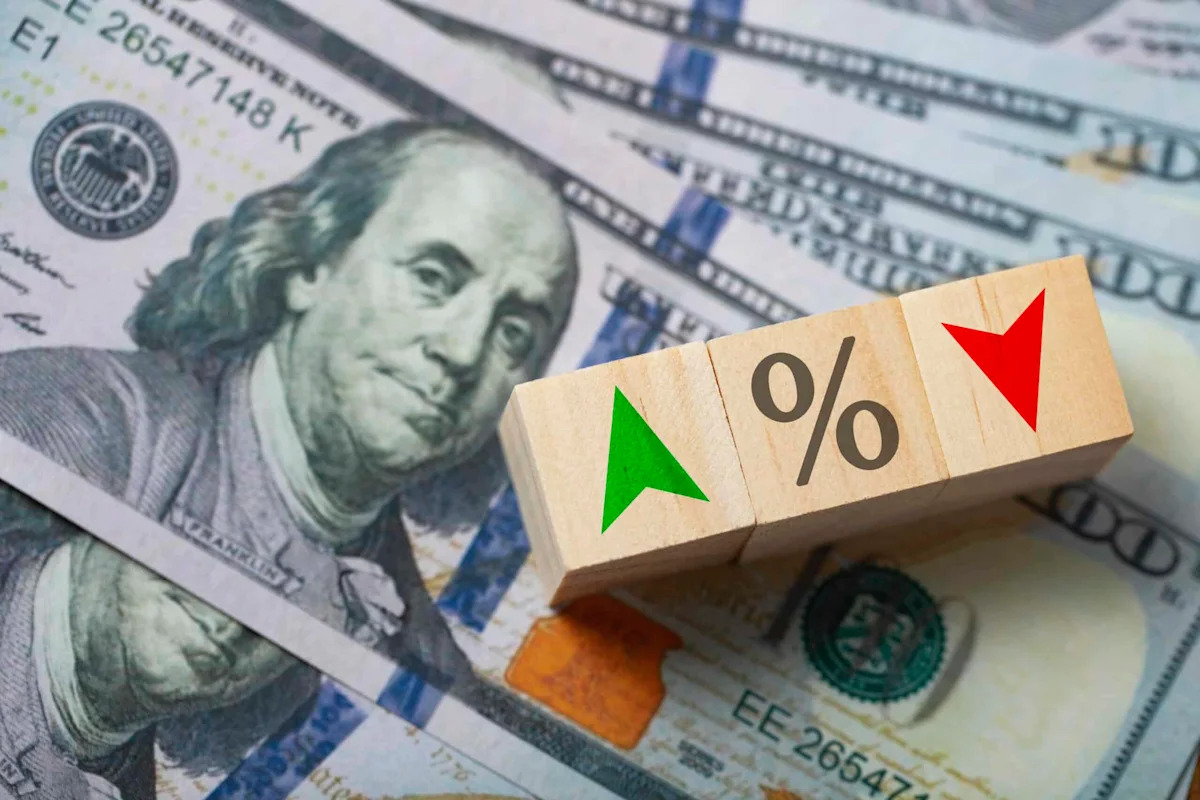
America Got Addicted to Cheap Money — Now the Economy Is Cracking as Rates Exceed 5% Rich Duprey Wed, October 7, 2026 at 11:22 AM EDT 6 min read TLT -0.50% MSFT -0.37% BLK -0.95% WMT +1.24% GOOG -0.46% Explore stocks on Coinbase Trading disclosure Trading disclosure The above button links to Coinbase. Yahoo Finance is not a broker-dealer or investment adviser and does not offer securities or cryptocurrencies for sale or facilitate trading. Coinbase pays us for certain activity generated through this link. Prices displayed are informational.
$4.3 trillion in corporate bonds mature by 2031, and refinancing at 6%+ could double interest costs from the original 3% rate.
Rising mortgage rates erased roughly $71,000 in homebuyer purchasing power, while federal interest costs now consume $1 of every $5 in tax revenue.
Investors poured $2.6 billion into TLT during its record 10-day losing streak, betting on 5.4% yields despite the fund's 14.7-year duration risk.
Building a portfolio and living off one are two completely different skills, and almost nobody teaches the second. This problem is what The Definitive Guide to Retirement Income helps, and it is free today. Read more here. (Sponsor)
For 15 years, borrowing was close to a free lunch. Companies locked in 3% debt, homeowners secured sub-4% mortgages, and Washington financed deficits at yields that barely registered. That era is over.
The 10-year Treasury yield closed at 5.28% on Oct. 2, its highest level since 2002, and the 30-year mortgage rate averaged 7.28% in the Oct. 1 survey from Freddie Mac. Investors are now finding out which business models, household budgets, and government finances depended on cheap money. The answer will shape portfolios for years.
About $4.3 trillion of U.S. nonfinancial corporate bonds matures between 2027 and 2031, according to a Reuters analysis of LSEG data. These are bonds from companies outside banking and insurance, such as Walmart (NYSE:WMT) and ExxonMobil (NYSE:XOM). Annual maturities rise from roughly $572 billion in 2027 to $1.03 trillion in 2030.
Most of that debt was borrowed when money was nearly free. A company refinancing $10 billion of 3% bonds at 6% sees annual interest expense double, from $300 million to $600 million. That is $300 million less for dividends, buybacks, hiring, and capital spending. Granted, $4.3 trillion is five years of maturities, not distressed debt. But Reuters reports that coupons on some CCC-rated bonds could roughly double at current rates.
Many successful investors eventually reach the same moment. The saving is done, the portfolio is built, and the question quietly changes from how much can I grow this to how much can I take out? Get that second question wrong and decades of good investing can come apart in a handful of years.
That is exactly what The Definitive Guide to Retirement Income helps answer. It covers what your retirement could actually cost, which income sources are worth using, and the withdrawal math that decides whether the money lasts. It is free today from Fisher Investments. Read More Here ›
Here's the part most coverage skips. AI companies are lining up at the same window. Goldman Sachs estimates Amazon (NASDAQ:AMZN), Alphabet (NASDAQ:GOOGL), Meta Platforms (NASDAQ:META), Microsoft (NASDAQ:MSFT), and Oracle (NYSE:ORCL) could issue roughly $420 billion of gross debt in 2027, about 60% more than in 2026.
A JPMorgan analysis found that AI-company debt this year already equals 68% of new long-term Treasury borrowing. So $4.3 trillion of old, cheap debt is colliding with the highest yields in 24 years, while hyperscalers bid for the same dollars.
The era of the 'free lunch' is officially over. With a $4.3 trillion refinancing wall looming and interest expenses doubling, investors must find out which companies are built to survive the high-rate squeeze. © 24/7 Wall St.
The mortgage rate itself isn't the interesting number. Purchasing power is. According to the Associated Press, the 30-year rate rose to 7.28% from 7.03% a week earlier, the sixth straight weekly increase and the biggest one-week jump in four years.
That is roughly $71,000 of lost borrowing power, and the house didn't get one penny more expensive. Surprisingly, prices needn't crash for housing to freeze. Buyers can't afford the same home, and owners holding 3% mortgages won't sell, which squeezes volume for builders and lenders.
Washington faces the same arithmetic. Federal interest expense runs near $1 trillion annually, roughly $1 of every $5 in tax revenue. The federal debt now equals 120% of GDP versus 56% in 2002, which explains why bond buyers are charging Washington more.
Barron's reported that investors poured about $2.6 billion into the iShares 20+ Year Treasury Bond ETF (NASDAQ:TLT) in one week -- its largest weekly inflow since August, bringing year-to-date inflows to roughly $4.9 billion. The fund simultaneously hit a record 10-day losing streak and traded near a record low. Prices keep falling, and investors keep buying.
Ironically, the fund's design explains both. BlackRock (NYSE:BLK) lists TLT's weighted average maturity at about 26 years and effective duration near 14.7 years. As a rule of thumb, each 1-point rise in long yields trims about 14.7% from the price. The 30-year yield is TLT's most direct driver, though it moves with the 10-year.
That cuts both ways. Thirty-year yields near 5.4% offer income unavailable for most of the post-financial-crisis era. Another jump, however, produces real capital losses. Sharp income investors can reduce that duration risk: defined-maturity ETFs locking in 5.7% corporate yields and money market funds paying 3.7%.
In short, cheap money built businesses that only work at low rates, and 5% exposes them one maturity at a time. Investors should favor cash-rich, investment-grade balance sheets that can refinance from strength, while being wary of leveraged companies with 2027–2031 maturities and CCC-rated debt. Treat long Treasuries as a position, not a parking spot: scale in gradually or ladder shorter maturities.
Regardless of your approach, you need to be checking each holding's debt maturity schedule in its latest filings before the wall arrives.
(Sponsor) Most people spend their entire working lives focusing on one thing: growing a pile of money. Then they retire and discover the skill they actually need is close to the opposite. Turning that pile into steady income, year after year, through good markets and bad, without ever running out.
It may be the least discussed and most consequential transition in personal finance, and plenty of otherwise careful investors walk into it with no real plan. That is exactly what The Definitive Guide to Retirement Income helps answer. It is a free guide from Fisher Investments covering what your retirement will really cost, where the cash flow should come from, and how much you can safely withdraw each year. Learn more here. Learn More Here ›
Contact editorial@247wallst.com for any questions or corrections.