NVDA -0.85% Trade NVIDIA on Coinbase Trading disclosure Trading disclosure The above button links to Coinbase. Yahoo Finance is not a broker-dealer or investment adviser and does not offer securities or cryptocurrencies for sale or facilitate trading. Coinbase pays us for certain activity generated through this link. Prices displayed are informational.
You've probably heard the cliché "it takes money to make money." And there's some truth to the premise. In the business world, you'll usually need at least a little seed capital to start.
If you're an investor with average income, however, you might be surprised how easily you could become a millionaire. And not from brilliantly lucky stock-picking, either; attempting to outperform the overall market can undermine your performance, in fact. The key, rather, is making disciplined contributions to the cause -- no matter how seemingly modest -- even when you don't want to make them. That's often when sticking with your plan helps the most.
Missed Nvidia in 2009? This Rare Signal Is Flashing Again. In 2009, a "Double Down" signal flashed for a little-known chipmaker called Nvidia. For the first time in years, that same "Total Conviction" signal is flashing for a company 1/100th the size of Nvidia. Continue »
And $500 per month would do the trick, given enough time. Here's how, and why.
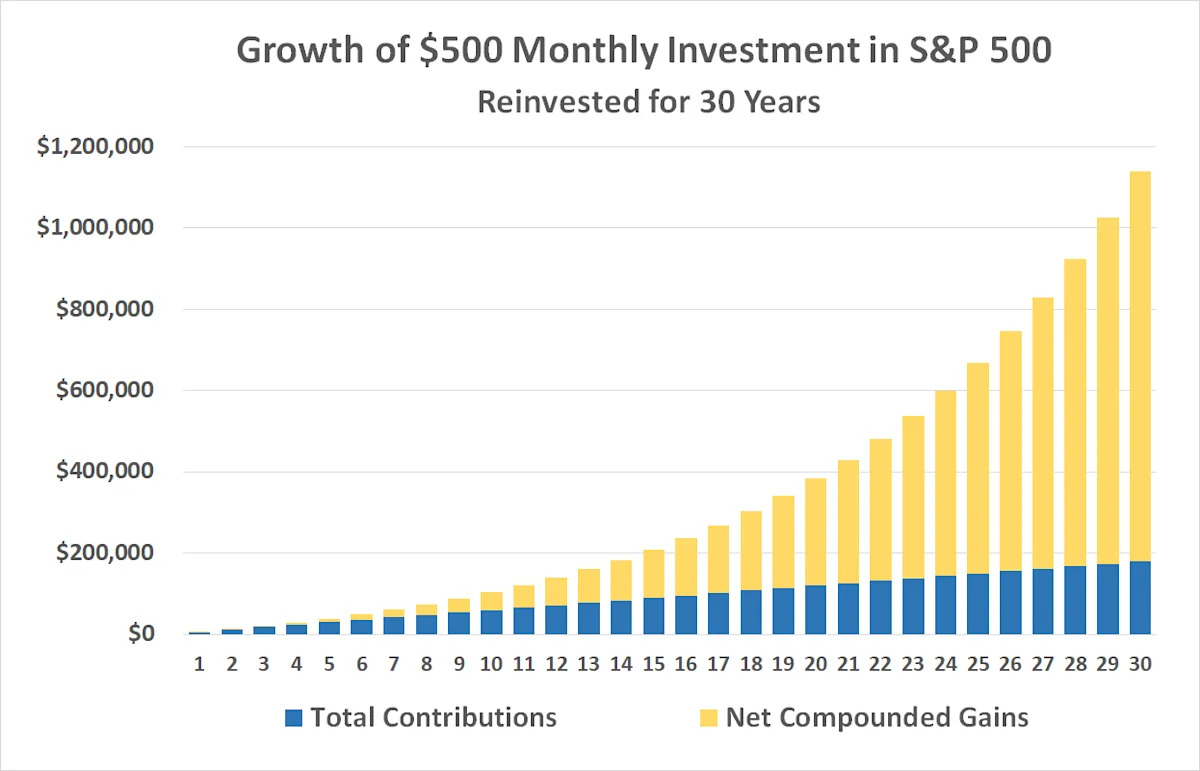
There's no denying that in the economic environment of 2026, coming up with an extra $500 per month can feel like a pretty tall order. For most households willing to buckle down on discretionary spending, though, it's possible. And if you're willing to invest that money in an S&P 500 (SNPINDEX: ^GSPC) index fund that matches the broad market's average annual gain of 10%, in 30 years you'd be sitting on a little over $1.1 million (or slightly less if you're not contributing this cash to a tax-sheltering retirement account).
The image below illustrates how and when this plan drives net growth. Much like a snowball rolling down a hill, most of it materializes during the final one-third of the time frame in question. The key is simply entering that final one-third of the time frame with as much invested capital as possible.
The stumbling block for most people usually pops up more than once during the first two-thirds of the time you're contributing to rather than withdrawing from a retirement savings account. It's easy to continue tucking money away when the economy is strong and the market is roaring. It's difficult, however, to force yourself to do so when the economy stinks and the stock market is stagnant (if not losing ground). Your income may not have grown in step with the cost of living.
The thing is, this is precisely when you're making the most progress, accumulating more market exposure while it's temporarily on sale.
If you've had or are having trouble doing so, try doing what most ordinary investors who become millionaires did. That's automating your contributions to an investment account, and then automating your purchase of a quality S&P 500 index fund or ETF with that cash. This approach sidesteps much of the mental discomfort of having to make it happen by hand when the market's performing poorly.
A simple mental trick? Arguably yes. But if it works, it works. Sometimes, when you've got large sums of money on the line, you have to fight your brain's tendency to defend against short-term worry.
It helps to build automated approaches that reflect faith in the stock market's well-established track record of long-term gains... something that's easy to lose sight of when stocks are underperforming.
Before you buy stock in S&P 500 Index, consider this:
The Motley Fool Stock Advisor analyst team just identified what they believe are the 10 best stocks for investors to buy now… and S&P 500 Index wasn't one of them. The 10 stocks that made the cut could produce monster returns in the coming years.
Consider when Netflix made this list on December 17, 2004... if you invested $1,000 at the time of our recommendation, you'd have $370,440!* Or when Nvidia made this list on April 15, 2005... if you invested $1,000 at the time of our recommendation, you'd have $1,470,022!*
Now, it's worth noting Stock Advisor's total average return is 955% — a market-crushing outperformance compared to 215% for the S&P 500. Don't miss the latest top 10 list, available with Stock Advisor, and join an investing community built by individual investors for individual investors.
*Stock Advisor returns as of October 7, 2026.
James Brumley has no position in any of the stocks mentioned. The Motley Fool has no position in any of the stocks mentioned. The Motley Fool has a disclosure policy.
History Says This 1 Habit Has Helped Turn Ordinary Investors Into Millionaires was originally published by The Motley Fool