Iranian authorities are trying to persuade prominent singers in exile to return home. While the state seeks to harness music as a political tool, music has also become a powerful expression of dissent and resistance.
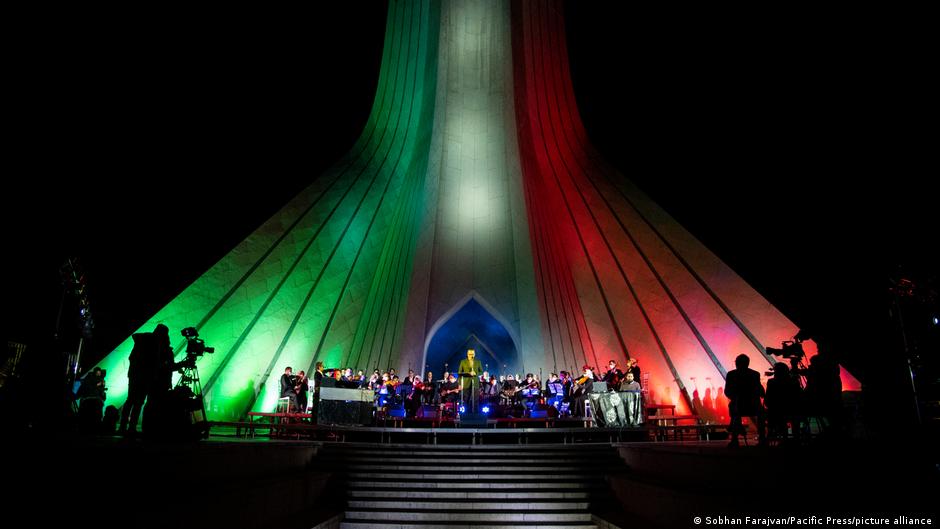
https://p.dw.com/p/5NvEOSince the 1979 Islamic Revolution, there has been an ongoing conflict between the Iranian state and musicImage: Sobhan Farajvan/Pacific Press/picture alliance AdvertisementAfter spending 47 years abroad, Iranian musician Bijan Mortazavi returned to his homeland at the end of September.
Mortazavi is one of Iran's most renowned violinists, singers, and composers.
In July 2026, he performed with his famous white violin at the closing ceremony of the FIFA World Cup alongside the New York Philharmonic Orchestra.
In the videos that he and his wife have now posted on social media, the couple can be seen taking walks through the city of the Iranian capital, Tehran, while passersby greet the musician warmly and welcome him.
Singer Mohsen Namjoo also recently returned to Iran after about 20 years in exile.
Internationally renowned for his experimental Persian music, he blends traditional Persian singing and poetic lyrics with elements of blues, rock, jazz, and folk.
In 2009, Namjoo was sentenced in absentia by a court in Tehran to five years in prison.
He was accused of insulting holy sites and mocking verses from the Quran, among other things.
In a video posted online after his return to Iran, Namjoo said he had returned to the country to spend more time with his family and friends.
On August 27, Abbas Salehi, Iran's minister of culture and Islamic guidance, said in an interview with the prominent Iranian media outlet Farhikhtegan that his ministry had compiled a list containing the names of more than 100 distinguished Iranians living abroad.
The goal, he said, was to remove obstacles to their travel or return to Iran.
Salehi stressed that even "critics of the Islamic Republic" could return at any time. He added, however, that the return of artists does not necessarily mean they would perform in Iran. Instead, they could simply visit the country, the minister said.
Sina Yousefi, a human rights lawyer, pointed to international law, specifically Article 12 of the International Covenant on Civil and Political Rights, to which Iran is also a signatory.
According to this provision, no one may be arbitrarily prevented from entering their own country. This right cannot be made contingent on a citizen's level of loyalty to the government, he told DW.
"The idea of seeking out certain well-known figures — who the reformists, in particular, believe are less likely to cross the red lines — and winning them over to collaborate or bringing them back to the country is not new," said Sepideh Raissadat , an ethnomusicologist who has been studying the history and development of Persian music for years.
As an internationally renowned performer of classical Persian music, she combines her artistic work with scholarly research, with her dissertation focusing on the lives of Iranian female singers since the 1979 Islamic Revolution.
Iran uprising seen through the eyes of Iranian women To view this video please enable JavaScript, and consider upgrading to a web browser that supports HTML5 video
"The 1979 revolution in Iran was a revolution against music. Music was one of the red lines," said Raissadat, referring to statements by the leader of the revolution, Ayatollah Ruhollah Khomeini, who as early as July 1979 had publicly described music as harmful to society and called for its complete abolition.
In a speech to employees of Radio Darya on July 21, 1979, Khomeini is said to have described music as "a betrayal of the country" and "a betrayal of the youth." A few days later, the Iranian newspaper Keyhan quoted him as saying that music was "like a drug” and must be completely eradicated.
During the Iran-Iraq War from 1980 to 1988, however, music made a comeback in the form of revolutionary and religious songs. It was also used to stir up feelings of national pride and a sense of belonging.
The regime also failed to completely banish the female voice from the public sphere. "They couldn't completely eliminate the voice of women. The female voice returned through choral singing," said Raissadat.
But the conflict between the state and music continued.
For years, musical instruments were not allowed to be shown on Iranian television. Instruments were confiscated or destroyed on the streets. Fearing repercussions, musicians did not carry their instruments in public, while some hid them in their cars.
"Listening to banned music at home was a political act. And when women began to sing, that, too, became a political act," Raissadat noted. The development of Iranian pop music was also part of this political and cultural tension, she underscored. "People began producing new domestic pop music to compete with music from Los Angeles."
Over the past ten years, social media — which is not entirely under government control — has become increasingly important and now wields considerable influence.
This change is particularly evident among young people, with young women now even playing the guitar without headscarves and performing in public.
Iranian singer finds voice in GermanyTo view this video please enable JavaScript, and consider upgrading to a web browser that supports HTML5 video
Raissadat observes a particular trend among the families of the young people who were killed during the nationwide mass protests in late December 2025 and January 2026.
The demonstrations began on December 28, 2025, and were violently suppressed by security forces.
Human rights organizations report that thousands of protesters were killed, but the exact figures are unknown due to the extensive information blackout imposed by the regime.
"The most important thing we've seen in recent years has been the use of music by the bereaved families of those killed in the protests. This stands in complete contrast to Shiite tradition and our history," said Raissadat.
At some funerals, families turned the memorial service for their loved ones into a new form of protest.
Instead of religious hymns, music played, and the mourners sang and danced along to it. In doing so, they created a deliberate contrast to traditional religious mourning rituals, the musician said.
"Music became a weapon. Those who were mourning were able to connect with it on their own, and at the same time, it stood in opposition to what the political system stands for," Raissadat pointed out, adding, "Dancing in white clothing also became an expression of this resistance."
This article was originally written in German.