play Live Sign upShow navigation menuplay Live Click here to searchsearchSign upSport|FootballMiles away from Argentina, Messi’s farewell hits home for his Indian fansAlmost 15,000km away from Argentina, Messi’s magical presence on the field left a lasting mark on fans across India.
xwhatsapp-strokecopylinkgoogleAdd Al Jazeera on GoogleinfoToggle PlayMessi super fan travels from India to Argentina for idol’s final game
What lengths would you go to prove your love for your sporting idol, especially when they are one of the greatest to have graced the football field?
For Lionel Messi’s superfan Yadil Iqbal, it took 40 hours of travel and thousands of dollars in expenses, all to tick off a bucket list: the once-in-a-lifetime opportunity to watch the diminutive forward’s last dance with Argentina, a game 21 years in the making.
But even as Iqbal packed his bags – carefully tucking the blue-and-white Argentina jersey and a special watch he hoped to gift Messi – there was a little twist in the story.
When he left his hometown Kodungallur in the southern Indian state of Kerala to attend Messi’s farewell friendly against Benin, the internet-popular creator did not have a ticket to Tuesday’s match at the Monumental Stadium in Buenos Aires.
During the 15,000km (about 9,300 miles) journey, which involved multiple stops and long waits at airports, Iqbal documented his trip for his 1.7 million followers on Instagram. But not once did he feel anxious about the risk he was taking.
“I prayed to God that Messi wins the World Cup. Four years ago, He made it happen, and I saw it with my naked eyes,” Iqbal told Al Jazeera, referring to Messi’s first-ever World Cup victory at Qatar 2022.
“Now, nothing feels like a big challenge to me.”
Proving the saying “fortune favours the brave” right, Iqbal found the coveted match ticket hours after landing in Argentina. Getting his hands on it at the last minute in the resale market meant paying $1,000, a price he described as “three times the original value”.
But for Iqbal, who has named his toddler son “Lian Messil” – a wordplay on Lionel Messi – it is a small price to pay.
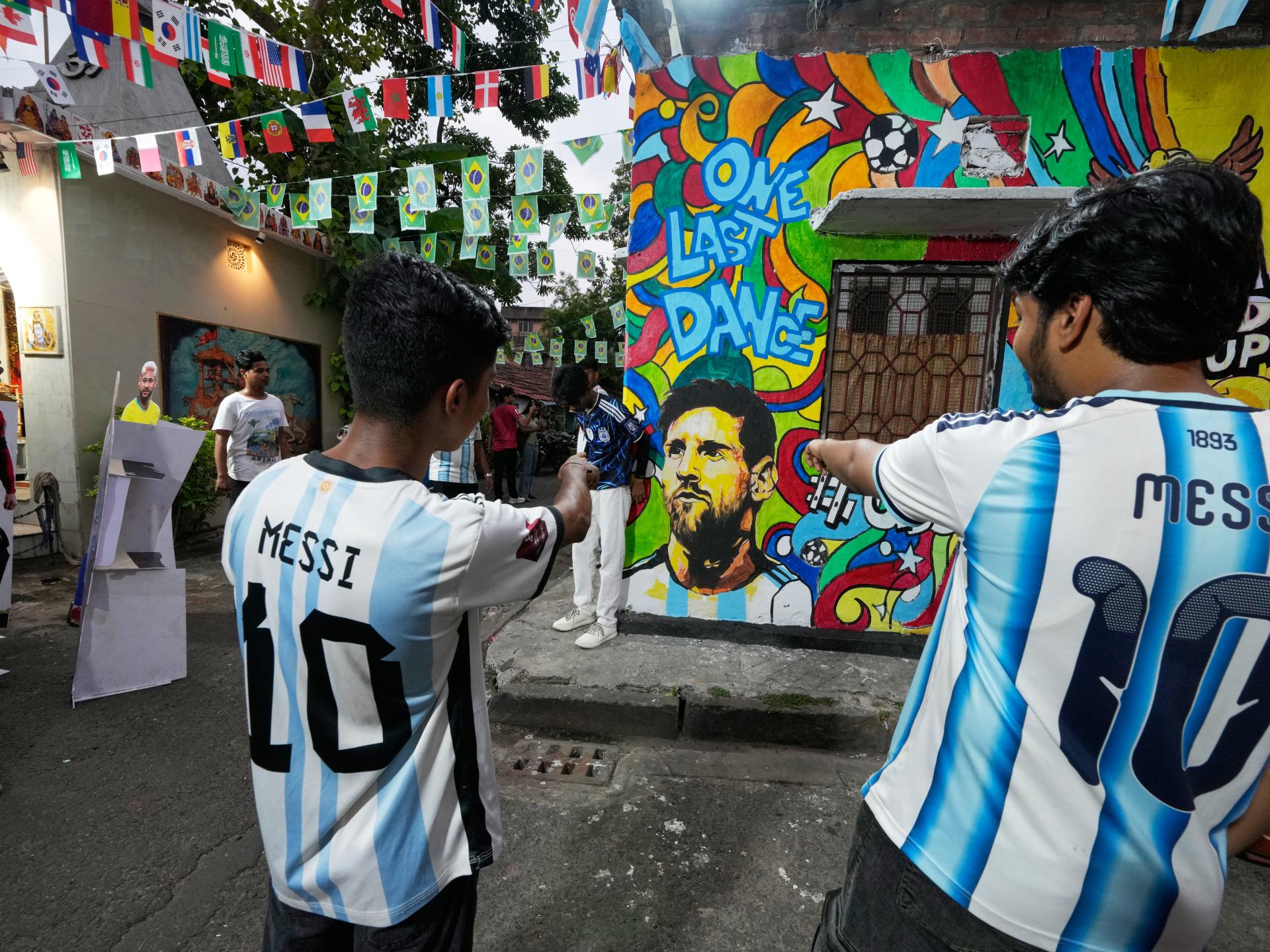
Like Iqbal, much of Kerala, as well as Kolkata in the eastern state of West Bengal, is crazy for the record eight-time Ballon d’Or winner, also the most-capped player in Argentinian history.
He may be born in Rosario, but to the thousands of supporters in those states and millions countrywide, he is one of their own.
Come any World Cup, parts of neighbourhoods in Kerala resemble a sea of sky blue-and-white – be it the Argentina flags hanging outside houses or, in some cases, the humble abode itself painted in the colours of the Albiceleste.
A massive mural – 32 feet in height and 20 feet in width (9.75 metres by 6 metres) – featuring Messi’s major trophies is his way of showing his love for the Inter Miami forward.
“I got that built near my house after Argentina won the 2021 Copa America, but Messi saw it on Instagram only in June this year when I wished him happy birthday,” Iqbal recalls.
“I learned Spanish from Google Translate, posted the video online and luckily, he thanked me in the comments, taking my name.”
In the metropolitan city of Mumbai in western India, for Sagar Shinde, who has grown up watching Messi play, the thought of seeing the greatest of all time (GOAT) wear the Argentina jersey for the last time left him in tears.
“Do you want me to cry again?” he said when asked about his emotions a day before the game.
“I am going to continue watching football, but the man who made me fall in love with the game will not be around for the team I support.”
Shinde’s love for Messi knows no bounds. He declined to choose between his engagement day and Messi’s World Cup triumph when asked to pick one as his best memory.
A tattoo on his forearm speaks volumes. It bears the date on which Messi lifted the World Cup trophy in Qatar, finally stepping out of the shadow of the late Diego Maradona.
“I challenged my friend that if Messi wins the trophy, we should get a tattoo of him. When it happened, I told him, ‘God has given us what we wanted, so we have to live up to our promise’,” Shinde, a creative producer and sports content creator, said.
Like several others, he started following La Liga club Barcelona and the Argentina national team only because of one man: Messi.
He is also the cofounder of fan club FCB Mumbai, which hosts screenings of Barcelona and Argentina matches.
Keeping up with South American football action is no joke for those living in South Asia; watching live games often demands staying up way past midnight or waking up before the crack of dawn.
But the eight-and-a-half-hour time difference was hardly a problem for the Messi and Argentina fans, with hundreds turning up for the 4:30am kickoff screening in Mumbai and beyond on Wednesday.
“Messi is unique,” Shinde said, describing the ex-Barcelona player’s talent. “If you watch football, you have to admire Messi. His elegance, dribbling skills, and the way he conducts the play … everything.
“Even when Argentina are playing badly, Messi is still good. He’s that kind of player – he can touch the ball and create magic in a second.”
“He is an idol because he motivates us so much; he never gave up.”
Such is the impact of the magical Messi that his swansong drew about 85,000 fans in the Argentinian capital – more than the reported 70,000 fans who filled Levi’s Stadium in Santa Clara, California, in the United States, for the 2026 Super Bowl in the National Football League (NFL).
South American football expert Martin Mazur, who is based in Buenos Aires, believes that, over the years, Messi has transformed into a “cultural icon”.
“He had been one for the younger generation [in Argentina] before winning his first trophy, but the new generation clashed with the old ones for many years, until a couple of years before the 2021 Copa America,” he said.
“In the end, Messi kind of conquered even the older generations, who witnessed five major finals lost.”
Argentinian journalist Mazur, who has written for FourFourTwo magazine and La Gazzetta dello Sport, among other leading publications, said Messi bows out from international duty, enjoying the same hero status as Maradona, who led Argentina to 1986 World Cup glory.
“What Maradona represented for the older generations, Messi now represents for the new generation,” he explained.
“For some people who weren’t born when he won, they will find out what Messi means without him in action any more, through videos, as it happened with Maradona – he had the melancholia of the people who watched him in action, but also the kind of nostalgia of people who didn’t watch him.”
London-based Argentinian journalist Marcela Mora y Araujo believes that while Messi has not changed the way football is played today, he is “one of the most influential players of his generation”.
“His individual qualities are such that he is very much unique,” said Mora y Araujo, a columnist for the Times of India newspaper. “I wouldn’t say more people play like Messi now because no one can play like Messi.
“But he has definitely marked an era, at the club level as well as the country. For Argentina, it took him a while to get the recognition, acceptance and accolade that he thoroughly deserved, but at club level, he had much more of an impact.”
Mora y Araujo, who equally spends her time between the United Kingdom and Argentina, said Argentinian fans and team alike love the “Asian love” they receive from Bangladesh, Pakistan and India.
“It is a source of enormous joy and pride for Argentinians,” she added. “There are viral videos of Indian fans chanting songs from Argentina… It’s terrific.
“I am not alone in saying that we absolutely love it.”