Thousands of Afghans are attempting to leave Iran amid intensifying attacks and collapsing infrastructure. While children face growing hunger and disease, undocumented refugees in cities like Tehran remain stranded.
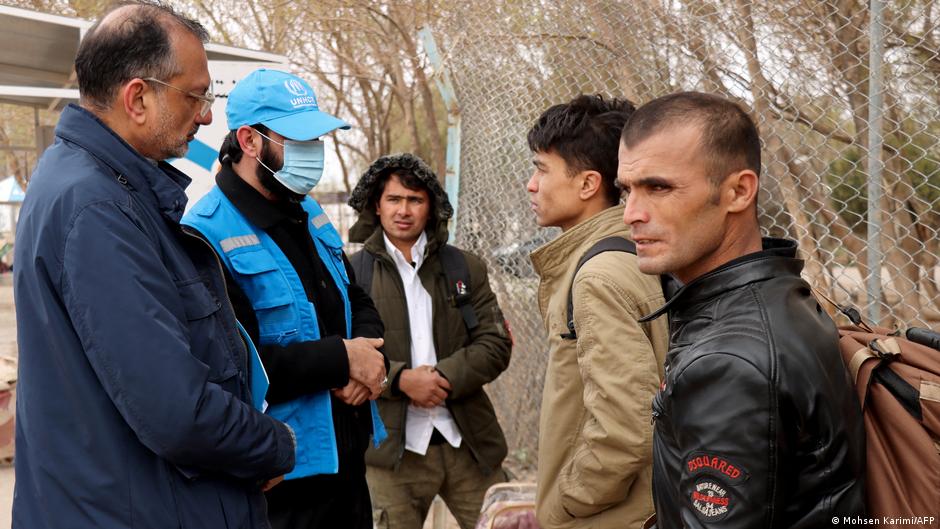
https://p.dw.com/p/5AHjBMany Afghans in Iran are trying to return to their homeland via border crossings such as Islam QalaImage: Mohsen Karimi/AFPAdvertisementSince the outbreak of the Iran war, thousands of Afghan refugees living in the Middle East nation have been trying to leave and return to their homeland. So far, there are no reliable statistics on the number of returnees.
At border crossings such as Islam Qala, desperate families continue to arrive every day. Journalists on the ground report exhausted people who often reach the border after arduous journeys from various parts of Iran.
Mohammad Kabir Nazari, a 48‑year‑old who worked as a security guard in Tehran for the past 11 months, told the AFP news agency that the recent attacks on the capital were "50 times worse" than anything he had experienced during the 12‑day war in June 2025.
"Every day, rockets came from all sides," he said. "There was no protection for Afghans. The situation was very bad."
The United Nations Children's Fund (UNICEF) has warned that children are suffering the most under these conditions. For families now forced to return to Afghanistanwith very limited resources, displacement and insecurity can quickly increase the risk of malnutrition and disease, especially for young children as well as pregnant and breastfeeding women.
"Families returning through Islam Qala will move onwards to communities where basic services are already under pressure," said UNICEF representative in Afghanistan, Dr. Tajudeen Oyewale, at a press briefing on March 10. "Any significant increase in returns would place additional strain on health, nutrition, water and child protection services that children and families rely on."
UNICEF also warns that the geopolitical situation is causing significant disruptions to supply chains, leading to delays in basic services. Malnourished children often do not receive life‑saving therapeutic food in time.
Over a million Afghans forced back from Iran to Taliban ruleTo view this video please enable JavaScript, and consider upgrading to a web browser that supports HTML5 video
Not everyone can or wants to return to Afghanistan. Zahra Sepehr, head of the Netherlands‑based organization AWA Legal and Social Foundation, told DW about Afghan refugees who are stranded in Tehran and unable to leave the city because they lack residency documents.
Local sources report that anyone who leaves Tehran must expect to be stopped and checked several times on the road while volunteer Basij paramilitary militias, who are fiercely loyal to the Islamic Republic, are stationed everywhere.
"Women's rights activists, human rights activists, as well as women and girls living alone are particularly affected," Sepehr said. Many of them have contacted her organization in urgent need of assistance. Due to security threats, they cannot return to Afghanistan and are therefore living under extremely difficult conditions in Iran.
Many are trying to remain anonymous in major cities. They continue to work illegally and under precarious conditions, often in low‑paid jobs, for example, as cleaners or as workers in small workshops or textile factories.
The Iranian government has officially declared a state of war. According to the authorities, special labor regulations now apply for employees of state institutions, with the option to work remotely or have reduced working hours.
Regime 'taking the Iranian people hostage'To view this video please enable JavaScript, and consider upgrading to a web browser that supports HTML5 video
These protective measures, however, do not apply to people who work as day laborers, such as cleaners, security guards or vegetable vendors. For them, the war not only brings increasing danger from attacks, but also the loss of already unstable sources of income.
According to the US-based human rights organization Human Rights Activists in Iran (HRANA), a total of 1,276 civilians have been killed in Iran since the start of the war, including at least 205 children. HRANA reported that the number of military fatalities stands at 197, with an additional 352 deaths whose status (civilian or military) remains unclear.
Hannah Neumann, chair of the European Parliament's Iran delegation, warned in an interview with DW of a further escalation of the conflict.
"The EU should work to ensure that military attacks do not hit civilian infrastructure," she said, pointing to the destruction of a seawater desalination plant in southern Iran that had previously supplied drinking water to around 20 villages.
The loss of such facilities can have far‑reaching consequences, Neumann stressed, as water is an existential resource in the region. And when vital infrastructure is destroyed, she added, it further worsens the humanitarian situation, especially for the most vulnerable segments of the population.
The United Nations Refugee Agency (UNHCR) reported on March 12 that up to 3.2 million people, representing an estimated 600,000 to one million households, have been temporarily displaced within Iran by the ongoing conflict, according to preliminary assessments.
EU lawmaker says Iranians 'deserve freedom and democracy'To view this video please enable JavaScript, and consider upgrading to a web browser that supports HTML5 video
UNHCR also estimates that around 1.65 million refugees and other people in need of international protection live in Iran. However, the number of unregistered refugees is significantly higher, according to Iranian authorities. At the end of 2024, Iran's ambassador and permanent representative to the United Nations, Amir Saeed Iravani, estimated that over six million Afghans lived in Iran.
Many refugees avoid registering because they fear being deported to Afghanistan or hope to continue their journey to a safer country. As a result, they remain in precarious situations, often living in crowded areas of big cities such as the capital, Tehran, the epicenter of the current conflict.
This article was originally written in German.