@rockmarooned Published March 12, 2026, 9:00 a.m. ET Photos: Everett Collection ; Illustration: Dillen phelps Where to Stream: Barry Lyndon Powered by Reelgood More On: oscars How to Watch All 10 Best Picture-Nominated Films Before The 2026 Oscars The Best Picture Showdown Between ‘One Battle After Another’ and ‘Sinners’ Brings Some Legitimate Heat To Oscars 2026 ‘Stand By Me’ Star Corey Feldman Claims He “Was Not Invited” To The Oscars’ Rob Reiner Tribute: “I’ll Honor Rob My Own Way” When Are The Oscars? Start Time, Channel, Oscars 2026 Streaming Info By most standards, the 2026 Oscar nominees for Best Picture are pretty strong. Consider the factors: The race has seemingly come down to One Battle After Another versus Sinners, one of the best movies of the year against… another one of the best movies of the year. The closest thing to a shoulder-shrugger is the professionally made crowdpleaser F1. The more online cineastes have had to resort to hating Hamnet or Frankenstein to find a bone to pick. By most standards, the Academy has acquitted itself pretty well. It’s not far off from the ideal promised by the 2009 re-expansion to ten nominees: a wider variety of movies from populist to arthouse, all without needing to pay any unearned respect to something like Wicked: For Good (or, thinking back to 2009, The Blind Side) to fill out the group.
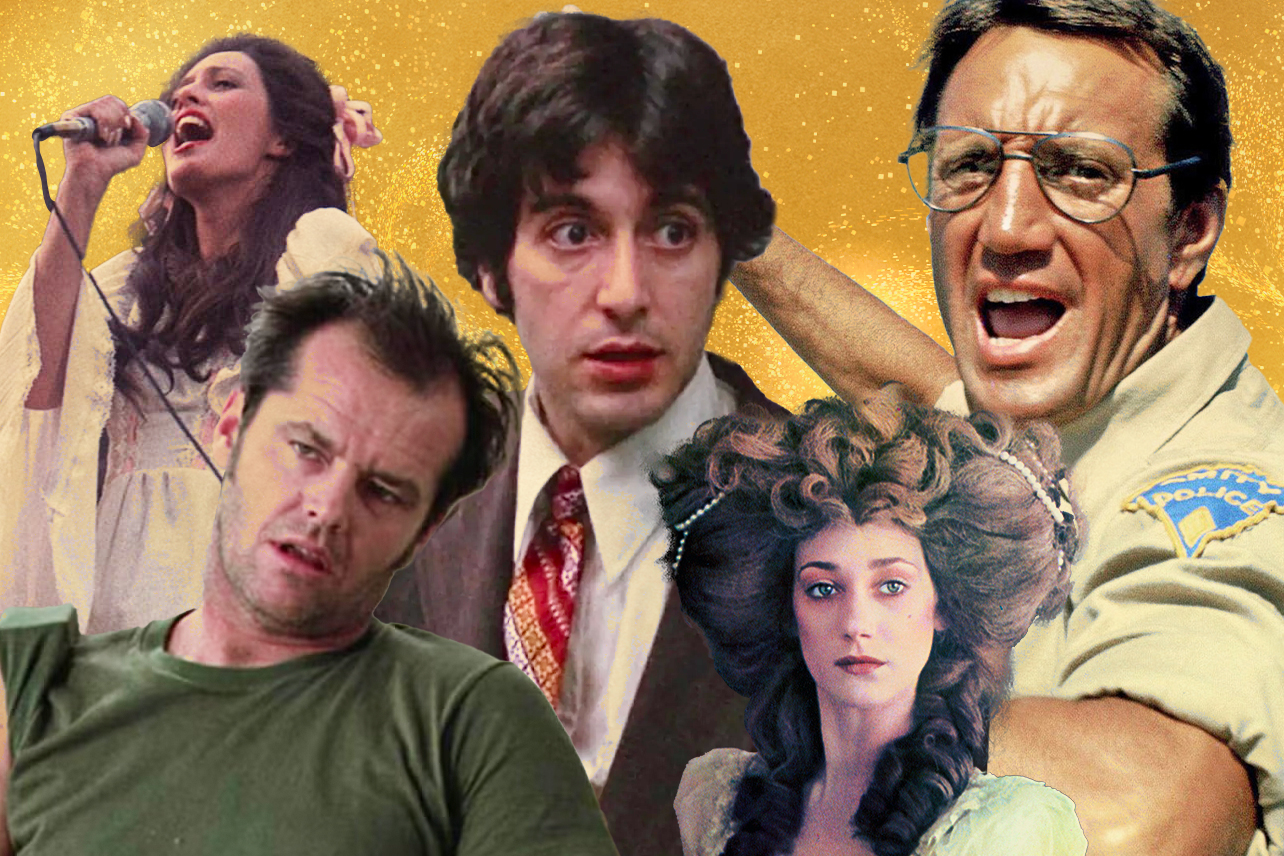
But this year also marks the 50th anniversary of what may be the single best collection of Best Picture nominees ever assembled, especially from the 65-year period during which there were only five nominees. For 1975, the Academy was faced with such an avalanche of classics they seemingly had no choice but to get it pretty damn near perfect. The nominees were: Steven Spielberg’s industry-changing blockbuster Jaws; Stanley Kubrick’s second and final film of the 1970s, Barry Lyndon; Robert Altman’s multi-character epic Nashville; Sidney Lumet’s live-wire crime dramedy Dog Day Afternoon, featuring an all-timer Al Pacino performance; and the eventual winner (and a record-setter in its own right), Milos Forman’s film version of One Flew Over the Cuckoo’s Nest, with an iconic Jack Nicholson turn. It’s the rare occasion where someone seeking a quick overview of that year in American cinema could simply… watch the Best Picture nominees.
Amazingly, this quintet didn’t go five-for-five with directing nominees; the then-green Spielberg was replaced with, well, fair enough: none other than Federico Fellini, for Amarcord. Nothing preventing the awards from looking like Oops! All Legends, in other words. Further down into the big categories and perhaps more bizarre, given its trio of memorable characters and healthy supply of quotable lines, Jaws didn’t make the cut for Adapted Screenplay. (The absence of Nashville, given Altman’s encourage of improvisation, is less surprising.) Still: It’s hard to beat that group of five, regardless of how the other awards worked out.
Capturing films showcasing the ascent of Spielberg, peak Lumet and Forman, a periodic Kubrick emergence, and the restlessly creative Altman, collectively featuring the likes of Nicholson, Pacino, Roy Scheider, Richard Dreyfus, Shelley Duvall, Lily Tomlin, and Ryan O’Neal, feels both rooted in the specifics of ’70s culture (when else does Ryan O’Neal topline a Best Picture nominee?) and also reflective of the legend of ’70s filmmaking in America, with its confluence of a new vanguard and, in Spielberg’s case, a reinvigorated popular entertainment. It’s important to know, though, that it really wasn’t just Jaws on the box office charts; three of the five Best Picture nominees occupied the top five list of the year’s biggest domestic grossers (though Jaws more than doubled the numbers for Cuckoo’s Nest, which more than doubled the numbers for Dog Day Afternoon).
The abundance and mainstreaming of these newer voices in American cinema of the 1970s means there are plenty of Oscar ceremonies throughout the decade that look similarly stacked now; maybe it’s just an accident of fate that 1975 happens to not have the odd movie out that isn’t as talked about today. 1976, for example, boasts Rocky, All the President’s Men, Taxi Driver, and Network – and a well-regarded but seemingly less well-known Hal Ashby movie called Bound for Glory. 1974 has The Godfather Part II, Chinatown, The Conversation, Lenny, and, uh, The Towering Inferno (which is rather like if the 1975 box office hit Return of the Pink Panther managed to elbow out one of the final five). Fast-forward to 1999, a year near-universally acknowledged as a particular good one for American film, and the five Best Pictures are representative of something, but not particularly great cinema: American Beauty (you had to be there), The Green Mile (even at the time, you really didn’t), The Cider House Rules (what?!), and, finally, a couple of great ones: The Insider and The Sixth Sense.
So is there any thematic unity drawing together these five especially top-tier films from ’75? Jaws, Nashville, and Dog Day Afternoon can all lay claim to feeling particularly like they’re About America in a way befitting the country’s then-looming bicentennial. All three have different senses of desperation, entwined with capitalism and politics and human frailty; One Flew Over the Cuckoo’s Nest feels more quarantined from its release date, owing to adapting a 1962 novel and setting it closer to the time of the book’s publication than the movie’s release. (The England-set Barry Lyndon is really the odd one out here, but then Kubrick’s movies feel increasingly out of step with their precise moment starting around this point, in a really productive and interesting way that nonetheless garnered him mixed reactions for this next/last three movies after Lyndon.) The mosaic of performances and characters in Nashville give it an especially eye-opening and ear-opening scope, while Dog Day Afternoon sticks its colorful characters onto a single city block for most of its runtime. Both Dog Day and Cuckoo’s Nest feature a charismatic ’70s icon at their center; while Pacino telegraphs his character’s frayed nerves, Nicholson’s whole deal is appearing confident and cool in his rebellion even as he puts himself in greater harm’s way than he seems to understand.
Spielberg, somewhat characteristically, offered a more optimistic view of American masculinity, teaming up three very different personalities and tasking them with hunting and killing a shark threatening a small community. It’s a Howard Hawks-y arrangement with wariness giving way to a chummy can-do spirit. But the reasons for the hunt in the first place – that the film’s beach-town mayor refuses to close beaches and harm tourist season, even if it means men, women, children, and one unlucky dog will get chomped – really tie the movie together in terms of making it feel just as quintessentially American as the Altman or Lumet films.
There are omissions, too, of course, in this 1975 version of America. Nashville has a number of compelling female characters but films actually directed by women or minorities are nonexistent in this small sampling; recent Best Picture groups typically include at least one movie directed by someone who’s not a white male. But that’s a problem with most groups of Best Picture nominees, reflecting social and industry ills more than 1975 in particular. Within this group of five, some movies’ stock may have risen or fallen over the years; I’d sense that Dog Day Afternoon now has a bit more cultural juice than the ultimate winner Cuckoo’s Nest, for example. But you won’t find many film fans telling you to skip any of these five, a stark contrast to the disappearing act some nominees inevitably perform once the season clears out. (Like I said before: The Cider House Rules?!) For one year, it really was an honor just to be nominated.
Jesse Hassenger (@rockmarooned) is a writer living in Brooklyn podcasting at www.sportsalcohol.com. He’s a regular contributor to The A.V. Club, Polygon, and The Guardian, among others.