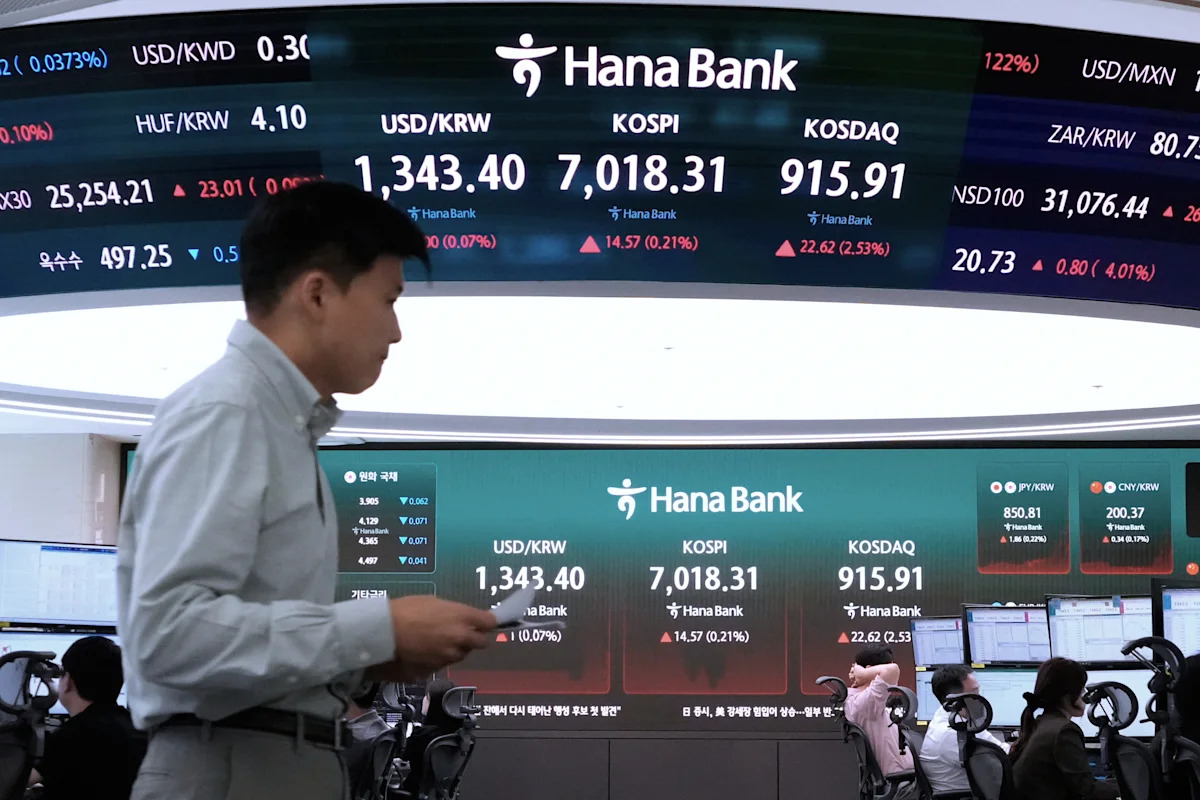
Asian stocks mostly fall back despite latest earnings-driven rally on Wall Street 1 / 4 Asian stocks mostly fall back despite latest earnings-driven rally on Wall Street A currency trader passes by screens showing the Korea Composite Stock Price Index (KOSPI) and the foreign exchange rate between U.S. dollar and South Korean won at the foreign exchange dealing room of the Hana Bank headquarters in Seoul, South Korea, Tuesday, Oct. 6, 2026. (AP Photo/Ahn Young-joon) Full caption ELAINE KURTENBACH Wed, October 7, 2026 at 12:04 AM EDT 3 min read ^N225 -0.74% CL=F +0.61% ^GSPC +0.58% ^AXJO -0.09% Shares mostly retreated in Asia on Wednesday after U.S. stocks hit all-time highs, lifted by expectations of fat corporate earnings.
U.S. futures were little changed and oil prices advanced.
In Tokyo, the Nikkei 225 lost 0.9% to 70,284.81, while the Kospi in South Korea also shed 0.9%, to 6,876.76.
Hong Kong's Hang Seng fell 0.6% to 24,129.96 and Taiwan's Taiex edged 0.2% lower.
Markets in Shanghai were closed for a national holiday.
In Australia, the S&P/ASX 200 edged 0.1% higher to 8,740.10.
On Tuesday, U.S. stocks forayed into new heights despite an array of challenges.
The S&P 500 climbed 0.6% to a record of 7,818.93, topping its all-time high set in August. Despite worries over the Iran war, high inflation and pressures from the bond market, the index at the heart of many 401(k) accounts has soared 23% since hitting a trough in late March.
The Dow Jones Industrial Average added 0.5% to 51,521.28, while the Nasdaq composite tacked 0.4% onto its own all-time high set the day before, closing at 27,599.79.
"The rally reflected confidence that corporate earnings, particularly across technology and AI-related sectors, can withstand elevated energy costs and restrictive interest rates," Ng Jing Wen of Mizuho Bank said in a commentary. "The resilience suggests investors continue to prioritize earnings momentum over near-term inflation risks," she said.
Record-high stock prices are helping investors feel better about their finances, or at least less bad, while Americans are generally feeling discouraged about keeping up with the fast-rising cost of living.
Many of the fears that sent the U.S. stock market to its bottom in March have indeed come true. Oil prices are high because of the war with Iran, which has made inflation worse. Yields have cranked higher in the bond market, which threatens to slow the economy by making it more expensive for everyone to borrow money. And Americans broadly say they're feeling more pessimistic about the economy and where it's heading.
But one vital source of support has persisted: strong corporate earnings.
Lamb Weston, which sells frozen fries and other potato products, said on Tuesday that its profit and revenue during its latest quarter topped its projections, for example. The results also beat analysts' expectations, and its stock rallied 7.5%.
All kinds of companies are expected to report robust profits for the July through September quarter. Delta Air Lines will report its third-quarter results on Friday, with several of the country's biggest banks headlining next week.
Analysts expect companies in the S&P 500 to deliver overall growth of nearly 30% in earnings per share from a year earlier, according to data provider FactSet. If they're correct, it would be the third straight quarter of growth better than 25%.
If companies fail to deliver such performances, stock prices could easily fall back from their records. Some critics also point to a possible bubble in stocks in the artificial-intelligence industry given how much they have soared in the frenzy around the technology.
AI stocks have been a huge force driving the U.S. market to records, including Nvidia's 28.3% surge so far this year. That's roughly double the broad market's gain.
Bond yields offered some slack on Tuesday after falling back from their highest levels in years or even decades.
The yield on the 10-year Treasury, which is the focal point of the U.S. bond market, eased to 5.28% from 5.31% late Monday. It fell after oil prices steadied somewhat.
But crude prices rebounded early Wednesday. The price for a barrel of Brent crude oil, the international standard, was up 0.9% at $101.49. That's still below the nearly $110 it was at a few weeks ago.
U.S. benchmark crude rose 0.9% to $90.21 per barrel.
Also early Wednesday, the U.S. dollar rose to 158.44 Japanese yen from 158.10 yen. The euro slipped to $1.1238 from $1.1260.
AP Business Writer Stan Choe in New York contributed to this report.